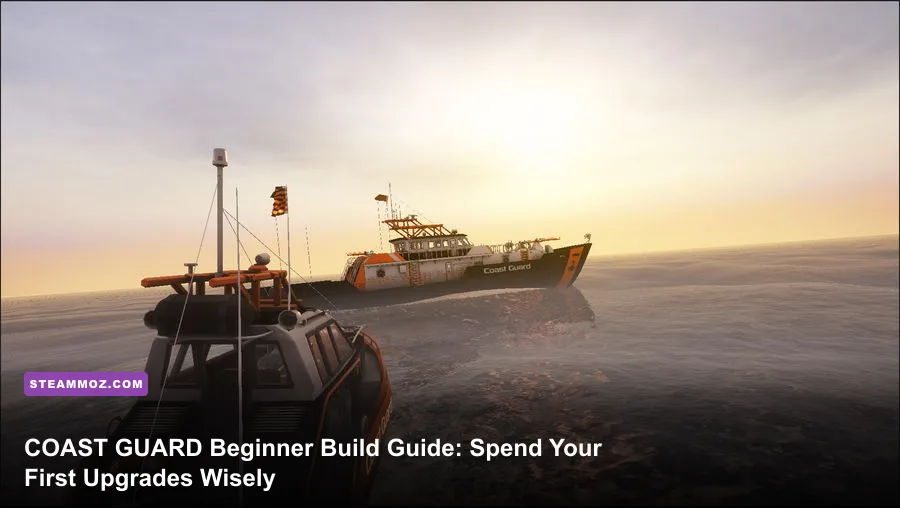
The best COAST GUARD starting build is a balanced, investigation-first setup: prioritize navigation and rescue equipment, keep enough resources for emergency operations, and delay cosmetic or niche improvements until you understand the mission loop. COAST GUARD isn’t an RPG with a skill tree, fixed character classes, or damage numbers. Your “build” is really the order in which you prepare for patrols, inspect vessels, collect evidence, and handle rescue scenarios.
That distinction matters. Players arriving from games such as Dungeon Siege or other traditional RPGs often look for a class, weapon loadout, or stat allocation that simply doesn’t exist here. Instead, COAST GUARD tests judgment. The strongest beginner setup gives you flexibility for the early missions and protects you from the two most common mistakes: rushing story choices and wasting limited preparation resources on upgrades that don’t solve an immediate problem.
The Best Starting Build for COAST GUARD
Start with a balanced patrol-and-investigation build. In practical terms, that means choosing tools and preparations that support three jobs: reaching a target safely, completing the inspection or rescue objective, and preserving enough time and equipment to deal with an unexpected complication.
There’s no conventional character screen where you put points into Strength, Dexterity, or Intelligence. COAST GUARD’s progression is mission-driven. Your effective power comes from knowing which activity a scenario is emphasizing and selecting the safest response rather than the most aggressive one.
| Priority | What to emphasize | Why beginners need it | When to invest more |
|---|---|---|---|
| Navigation and patrol readiness | Route awareness, steady movement, careful positioning | Prevents avoidable delays and poor approaches | Before longer patrol or rescue scenarios |
| Rescue preparation | Emergency equipment and patient, controlled actions | Gives you room for mistakes during time-sensitive objectives | Whenever a mission hints at survivors or danger at sea |
| Inspection and evidence | Thorough searches, documentation, and dialogue | Supports investigation objectives and better decisions | Before vessel inspections and crime-related cases |
| Story flexibility | Manual saves and conservative choices | Lets you recover from an investigation going sideways | Before major conversations or branching decisions |
| Cosmetic or specialist options | Only after the core loop feels comfortable | They rarely rescue a failed early operation | After you understand mission requirements |
The key is balance. A rescue-heavy setup can leave you underprepared for investigation work, while an inspection-focused approach encourages overthinking when a scenario needs quick action. COAST GUARD rewards a captain who can switch gears.

🎮 COAST GUARD
Looking to experience this game? Grab your digital key directly on our store for $3.59.
View on Steammoz Store →How COAST GUARD Actually Progresses
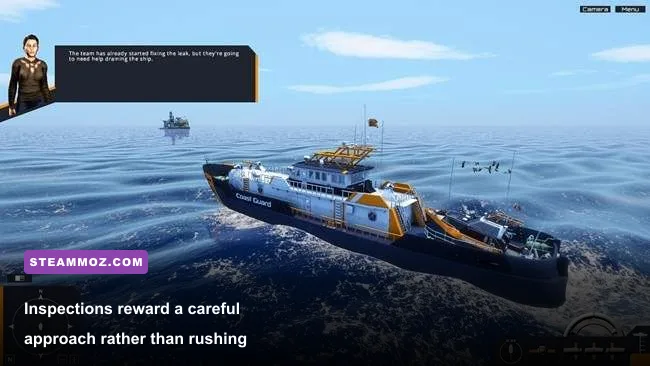
COAST GUARD is structured around patrol assignments, narrative cases, and maritime activities rather than open-ended grinding. You won’t become stronger by repeatedly farming enemies because there is no combat progression loop in the usual RPG sense. The game’s core cast and scenarios push you from one responsibility to the next, and your improvement comes from understanding the rules of each activity.
Before launching a mission, read every objective carefully. A prompt that sounds like a simple patrol may also include an inspection, a search for evidence, or a rescue condition. Those secondary requirements are where new players lose momentum. If you only focus on the obvious destination, you can arrive unprepared for the actual evaluation.
Think of each mission as having three layers:
- Travel: reach the assigned area without turning the approach into a chaotic detour.
- Procedure: complete the inspection, rescue, search, or interview with attention to the instructions.
- Judgment: choose how to interpret evidence and respond to people involved in the case.
That structure makes COAST GUARD closer to a story-driven simulation than an action game. The best “leveling” strategy is to master the procedure layer first. Once you stop losing time to navigation and confusing interaction prompts, you can concentrate on the narrative decisions.
It’s also worth setting realistic expectations about the game’s age and scope. The official COAST GUARD Steam page presents it as a maritime simulation with narrative missions, not a deep vessel-management sandbox. If you’re expecting the complexity of a full naval simulator, the relatively guided mission design may feel modest. As a beginner guide, though, that’s good news: you don’t need a spreadsheet of hidden stats to get started.
First-Mission Skill Priorities and Gear Logic
Because COAST GUARD doesn’t offer a normal skill tree, use a priority system instead. Every time the game gives you a choice about preparation, favor options that improve reliability across several mission types. A navigation aid or general-purpose rescue tool is usually more valuable early than an option that only applies to a narrow scenario.
1. Put safe navigation first
Steady movement is more useful than speed. Beginners often overcorrect while approaching a target, lose their line, and create extra work for themselves. Use broad, deliberate adjustments and begin lining up with the objective before you are directly beside it. If the game gives you a waypoint or target marker, treat it as a route guide rather than a finish line you can reach at full speed.
2. Prepare for rescue before investigation
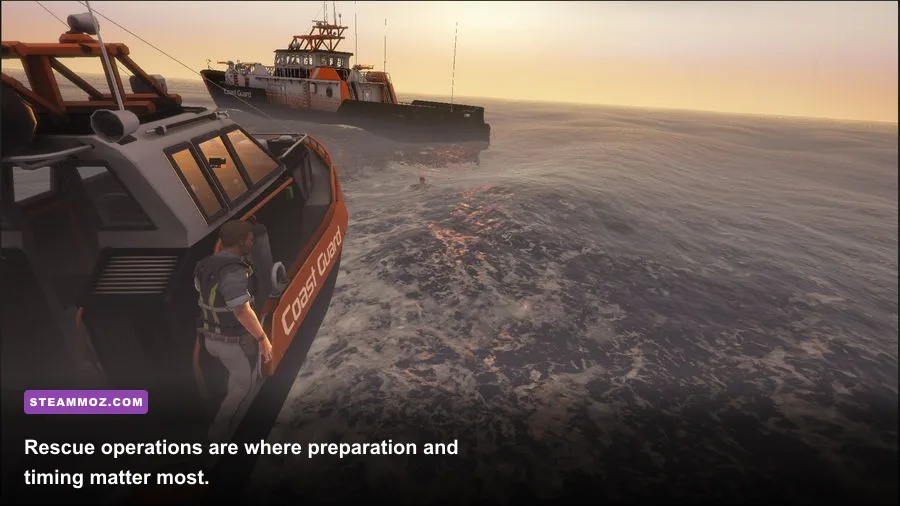
Rescue objectives usually carry more immediate risk than ordinary inspection tasks. If a mission briefing mentions people in danger, prioritize the tools and preparations that let you respond without improvising. Don’t spend your early resources on optional improvements and then discover that the scenario expects careful recovery work.
3. Treat evidence as a progression resource
During an inspection or investigation, examine the environment systematically. Check obvious interaction points, read available information, and don’t assume the first clue is the complete answer. Evidence is not just decoration; it gives context for later dialogue and helps you choose a response that fits the case.
4. Save before major decisions
COAST GUARD is built around decisions, and a choice that feels polite or efficient may not produce the result you expected. Create a manual save before a major interview, inspection conclusion, or report. This isn’t about chasing a “perfect” story on your first run. It’s about learning how the game communicates consequences.
| Early-game situation | Best beginner response | Common mistake | Reason |
|---|---|---|---|
| Routine patrol | Use a controlled route and confirm the objective | Rushing directly toward the marker | Speed creates positioning errors and missed instructions |
| Vessel inspection | Search methodically and record what you find | Leaving after the first obvious interaction | Secondary evidence can shape the case outcome |
| Rescue operation | Follow the prompt sequence and stay patient | Making frantic movements near the target | Careful positioning is safer than constant correction |
| Major dialogue choice | Save, review the case details, then answer | Picking the fastest conversational option | Context matters more than speed |
| Unclear objective | Re-read the mission text and inspect nearby points | Assuming the mission is bugged immediately | Many apparent dead ends come from skipped interactions |
A Practical Patrol Rotation for New Players
Use this rotation whenever you begin a new COAST GUARD assignment. First, read the briefing twice: once for the broad story and once for verbs such as “inspect,” “search,” “rescue,” “locate,” or “report.” Those verbs tell you what kind of preparation matters.
Second, make a mental route. You don’t need to plot every turn, but identify the starting point, the likely objective area, and the return or handoff point. A little planning keeps you from treating the ocean like a maze.
Third, approach the objective slowly. The final approach is where your camera, vessel position, and interaction prompts matter most. If you arrive at an awkward angle, reposition rather than forcing the interaction. It’s faster to take a few calm seconds than to spend the next minute correcting a bad approach.
Fourth, complete the procedural task before interpreting the story. During an inspection, gather the available information first. During a rescue, follow the immediate safety instructions first. Don’t jump ahead because you think you already know who is responsible.
Finally, pause before submitting a conclusion or selecting a major dialogue response. COAST GUARD’s drama works best when you treat these moments as case decisions, not multiple-choice trivia. Review what you actually found, separate evidence from assumptions, and choose the response that matches the facts.
This rotation is similar to the discipline that makes stealth games work. Our Desperados III coverage makes the same broader point: success usually comes from preparation and observation rather than frantic reactions. COAST GUARD simply swaps gunfire for maritime procedure.
Investigation Choices, Evidence, and Dialogue
The investigation side is where your starting build has the biggest effect. A patient player effectively creates more options because they collect more context before making a decision. A rushed player narrows the case prematurely and may interpret a suspicious detail as proof.
Use a simple evidence rule: observe, verify, then accuse. Observe the object, person, or situation the mission points toward. Verify by checking whether nearby interactions add supporting detail. Only then decide how forcefully to respond in dialogue or reporting.
Be especially careful with emotionally loaded conversations. Characters may be evasive, frightened, or hostile, but their attitude isn’t automatically proof of guilt. Choose questions that clarify the timeline and facts. If the game gives you a chance to request information rather than make a judgment, take it.
There’s also value in accepting an imperfect result. COAST GUARD’s narrative isn’t designed like a loot game where every mission must produce maximum rewards. A flawed decision can still move the story forward and teach you what the game considers relevant. Reloading is useful for learning, but don’t let the search for the “correct” branch erase the tension from the first playthrough.
For players who enjoy narrative games with consequences, compare this approach with the branching choices in Disciples: Liberation. COAST GUARD is less about character builds and more about professional judgment, but both games reward reading the situation before committing.
Performance Settings for a Smoother First Playthrough
COAST GUARD is an older PC release, so most modern systems can run it comfortably, but a stable frame rate still helps during vessel movement and first-person interactions. The goal isn’t to max every slider blindly. Prioritize a consistent presentation and clear visibility around the ship and investigation areas.
| Setting | Recommended starting value | Likely performance impact | Visual trade-off |
|---|---|---|---|
| Resolution | Native monitor resolution | High if reduced or increased | Native resolution keeps text and interfaces sharp |
| Texture quality | High, then lower if VRAM is limited | Moderate | Lower values make surfaces look softer |
| Shadows | Medium | Moderate to high | Medium preserves depth without a large cost |
| Anti-aliasing | Medium or the first stable option | Moderate | Lower settings produce more jagged edges |
| Ambient occlusion | Low or medium | Moderate | Lower values reduce contact shading around objects |
| Reflections and water effects | Medium | Moderate to high near open water | Lower settings make the sea less detailed |
| Motion blur | Off for clearer movement | Small performance benefit | Cleaner camera movement during patrols |
If performance dips, reduce shadows and water or reflection effects before dropping resolution. Those settings are more likely to cause frame-time spikes during maritime scenes. Keep textures higher if your graphics memory allows it, because texture reduction tends to make the whole game look worse without fixing every stutter.
Also check the game’s display mode, cap the frame rate if your system produces uneven frame pacing, and close overlays that interfere with older PC titles. The official publisher information for COAST GUARD is a better reference for the original release details than random compatibility claims, while Reality Twist’s official site provides developer context.
Beginner Mistakes That Ruin Good Runs
Several habits make the opening hours harder than they need to be.
- Rushing every objective: COAST GUARD rarely rewards panic. Read the prompt and use the time to set up a clean approach.
- Assuming every suspicious detail proves wrongdoing: Investigations need context. Record the clue, then look for confirmation.
- Ignoring secondary instructions: A mission’s main destination may not be its only requirement.
- Spending resources on narrow options too early: General-purpose preparation gives you more room for mistakes.
- Skipping saves before decisions: Branching story moments are exactly when a backup matters.
- Blaming the controls before checking positioning: Many failed interactions are caused by approaching from the wrong angle.
If you’ve played games with punishing early progression, you’ll recognize the value of a conservative opening. Our Dins Curse beginner tips use a similar principle: protect the fundamentals first, then experiment once the immediate threats are under control.
When to Change Your Starting Build
Change your approach when the mission type changes, not because a single interaction went badly. If you’re moving into a case centered on inspections, put more attention on evidence collection and dialogue. If the briefing clearly signals a rescue, prepare for the practical operation first. A flexible loadout is better than trying to force one universal answer across every chapter.
You should also revise your routine if you’re consistently losing time in the same place. Repeated navigation trouble means you need a calmer route. Repeated investigation mistakes mean you’re making conclusions before checking all available information. Repeated rescue failures mean you’re rushing the interaction sequence or approaching the target poorly.
The best long-term COAST GUARD build is therefore a habit: read the briefing, prepare for the most dangerous requirement, gather evidence, and save before committing to a major decision. There are no flashy skill trees to hide behind, and that’s the point. Your judgment is the progression system.
Follow that plan and the early game becomes far less mysterious. You’ll spend less time fighting the interface, more time understanding each case, and arrive at the later missions with the one upgrade that matters most: confidence in your own decisions.