
The best CITYCONOMY: Service for your City starting build is a garbage-first route built around short residential jobs, careful driving, and early reinvestment into road-cleaning or landscaping equipment. The game doesn't have a traditional RPG skill tree, weapon loadout, or character-stat screen, so “build” here means your service order, vehicle priorities, and daily route. Start with waste collection, learn the map, avoid unpaid mileage, then add street sweeping or gardening once your first truck consistently covers operating costs.
What the Best Beginner Build Actually Looks Like
CITYCONOMY is a service-vehicle simulator rather than a conventional city builder. You take contracts, drive to work areas, perform the job with the correct vehicle, and return to the wider city economy. That distinction matters. New players often grab the most interesting-looking task immediately, only to discover that a long drive, awkward reversing, or equipment setup has eaten the profit before the job is complete.
Your opening plan should therefore be deliberately boring. Choose jobs that are close together, use one vehicle type for several consecutive contracts, and postpone expensive detours. Garbage collection is the strongest starting lane because it teaches the game's most important habits at low risk: positioning the vehicle, recognizing service points, managing the work area, and finishing a route without turning every contract into a sightseeing trip.
| Build Stage | Primary Service | Vehicle Focus | Why It Works |
|---|---|---|---|
| Opening | Garbage collection | Garbage truck | Reliable practice with compact routes and repeatable work |
| First expansion | Street cleaning | Street sweeper | Uses the same map knowledge while broadening contract options |
| Second expansion | Gardening and mowing | Lawn mower or landscaping vehicle | Good for nearby outdoor jobs and route variety |
| Established setup | Sewer maintenance | Sewer service equipment | Longer, more technical work with better upside after preparation |
Keep your first build narrow. Buying or selecting every service type at once feels flexible, but it creates the opposite result: more travel, more controls to remember, and less money available for the vehicle or equipment that actually earns your next payout. The official CITYCONOMY Steam page highlights the game's broad range of urban services, but beginners should treat that variety as a progression path rather than an opening checklist.

🎮 Bleed
Looking to experience this game? Grab your digital key directly on our store for $4.99.
View on Steammoz Store →Your First Ten Jobs: A Route That Builds Momentum
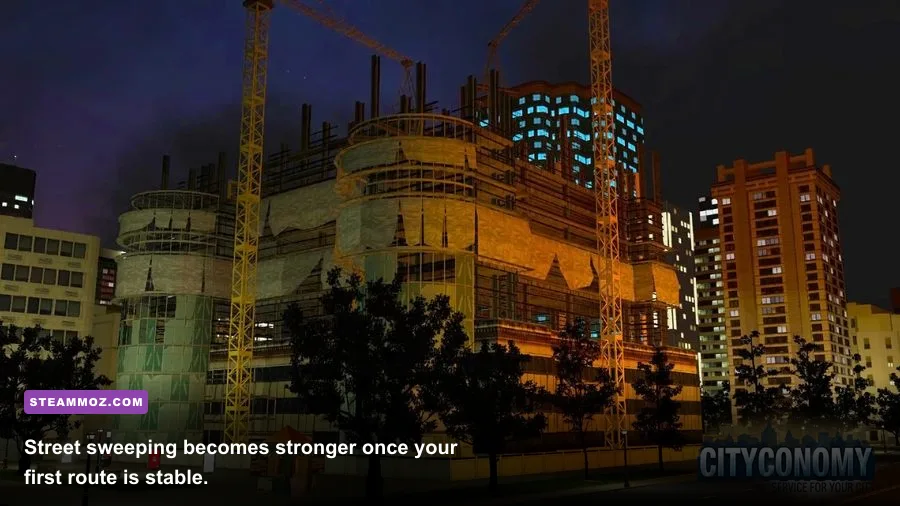
Before accepting anything, open the job list and compare three things: service type, distance, and the number of separate work locations. The highest displayed reward isn't automatically the best contract. A nearby garbage job with one compact collection area can beat a larger assignment on the far side of the map, especially when you're still learning vehicle handling.
Jobs one through three
Take the closest garbage collection work available. Drive there without rushing, park so the working side of the truck has room, and complete the entire interaction before moving. CITYCONOMY's vehicles are wide and the urban streets are full of corners, parked cars, curbs, and narrow access points. A clean approach saves more time than aggressive driving ever will.
After the first job, don't immediately jump to a distant contract. Look for another garbage assignment in the same district. Think in loops: accept a nearby task, complete it, scan for a second nearby task, then return when the route is finished. This reduces deadhead travel—the unproductive driving between contracts—and gives you a practical mental map of residential streets.
Jobs four through six
At this point, test a slightly longer garbage route or a nearby street-cleaning contract if the required vehicle is available. Street sweeping introduces a different working rhythm, but the strategic lesson is identical: the service area matters more than the reward number. Keep your vehicle aligned with the road, avoid clipping obstacles, and don't abandon a nearly completed route for a contract on the other side of town.
Jobs seven through ten
Now you can add one landscaping or mowing job if it sits close to your existing route. Gardening is a useful secondary service because it makes you read the environment differently: parks, verges, and open spaces aren't just scenery; they can be work locations. Still, don't let one attractive outdoor contract drag you into a long cross-city drive. Finish your compact garbage and road-service circuit first.
| Priority | Contract Choice | Accept When | Reject When |
|---|---|---|---|
| S-Tier | Nearby garbage collection | It shares a district with another available job | The access route is congested or awkward |
| A-Tier | Nearby street cleaning | You already understand the roads and vehicle positioning | It requires a long empty drive |
| B-Tier | Gardening or mowing | The work area is close and easy to approach | It pulls you away from a profitable loop |
| C-Tier | Sewer maintenance | You have spare funds and know the destination | You are still learning controls and map landmarks |
For more route-planning discipline, Steamoz's convoy-saving tips apply surprisingly well here: protect your time, understand the cost of movement, and don't confuse a bigger objective with a better objective.
Vehicle Priorities and the Upgrade Trap
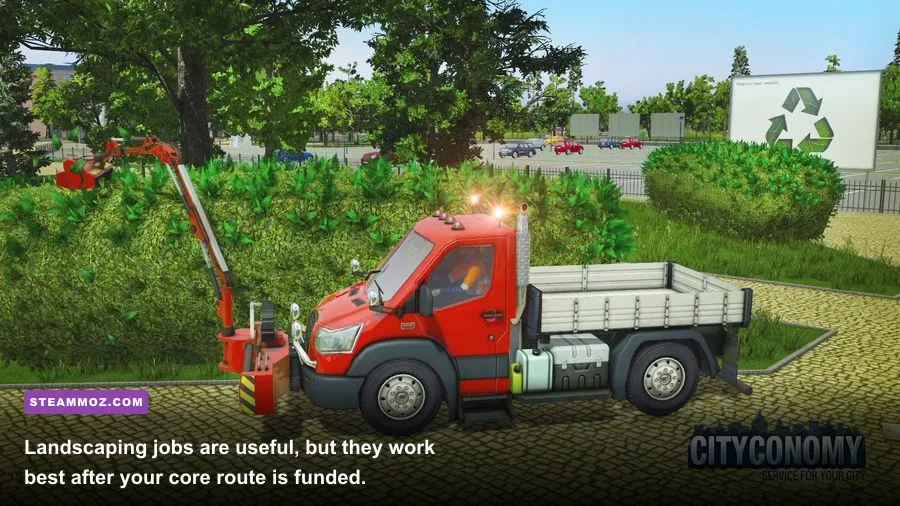
Your first spending decision should improve the service you already understand, not unlock a glamorous task you haven't practiced. In CITYCONOMY, the vehicle is effectively your class. A garbage truck asks you to master collection points and urban positioning; a street sweeper rewards steady road alignment; a lawn mower or landscaping vehicle changes the scale and shape of the work area; sewer equipment usually demands more confidence with destinations and setup.
Don't burn early income on cosmetic choices or unnecessary variety. Your target is a stable service loop: one vehicle, one district, and enough completed work to make the next expansion feel comfortable rather than desperate. If the game presents a purchase or service-selection screen, compare the new vehicle's earning opportunity with the time it will spend traveling empty.
| Investment | Early Value | Risk | Recommendation |
|---|---|---|---|
| Garbage-service access | High | Low | Make it the foundation of the opening build |
| Street sweeper access | High | Medium | Add after you know the main road network |
| Landscaping equipment | Medium | Medium | Use for nearby jobs, not forced cross-city routes |
| Sewer-service equipment | Medium to high | High | Delay until your route planning is consistent |
| Extra service variety | Low early | High | Buy only when your current loop is comfortably profitable |
The common upgrade trap is spending because a new vehicle is available, then discovering that its jobs are too far away or too fiddly to complete efficiently. Treat each purchase as a time-management decision. A vehicle that earns a large reward once in a while may be weaker than a modest service you can complete repeatedly with almost no wasted travel.
Also keep your graphics settings practical while learning. Driving sims punish stutter because a frame hitch can turn a careful corner into a collision. Steamoz's low-FPS settings guide and Architect Life performance fixes cover the same basic principle: prioritize stable frame delivery over expensive visual effects.
Driving, Parking, and Service-Site Technique
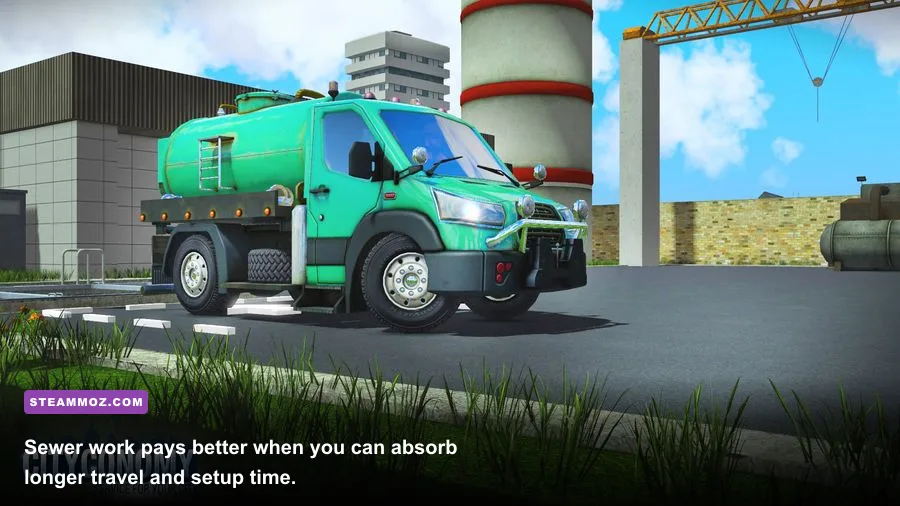
The fastest CITYCONOMY players aren't necessarily the ones who drive fastest. They're the ones who arrive facing the correct direction. Before entering a narrow lane or work area, slow down and decide how you'll leave. Reversing a large service vehicle through a tight street is slow, awkward, and often more damaging to your route than taking a wider approach.
Use landmarks, not vague map memory
Memorize distinctive intersections, bridges, industrial buildings, and park entrances. The city can feel repetitive when every street is lined with similar buildings, so landmarks prevent the classic beginner mistake of accepting a job that looks close on the map but sits behind an inconvenient access route.
Park for the entire interaction
At a collection or maintenance site, leave yourself room for the vehicle's working animation and any movement the job requires. Don't wedge the truck against a curb simply because the marker is nearby. If the first attempt fails, reposition calmly instead of spinning the vehicle in place. The small pause costs less than a damaged route and a long recovery drive.
Separate mistakes from bad contracts
If a job feels slow, identify why. Was the destination far away? Did you lose time searching for the entrance? Did the vehicle need repeated repositioning? Was the work itself complicated? This matters because each answer suggests a different fix. Better mapping solves travel, slower approach solves positioning, and service practice solves the work interaction. Simply choosing higher-paying jobs won't fix any of those problems.
Take screenshots or write down useful landmarks if you need to. CITYCONOMY is at its best when you gradually build a mental city map rather than treating every contract as a disconnected icon. The approach also translates well to other vehicle-focused games; Steamoz's Cossacks 3 system guide is a reminder that technical stability matters just as much as strategy when a game relies on busy scenes and long sessions.
When to Expand Beyond Garbage Collection
Expand when your current route feels repeatable, not merely when you can technically afford the next service. A good test is whether you can complete several nearby garbage jobs without getting lost, scraping every corner, or spending most of the contract driving empty. If the answer is no, another vehicle won't solve the underlying problem.
Street cleaning is the natural first expansion because it keeps you in the urban road network. You already know the important turns, loading areas, and troublesome intersections, so the learning curve is manageable. Landscaping comes next if you enjoy slower, more precise work around parks and roadside spaces. Sewer maintenance should be treated as a later specialization: it can be rewarding, but longer routes and more involved work punish poor preparation.
| Expansion | Readiness Check | Route Rule | Main Failure Point |
|---|---|---|---|
| Street cleaning | You can navigate the main districts confidently | Chain road jobs in the same area | Wasting time on empty roads |
| Landscaping | You can approach work sites without repeated repositioning | Pair parks and verges with nearby contracts | Underestimating setup time |
| Sewer maintenance | You have spare funds and know destination landmarks | Plan the full trip before accepting | Long travel and unfamiliar access points |
| Multiple services | Your first route is consistently profitable | Keep each vehicle assigned to a clear job type | Splitting money too thinly |
The developer's official Nano Games site is worth checking for game information, while the CITYCONOMY Steam Community hub can help with version-specific quirks and player-discovered route advice. Because this is an older PC simulation, control behavior and performance can vary between systems, so don't assume a guide written for a different build matches your setup perfectly.
The final version of this beginner build is simple: garbage collection as your income engine, street cleaning as your first specialist expansion, landscaping as a flexible side lane, and sewer work only after your route discipline is solid. Keep contracts close, drive for accuracy rather than speed, and spend on earning capacity instead of collecting every service option. CITYCONOMY rewards that restraint. Once the city starts feeling familiar, the same modest opening setup becomes a dependable network of routes—and that's when the bigger jobs finally become worth chasing.