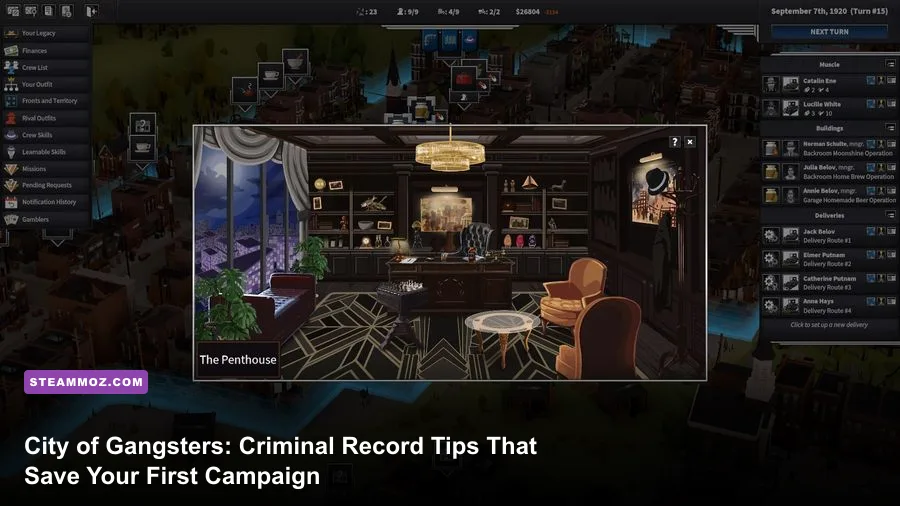
The fastest way to survive your first City of Gangsters: Criminal Record campaign is to treat every turn as a logistics decision, not a shopping spree. Stabilize one production chain, keep cash and supplies moving, use favors before money when possible, and delay risky criminal operations until your crew and escape routes are ready. These 10 tips will help you turn a fragile bootlegging outfit into a dependable neighborhood machine.
City of Gangsters on Steam is a deliberately demanding management game. The Criminal Record content makes that pressure more interesting because illicit work can accelerate your rise while exposing weak planning. If you enjoy supply-chain puzzles, the same mindset behind our fast leveling and gold farming advice applies here: efficiency beats flashy expansion.
1. Read the neighborhood before choosing a headquarters

Your opening location determines how many turns you spend walking, hauling, recruiting, and making deliveries. Before placing or upgrading anything, inspect nearby customers, suppliers, empty lots, and existing buildings. A headquarters beside several customers may look attractive, but a location with no dependable raw materials can leave your production line idle.
Look for a compact triangle: one source of inputs, one production site, and several buyers within a short route. In the early game, distance is more expensive than rent because every trip consumes a character’s available actions. A slightly less glamorous neighborhood with clustered targets is usually stronger than a central district where every delivery crosses half the map.
Also check which businesses already occupy the area. Existing establishments can be targets, competitors, suppliers, or future opportunities depending on your contacts and mission progress. Don’t expand simply because an empty building is available. Your first objective is a reliable loop that produces and sells every month.

🎮 City of Gangsters: Criminal Record
Looking to experience this game? Grab your digital key directly on our store for $2.99.
View on Steammoz Store →2. Build one complete supply chain before diversifying
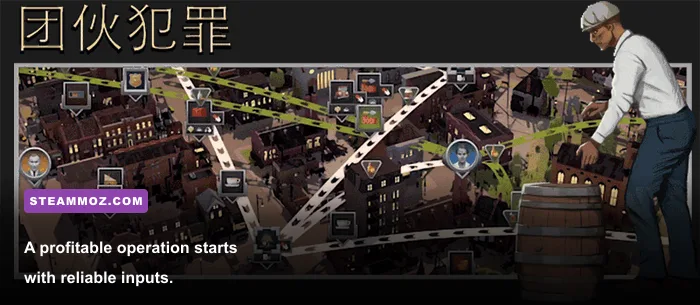
The classic beginner mistake is opening several production buildings before securing their inputs. City of Gangsters rewards finished goods, not impressive-looking infrastructure. If a distillery needs a regular supply of corn, sugar, yeast, or another input, that material must be available at the right place and time. A dormant building is not an investment; it’s money locked into a problem.
Start with one product line you can feed consistently. Moonshine is a sensible early focus because it teaches the core rhythm: acquire inputs, process them, move the finished product, and sell it to a customer with enough demand. Once that chain is stable, add storage or a second outlet before adding a completely different product.
| Expansion Choice | What It Improves | Early-Campaign Verdict |
|---|---|---|
| Extra customer outlet | Sales capacity and cash flow | Strong after your first product sells out |
| Storage or warehouse capacity | Buffer against supply delays | Often better than rushing a second product |
| Second production line | More product variety | Wait until inputs and labor are dependable |
| Large territory expansion | More contacts and opportunities | Risky before your core route is profitable |
Keep a small reserve of cash after every purchase. A profitable month can still become a disaster if an unexpected mission, bribe, purchase opportunity, or supply shortage arrives and you have no flexibility.
3. Track action economy like a turn-based combat game
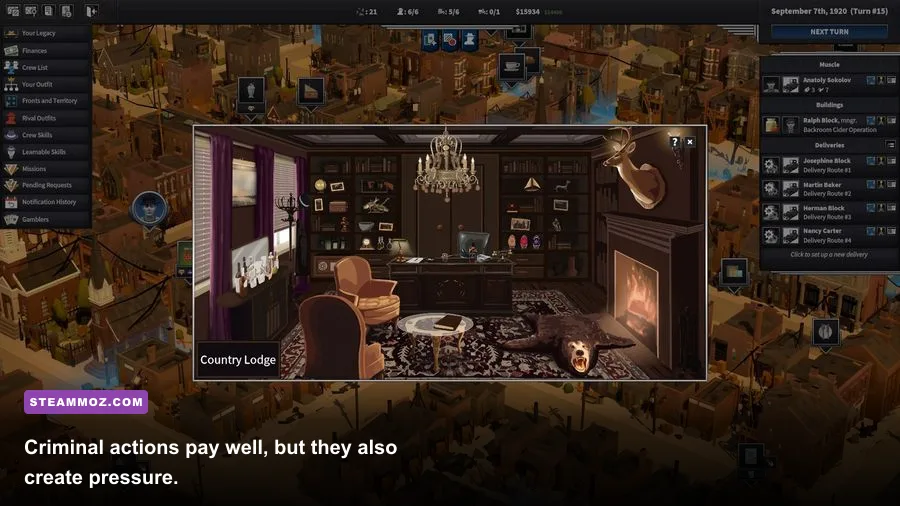
Every character action has an opportunity cost. Moving, trading, collecting, recruiting, making deliveries, and performing criminal work all compete for the same limited schedule. That’s why a short route with fewer interruptions can outperform a bigger operation with higher theoretical revenue.
Group tasks by location. If a crew member is already near a supplier, have them collect the input and complete another nearby interaction before returning home. Avoid sending your best operator across town for a single delivery when another character can handle it locally. You’re not merely saving travel time; you’re increasing the number of productive actions completed during each monthly turn.
A useful rule is to plan one turn ahead. Before ending the month, ask three questions: where will each character begin next turn, what inventory will be waiting there, and which contact interaction unlocks the next useful action? This habit prevents the classic dead turn where your crew spends the entire month repositioning.
For a related lesson in efficient progression, see our route-planning guide for Dungeons 2. The games are different, but the principle is identical: movement that doesn’t create value is a hidden tax.
4. Spend favors before spending scarce cash
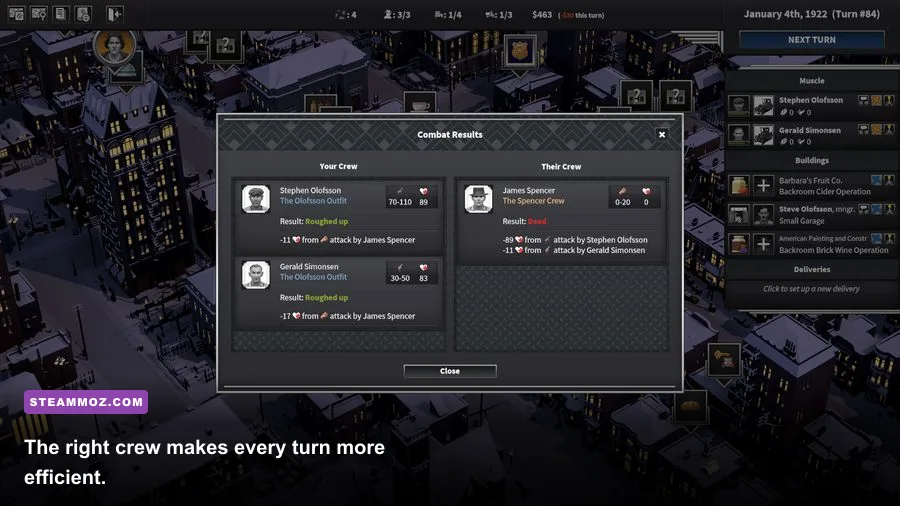
Money is visible, so new players naturally hoard it. Favors are easier to overlook, but they can be the better currency for unlocking contacts, securing assistance, and smoothing early negotiations. Use favors when they accelerate a key bottleneck, especially if the alternative is buying an expensive building or delaying production.
Don’t burn every favor on a minor discount. Prioritize contacts who expand your network, provide dependable inputs, unlock new customers, or reduce the risk attached to Criminal Record activities. A contact that opens a complete chain is worth far more than one that merely saves a small amount on a single transaction.
Recruitment also deserves scrutiny. A character with strong social or operational utility may be more valuable than a stronger-looking specialist who cannot reach your routes efficiently. Keep your crew compact at the start. Extra mouths to feed and extra wages can erase the profit from a production line that hasn’t reached full capacity.
5. Treat Criminal Record activities as controlled risks
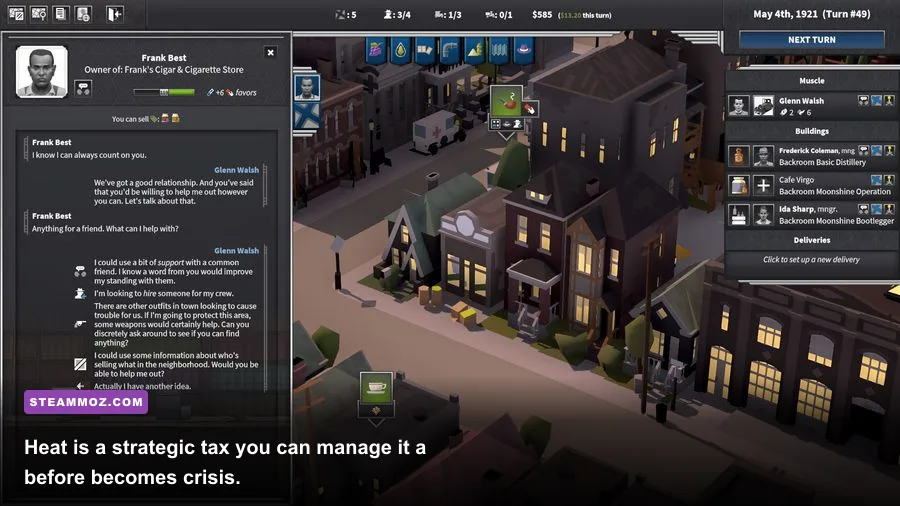
Criminal Record operations are not free money. They’re high-value opportunities that trade immediate rewards for exposure, resource commitments, and possible disruption to your normal business. The safest time to attempt one is when your legal-looking cash flow can survive a bad result and your crew has enough mobility to react.
Before committing, inspect the operation’s requirements and likely follow-up costs. If it consumes a valuable character for several actions, calculate what that character would have earned through deliveries or recruitment. A criminal activity that pays quickly but leaves your production line idle may be less profitable than it appears.
Keep risky work away from the center of your core route when possible. Your main business should continue operating even if a criminal objective creates pressure nearby. Never let one operation consume all of your transport capacity, cash, and available crew at once.
| Situation | Recommended Move | Reason |
|---|---|---|
| Cash flow is unstable | Delay the operation | A failed turn can stop your entire business |
| Core product has surplus stock | Consider the operation | Your crew can take a temporary detour |
| Police or neighborhood pressure is rising | Stabilize first | Adding exposure compounds existing problems |
| Several crew members are available | Assign a specialist while others deliver | Keeps ordinary revenue moving |
6. Protect your main route from pressure and disruption
Heat and enforcement pressure are easiest to handle before they become urgent. The exact warning indicators and consequences can vary by situation, but the strategic answer is consistent: don’t concentrate every important building, character, and inventory stack in one vulnerable pocket.
Maintain alternate delivery paths and avoid keeping your entire reserve at a single location. If an operation interrupts one site, a second outlet or nearby storage point can keep the business alive. This is also why expansion should be gradual. A wide empire with no redundancy is weaker than a compact network that can absorb one bad month.
When pressure rises, stop adding risk. Use the next few turns to sell existing stock, complete low-exposure tasks, and rebuild cash. Trying to solve a heat problem by taking an even bigger criminal job is how campaigns spiral.
7. Upgrade for bottlenecks, not prestige
Upgrades feel rewarding, but the best purchase is the one that removes the current constraint. If production is waiting on inputs, improve sourcing or storage. If finished goods are piling up, add sales capacity or delivery support. If your crew is constantly traveling, recruit or reorganize before buying another building.
Write down the limiting step at the end of each turn. Is it supply, processing, transport, customers, labor, or cash? Solve that one step first. This simple diagnostic prevents the expensive mistake of upgrading production when the real problem is that you can’t sell what you already make.
For hardware-conscious players, our PC performance guide shows the same useful habit: identify the actual bottleneck instead of upgrading blindly. Apply that thinking to every business decision here.
8. Use missions to unlock momentum, not just rewards
Missions often provide more than a one-time payment. They can introduce contacts, reveal new opportunities, open production options, or push your organization into a better position. Read the requirements before accepting them, especially if completing one will pull a key worker away from your only profitable route.
Prioritize missions that improve your network or solve a current shortage. A reward that expands access to customers can create recurring income, while a cash payout may disappear after one purchase. Keep an eye on deadlines and avoid stacking several objectives that all require the same character.
9. Keep inventory moving and cash liquid
Stockpiling feels safe, but idle inventory is dead capital. Keep enough material to survive a delayed supply run, then move the rest toward customers. A full warehouse doesn’t help if wages, purchases, and mission costs are paid in cash.
At the same time, don’t sell your entire reserve just because a buyer is available. Maintain a buffer for the next production cycle and an emergency expense. A practical early target is to finish each month with enough cash for at least one meaningful purchase plus your normal operating costs.
10. Save before major decisions and learn from failed turns
City of Gangsters is built around consequences, so saving before a major expansion, Criminal Record activity, or risky negotiation is sensible while you’re learning. More importantly, use the result to identify the failed assumption. Did you underestimate travel? Did you lack an input? Did the operation consume a key worker? Reloading without understanding the mistake only postpones the same lesson.
For your first campaign, judge success by stability rather than speed. A compact headquarters, one complete product chain, two dependable customers, a small reserve, and a crew that can cover deliveries will carry you much farther than an impressive map covered with half-finished projects.
You can compare the game’s management tension with our Dungeon Siege retrospective, but City of Gangsters demands a different kind of patience. There’s no single overpowered build to carry you. Your advantage comes from planning routes, protecting cash flow, and choosing exactly when to take a dangerous opportunity.
For official details, check the official Steam listing, the SomaSim game page, and the Kasedo Games website. Start small, keep your routes tight, and make every criminal move serve the business underneath it.