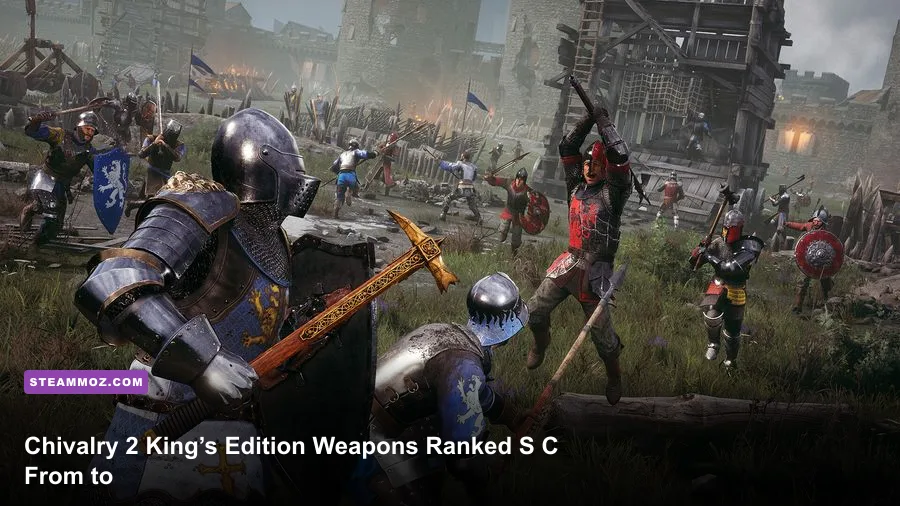
Short answer: Chivalry 2’s King’s Edition does not add a secret overpowered weapon or a separate damage tier. Its equipment is cosmetic, so the best practical loadouts still come from the standard arsenal. For most players, the Messer, Dane Axe, Polehammer, Greatsword, and Longsword deserve S-Tier status, while the War Club, Glaive, Spear, and Crossbow become excellent in the right hands. The real King’s Edition advantage is fashion: you get premium medieval armor and weapon appearances without changing the combat math.
That distinction matters because Chivalry 2’s store pages and edition names can make the bonus content sound more substantial than it is. The official Steam listing presents the King’s Edition as bonus customization content, not a pay-to-win expansion. You are buying a different look for your warrior, while weapon performance remains tied to the class loadout, attack type, hit zone, stamina management, and matchmaking situation.
What the King’s Edition Actually Adds
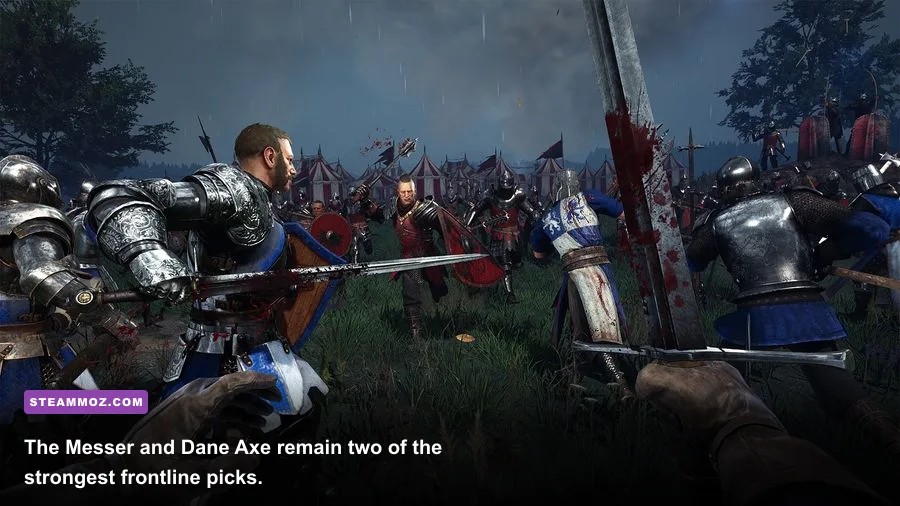
The King’s Edition is best understood as a cosmetic upgrade rather than a weapon pack. It does not unlock a new class, raise a weapon’s damage, improve swing speed, expand stamina, or give you a special combat ability. That means a player wearing King’s Edition armor has exactly the same competitive ceiling as someone using the standard visual sets.
The most important buying and ranking advice is simple: don’t select a weapon because its King’s Edition skin looks heavier, sharper, or more expensive. Chivalry 2’s visuals are deliberately theatrical. A broad axe can share the same underlying behavior as a less intimidating-looking version, and armor decoration won’t protect you from a counterattack.
| King’s Edition Element | Gameplay Effect | Ranking Relevance | Best Use |
|---|---|---|---|
| Armor appearances | No damage or defense bonus | Cosmetic only | Faction identity and roleplay |
| Weapon appearances | No change to reach, speed, or damage | Cosmetic only | Personal style and readability |
| Standard class weapons | Full combat performance | Determines the tier | Build selection and matchup control |
| Class abilities | Unchanged by the edition | Important for team value | Objective pressure and survivability |
For the broader context of how Steam editions can package cosmetic bonuses, compare this with our Crossing Souls weapon rankings. Chivalry 2 is a particularly clear case: the edition affects presentation, while the actual tier list is built around the live combat roster.

🎮 iO
Looking to experience this game? Grab your digital key directly on our store for $4.99.
View on Steammoz Store →Chivalry 2 Weapon Tier List
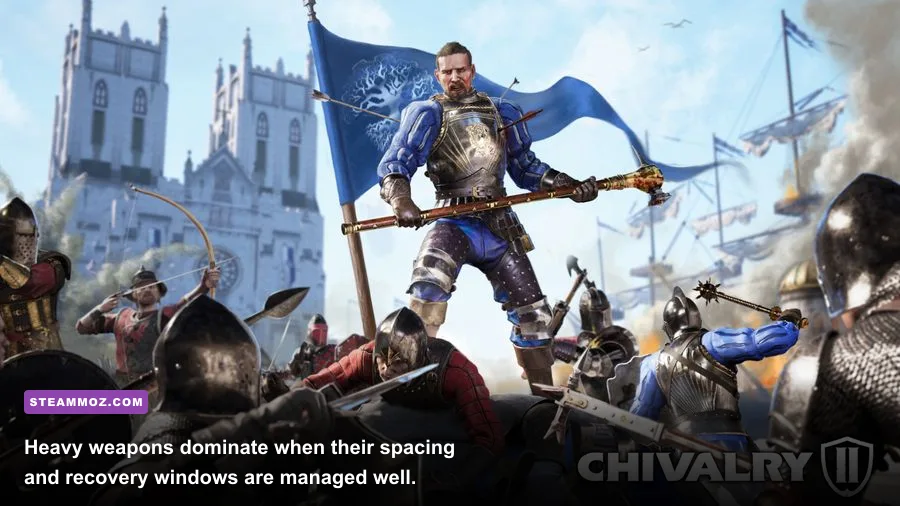
This ranking assumes a player understands the basics of feinting, dragging, ripostes, counters, active parries, and dodges. It also assumes a 64-player objective match rather than a controlled duel. A weapon’s value changes dramatically between a narrow arena, an open objective lane, and a chaotic melee where enemies attack from three directions.
| Tier | Weapons | Why They Rank Here | Best Situation |
|---|---|---|---|
| S-Tier | Messer, Dane Axe, Polehammer, Greatsword, Longsword | Excellent reach or burst, reliable recovery, strong heavy attacks | Frontline pushes, duels, mixed team fights |
| A-Tier | Battle Axe, Executioner’s Axe, Heavy Mace, War Club, Falchion, Morning Star | High damage and clear specialties, but more matchup-dependent | Objective brawls and committed engagements |
| B-Tier | Halberd, Glaive, Spear, Mace, Sword, Crossbow | Powerful range or utility with meaningful limitations | Spacing, support, and disciplined positioning |
| C-Tier | Dagger, Hatchet, Shortsword, Throwing Knives | Fast and dangerous, but unforgiving when fights become crowded | Ambushes, cleanup kills, and specialist play |
S-Tier weapons
Messer: The Messer is the safest recommendation for a player who wants one weapon that performs almost everywhere. Its slashing profile threatens multiple opponents, its reach gives you room to work, and its heavy attacks punish enemies who panic-block. The weapon’s real strength is not a single giant number; it is the combination of damage, arc, and forgiving spacing. Use horizontal swings when two opponents are stacked, then switch to overheads or stabs when a defender starts reading your pattern.
Dane Axe: The Dane Axe is one of the best burst tools in the game, particularly in the hands of a Raider who understands when to throw it and when to keep it. Its heavy overheads can make a careless opponent disappear, and carrying two Dane Axes gives the class a nasty ranged threat. The drawback is commitment. Miss a heavy swing or throw both axes without a plan and your fallback weapon may leave you fighting uphill.
Polehammer: The Polehammer excels against armored targets and players who rely too heavily on block. Its blunt damage profile makes it a superb Knight and Vanguard answer, while the long handle lets you punish enemies before their shorter weapon reaches you. Don’t mash horizontal attacks in a crowd. The Polehammer becomes much scarier when you mix overheads, stabs, and deliberate drags that force opponents to guess the impact point.
Greatsword: The Greatsword is a spacing weapon with huge team-fight value. Its long reach lets you hit the edge of a scrum without standing directly inside it, and its overhead and slash attacks create constant pressure. It is less forgiving after a whiff than the Messer, so footwork matters. Backpedal during an enemy’s approach, then commit only when you have a clear angle.
Longsword: The Longsword is arguably the cleanest dueling choice. It rewards counters, accurate stabs, and players who can recognize an opponent’s attack pattern. It doesn’t erase groups as easily as the Messer, but its speed and versatility make it dependable in one-on-one fights. If you are learning fundamentals, the Longsword teaches better habits than a pure damage crutch.
A-Tier weapons
The Battle Axe delivers brutal overhead damage and remains excellent in close objectives, but its shorter reach makes poor spacing immediately visible. The Executioner’s Axe is terrifying in crowded fights because its wide slashes can catch several bodies, though its slower commitment makes it vulnerable to counters and flanks.
The Heavy Mace is a Knight specialist’s dream against armor-heavy opponents. It hits hard and feels excellent when you are fighting around a doorway, but its attack rhythm is easier to read than the Longsword’s. The War Club has a similarly oppressive blunt identity, with long-reaching swings that can bully players who refuse to disengage. Its unusual timing is an advantage until experienced opponents learn your cadence.
The Falchion and Morning Star round out A-Tier because they offer strong all-purpose pressure without demanding the same strict spacing as polearms. Neither completely dominates every matchup, but both are reliable picks for players who like aggressive Footman or Knight engagements.
B-Tier and C-Tier weapons
B-Tier does not mean weak. The Halberd and Glaive are superb when you maintain range, but both feel awkward when an enemy gets inside your preferred distance. The Spear is excellent in disciplined formations and frustrating when surrounded. Its stabs can control a lane, yet a lone Spear user has fewer comfortable answers when several enemies collapse together.
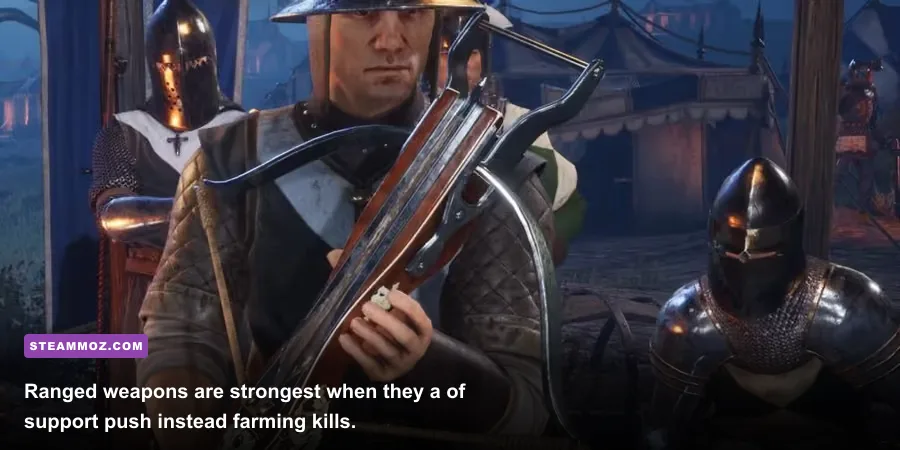
The Crossbow sits in B-Tier because it can swing a fight without needing melee superiority. Its reload window is the tax. Fire from cover, reload behind teammates, and rotate instead of standing in the same sightline. A Crossbowman who chases kills in the open is easy prey; one who deletes an enemy Knight before an objective push is priceless.
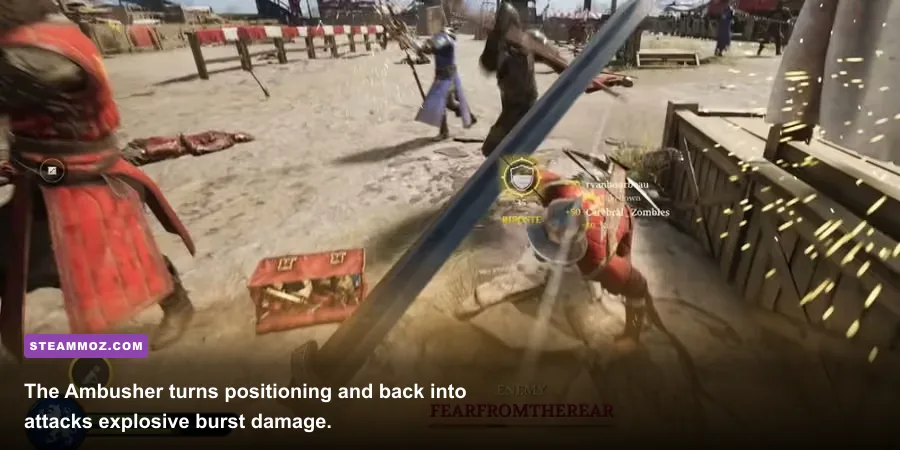
Dagger, Hatchet, Shortsword, and Throwing Knives are C-Tier for general use, not because they lack kill potential. They are fast, excellent for ambushes, and dangerous in the hands of an Ambusher. They simply demand better positioning than the S-Tier weapons. If you are forced into a frontal clash against a Greatsword or Messer, speed alone won’t save you.
Best Class Loadouts for King’s Edition Players
Since the edition doesn’t alter stats, choose the class that supports your preferred engagement distance. The Vanguard gives you the biggest offensive ceiling and access to aggressive weapons such as the Dane Axe and Greatsword. The Knight is more forgiving in a brawl, especially with the Polehammer, Heavy Mace, or Longsword. The Footman thrives when healing allies and controlling lanes, while the Archer should treat ranged damage as team support rather than a private minigame.
| Class | Recommended Weapon | Core Skill | Combat Plan |
|---|---|---|---|
| Vanguard Raider | Dane Axe | War Horn | Build takedowns, pressure objectives, keep one axe available |
| Vanguard Devastator | Greatsword | Oil Pot | Control space, punish clustered enemies, avoid blind swings |
| Knight Guardian | Polehammer | Banner | Anchor a push, block lanes, place support behind cover |
| Knight Officer | Longsword | Trumpet | Duel near allies, generate takedowns, heal during momentum windows |
| Footman Engineer | Mace | Bandage Kit | Build barricades, protect objectives, fight around structures |
| Archer Crossbowman | Crossbow | Banner | Target enemy heavies, reload safely, relocate after firing |
The strongest ability pairings are about tempo. A Vanguard’s War Horn is most valuable after a successful takedown streak, not at the beginning of a fight. A Knight’s Trumpet can turn a winning push into a sustained advance, while a Banner should sit close enough to heal the frontline but not so far forward that the first enemy wave destroys it.
How to Win Fights With the Top Weapons
Chivalry 2 is not a simple left-click damage contest. The first layer is initiative: make the opponent react. The second is defense: counter the incoming direction rather than holding block forever. The third is stamina. A player who burns stamina on repeated blocks eventually loses access to the defense that kept them alive.
Messer and Greatsword rotation
Start with a slash only when you have enough space to complete it. If the enemy counters early, feint the next slash into a stab or overhead. Drag the weapon slightly away from the target during the windup, then let the strike arrive late. This disrupts the opponent’s counter timing without requiring frantic inputs. Against groups, keep moving laterally so your arc catches the second target while you avoid being surrounded.
Dane Axe and Battle Axe pressure
Open with movement, not an immediate throw. The threat of a thrown Dane Axe can force a defender to dodge or raise their guard, creating the window for a heavy overhead. If you do throw, retrieve the weapon only when the immediate fight is stable. A common mistake is diving behind an enemy for a pickup while your team is still losing the objective.
Polehammer and Heavy Mace defense
These weapons excel when you let opponents start the exchange. Hold enough distance to see the windup, counter the incoming attack, then answer with an overhead or stab. Against a fast sword, don’t chase every miss. Force the sword user to cross your range and punish their recovery. Blunt weapons also reward target selection: prioritize Knights and Vanguards instead of wasting your slowest attacks on a retreating Archer.
For more genre-specific ranking lessons, our Dead in Antares gear ranking shows why raw damage alone rarely decides a practical tier list. The same principle applies here: consistency beats a flashy maximum when every death costs objective momentum.
King’s Edition Fashion Without Losing Readability
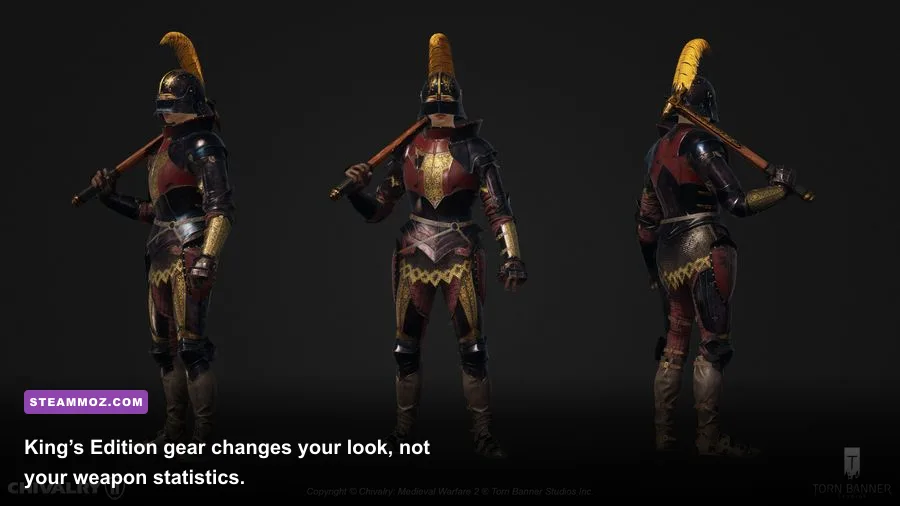
Cosmetics still matter in a first-person melee game because visual recognition affects reaction time. Choose armor and weapon appearances that remain easy for you to read during a crowded siege. If a bright weapon skin makes the head of your Messer harder to track, it may look excellent in a screenshot and perform worse for your own timing.
Faction identity also helps your mental game. Agatha, Mason, and Tenosia have different silhouettes and battlefield colors, but the crucial information is always the attack itself: windup direction, weapon length, foot placement, and release timing. Don’t assume an ornate King’s Edition helmet signals a high-level player, and don’t underestimate a basic-looking Knight. Cosmetics reveal nothing about skill.
At 60 frames per second, attack animations are easier to read than at an unstable frame rate. If your PC struggles during large sieges, reduce shadows, effects, and ragdoll detail before sacrificing resolution aggressively. The goal is a stable image that lets you recognize a horizontal slash or overhead windup. This advice also applies to other demanding PC games; see our low-FPS troubleshooting guide for a useful performance-first mindset.
Final Ranking and Buying Verdict
Buy the King’s Edition for its armor and weapon style, not for a competitive shortcut. There is no exclusive blade that secretly out-damages the base roster. If you want the strongest equipment, start with the Messer or Longsword, learn counters and feints, then branch into the Dane Axe, Polehammer, and Greatsword as your spacing improves.
My practical ranking is straightforward. S-Tier belongs to Messer, Dane Axe, Polehammer, Greatsword, and Longsword because they combine reliable damage with strong matchup coverage. A-Tier weapons such as Battle Axe, Executioner’s Axe, Heavy Mace, War Club, Falchion, and Morning Star can dominate their preferred fights. B-Tier weapons are specialists that reward discipline, while C-Tier picks are ambush tools for players who already understand positioning.
Before your next match, pick one weapon and commit to learning its range. Practice a slash-to-overhead feint, a counter against the three main attack directions, and a retreat route for when the fight turns into a surround. Then use the King’s Edition cosmetics to make that practiced loadout yours. Chivalry 2’s best equipment isn’t the item with the fanciest skin; it’s the weapon whose timing you can trust when the gate falls and six enemies come charging through.
For official details on updates, classes, and the live game, check the official Chivalry 2 website, the official Chivalry 2 social feed, and the developer’s support portal. Balance patches can shift individual matchups, but the core lesson will remain: cosmetics change your presentation, while execution wins the duel.