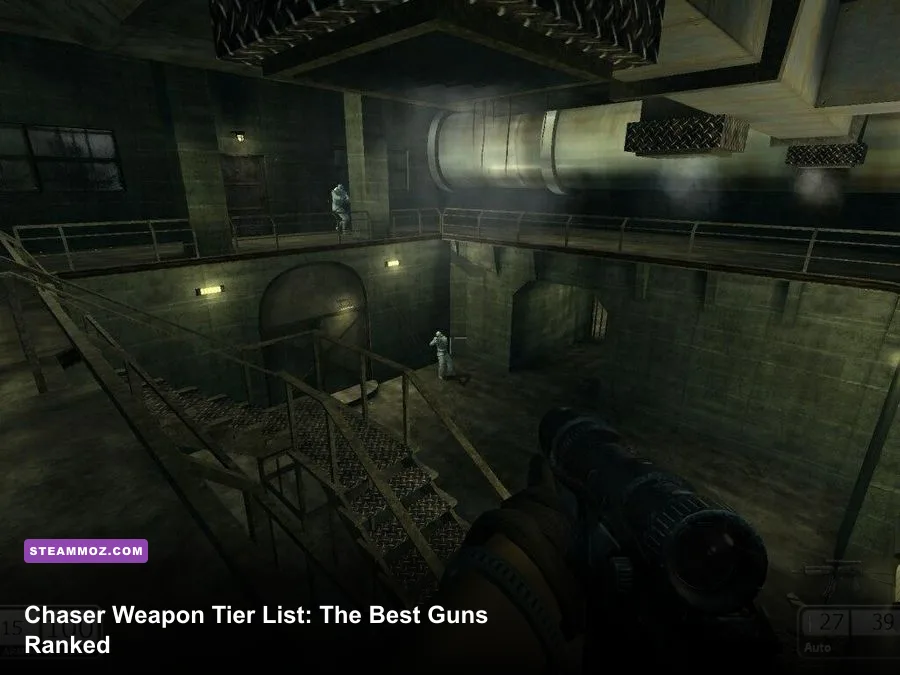
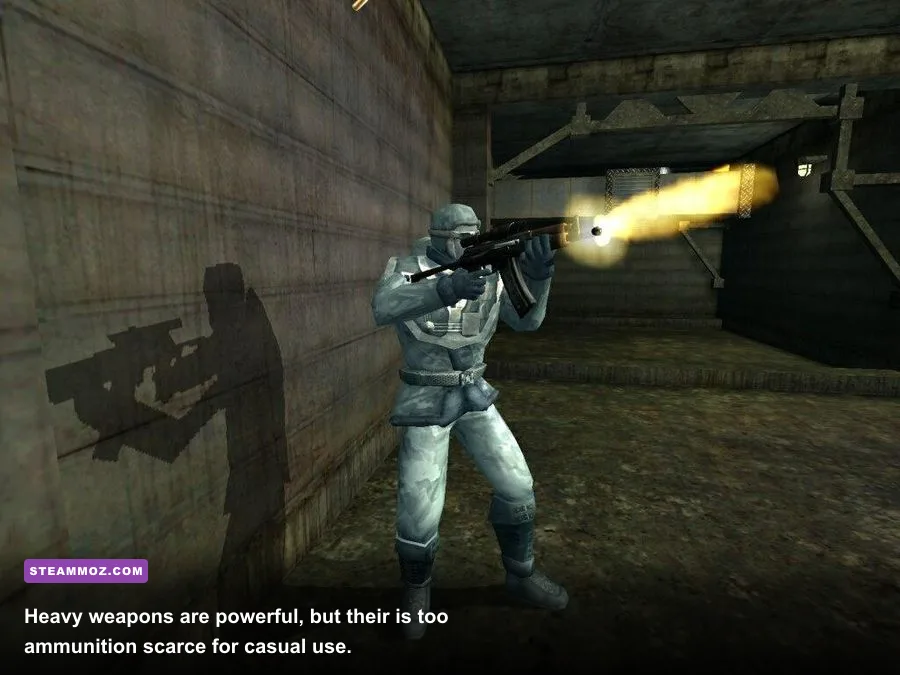
The M4 assault rifle is Chaser’s best all-round weapon, while the shotgun earns S-Tier status in close quarters and the sniper rifle dominates long sightlines. The rocket launcher and other heavy weapons hit harder, but limited ammunition keeps them out of the top spot. This ranking is based on campaign usefulness, ammunition economy, accuracy, reload safety, enemy matchups, and how well each weapon performs on the game’s cramped Mars facilities and exposed industrial environments.
Cryo Interactive’s Chaser is an old-school shooter with a surprisingly demanding weapon loop. Enemies are dangerous when they flank, armor can absorb careless bursts, and the campaign regularly forces you to swap between precision weapons and panic buttons. Unlike modern shooters, there’s no generous regeneration system or universal loadout that solves every room. Your weapon choice matters because missed shots cost real resources.
This guide covers the original PC campaign and the Steam release of Chaser. If you’re installing it today, start with the game’s official Steam store page, then check the Steam community discussions for compatibility notes. Players coming from newer shooters should also expect a more traditional health-and-armor rhythm, where positioning is often more important than raw damage per second.
Chaser weapon tier list at a glance
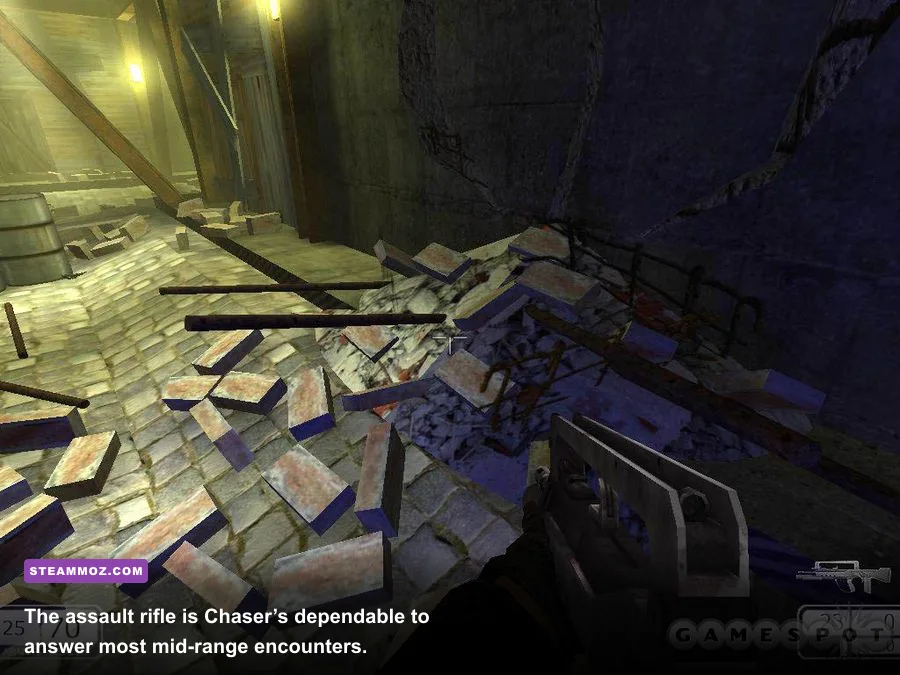
The ranking below separates weapons by practical campaign value rather than spectacular damage numbers. A gun that appears late, uses rare ammunition, or only works against one enemy type shouldn’t automatically outrank a reliable rifle you can use throughout the story.
| Tier | Weapon | Primary role | Why it ranks here |
|---|---|---|---|
| S-Tier | M4 assault rifle | General-purpose combat | Accurate, flexible, and effective against nearly every standard enemy |
| S-Tier | Shotgun | Close-range stopping power | Deletes rushing enemies and controls narrow rooms |
| S-Tier | Sniper rifle | Long-range precision | Excellent for exposed targets, sentries, and deliberate opening shots |
| A-Tier | AK-47 | Mid-range automatic fire | High impact and dependable against tougher targets, but less forgiving than the M4 |
| A-Tier | MP5 | Close-to-mid-range automatic fire | Fast handling and useful in interiors, with weaker reach than rifles |
| A-Tier | Rocket launcher | Heavy targets and groups | Devastating burst damage limited by scarce rockets and splash risk |
| B-Tier | Desert Eagle | Precision sidearm | Strong single-shot damage, but slow follow-up shots punish misses |
| B-Tier | Glock 17 | Early-game backup | Reliable and economical, though its damage falls behind later firearms |
| B-Tier | Uzi | Emergency spray weapon | Excellent close-range volume, poor ammunition efficiency at distance |
| C-Tier | Knife | Silent emergency melee | Useful for conserving ammunition, but dangerous against armed groups |
| C-Tier | Flamethrower | Area denial | Situational crowd control with awkward range and fuel dependence |
The biggest surprise is the M4’s position above the heavier weapons. Chaser rewards controlled bursts, and the M4 gives you the accuracy to place those bursts into the head or upper torso without burning through magazines. The AK-47 can feel more powerful per hit, but its recoil makes it less comfortable when enemies are moving laterally or appearing at medium distance.

🎮 Chaser
Looking to experience this game? Grab your digital key directly on our store for $1.24.
View on Steammoz Store →S-Tier weapons and the best equipment ranking
M4 assault rifle
The M4 is the weapon most players should build their campaign habits around. It handles medium-range firefights, remains manageable in corridors, and has enough precision for deliberate headshots. Use short bursts instead of holding the trigger. Three- to five-round bursts are usually enough against standard human enemies, while longer bursts are better reserved for armored targets or moments when an opponent is already staggered.
Its real advantage is transition speed. You can leave the M4 equipped while moving through a facility and only switch when the environment clearly changes. That saves time during ambushes and prevents the classic mistake of entering a room with a sniper rifle while a close-range enemy is already charging.
Shotgun
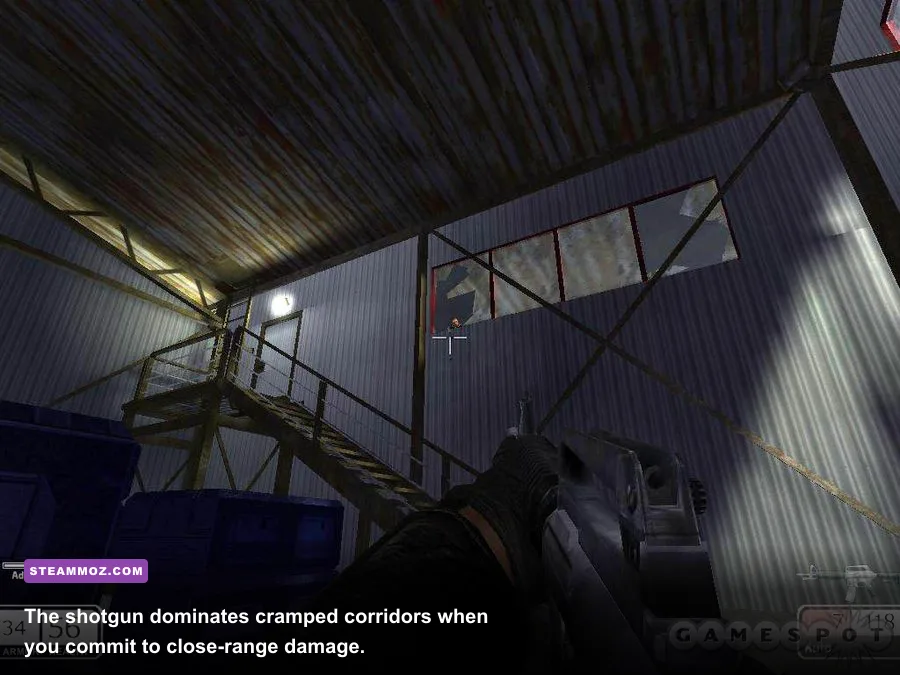
The shotgun is Chaser’s best panic weapon and one of its most satisfying guns. It belongs in S-Tier because the campaign contains plenty of tight doors, stairwells, maintenance passages, and sudden room entries where spread damage matters more than precision. At ideal range, one blast can stagger or eliminate a standard enemy before they have time to return fire.
Don’t treat it like a universal rifle. The damage falls sharply when you fire from too far away, and missing a blast during a reload animation can leave you exposed. The best rhythm is simple: pre-aim at doorway height, fire as the enemy commits, retreat around a corner, reload, then re-engage. Against groups, shoot the front target first to create space rather than trying to hit everyone at once.
Sniper rifle
The sniper rifle is unmatched whenever the level gives you distance. It’s especially valuable for opening encounters against stationary guards, elevated shooters, and enemies positioned across courtyards or industrial platforms. One clean shot can remove the most dangerous target before the rest of the room activates.
Its weakness is not damage; it’s tempo. Scoping slows your awareness, and the rifle becomes a liability in a crowded interior. Keep the M4 or MP5 ready before entering a building, and use the sniper rifle only after you’ve created a safe firing angle. A good Chaser player treats it as an encounter opener, not a weapon to carry through every corridor.
| Weapon | Best range | Best target | Main drawback |
|---|---|---|---|
| M4 assault rifle | Short to long | Standard soldiers and armored infantry | Needs burst control for ammunition efficiency |
| Shotgun | Point-blank to short | Rushing enemies and doorway ambushes | Low effectiveness at distance |
| Sniper rifle | Long | Sentries, exposed shooters, priority targets | Awkward during close-range pressure |
Players who enjoy methodical runs may prefer the sniper rifle as their personal number one. For a complete campaign ranking, though, the M4 wins because it solves more situations without forcing a dangerous weapon swap.
A-Tier guns that deserve regular use
AK-47
The AK-47 is the bruiser of the standard rifle category. It hits hard and feels excellent when enemies are grouped behind cover or moving through predictable lanes. Its recoil is the catch. Holding the trigger turns the muzzle upward quickly, so fire in controlled bursts and pull down slightly between shots.
Use the AK-47 when you expect tougher enemies at medium range and have enough ammunition to support a more aggressive approach. It’s also a strong choice for players who struggle to finish armored opponents with the M4. Just don’t waste rounds spraying at distant targets; the weapon’s damage advantage disappears when half the magazine misses.
MP5
The MP5 is more forgiving than the AK-47 and better suited to fast movement through interiors. It comes into its own in rooms where targets appear from several angles and you need to track them without fighting heavy recoil. Short bursts still help, but the MP5 tolerates controlled full-auto fire much better at close and medium range.
Its limitation is reach. Against enemies across a large yard or down a long industrial lane, the MP5 burns ammunition without delivering the clean results of the M4 or sniper rifle. Keep it as your indoor weapon and swap before pushing into open terrain.
Rocket launcher
The rocket launcher belongs in A-Tier because it can completely change a difficult encounter. It is the correct answer for clustered enemies, heavily protected targets, and moments when you need immediate area damage. Aim at the floor or nearby wall when a direct body shot is unreliable, but keep your distance: splash damage can hurt you badly in enclosed spaces.
Scarcity is the reason it doesn’t rank S-Tier. Rockets are too valuable to spend on a single ordinary soldier. Save them for groups, high-threat enemies, or scripted combat sections where the game clearly expects heavy firepower. If you find only a few rockets, think of them as emergency insurance rather than standard ammunition.
This resource-first approach also applies to equipment. Grenades are strongest before an enemy group spreads out, while armor should be collected before entering a known combat zone rather than immediately after taking damage. Chaser is closer to a classic corridor shooter than a modern loot game, so the timing of a pickup can matter as much as the item itself.
B-Tier weapons and when they outperform the ranking
Desert Eagle
The Desert Eagle is a powerful sidearm for players who aim well. It’s excellent for finishing wounded enemies, conserving rifle ammunition, and dealing with isolated targets. The slow cadence makes misses expensive, though, and it loses its edge when several opponents rush together.
Use it between rifle encounters rather than forcing it into every fight. A clean headshot followed by a quick retreat can save a surprising amount of primary ammunition, especially during exploration-heavy sections.
Glock 17
The Glock 17 is the dependable early-game fallback. It has manageable handling, a useful magazine, and enough consistency to carry you until stronger weapons become available. Its damage is modest, but that’s less important when you’re landing controlled shots and using cover properly.
Don’t discard it mentally just because it’s an early weapon. Keeping the Glock available can prevent you from wasting rare rifle ammunition on a lone, lightly armed enemy. It’s also a sensible choice when you’re exploring and don’t yet know whether the next room contains a serious firefight.
Uzi
The Uzi is fun, loud, and dangerously easy to overuse. At close range, its rate of fire can shred a rushing target. At medium range, its spread turns ammunition into noise. Tap the trigger and aim for the upper torso; spraying from the hip should be reserved for emergencies.
It ranks below the MP5 because it feels less controlled and less efficient. Still, it can outperform the MP5 in a chaotic room where enemies are already inside your minimum reaction distance.
Knife and flamethrower
The knife is a stealthy ammunition-saving tool, not a primary combat option. It can help against isolated enemies when the game gives you a safe approach, but trying to melee an armed group is usually a bad trade. The flamethrower is similarly specialized. It can deny a narrow passage and pressure clustered enemies, yet its range is awkward and fuel is too limited to make it a dependable default.
For players interested in older RPG and strategy systems alongside retro shooters, Steamoz’s Dungeon Siege review and ELEX PC fixes guide offer useful context on how older PC games handle progression, performance, and combat friction.
| Weapon | Best use | Ammo advice | Do not use it for |
|---|---|---|---|
| Desert Eagle | Finishing isolated targets | Fire only when the shot is deliberate | Close-range crowd control |
| Glock 17 | Early missions and ammunition conservation | Pair with cover and headshots | Armored enemies unless no alternative exists |
| Uzi | Emergency close-range defense | Use short bursts | Long sightlines |
| Knife | Silent takedowns and isolated opponents | Costs no ammunition | Open fights against multiple soldiers |
| Flamethrower | Doorways and narrow choke points | Reserve fuel for groups | Long-range engagements |
Best Chaser loadouts for different missions
Balanced campaign loadout
Carry the M4 as your default, the shotgun for rooms and stairwells, and the sniper rifle for open spaces. Keep the Glock 17 or Desert Eagle available when primary ammunition becomes tight. This setup covers nearly every engagement without leaning too heavily on rare ammunition.
Close-quarters assault loadout
Choose the shotgun, MP5, and Desert Eagle. Move quickly, clear corners before crossing them, and reload behind cover rather than in the middle of a doorway. The MP5 handles targets just outside shotgun range, while the pistol gives you a low-cost option for isolated enemies.
Resource-saving loadout
Use the Glock 17 and knife whenever the situation allows, then reserve the M4 for groups and armored opponents. This approach is slower, but it pays off in long missions where ammunition pickups are spread apart. The key is not bravery; it’s choosing fights that don’t require a full magazine.
Heavy-target loadout
Bring the AK-47, rocket launcher, and shotgun. Open with the rocket launcher only when multiple enemies are within the blast zone or a heavy target is exposed. Follow with controlled AK-47 bursts, then switch to the shotgun if anything closes the distance. Never fire rockets at your feet in narrow rooms, even if the target is directly ahead.
These loadouts work because they respect Chaser’s encounter design. The game frequently alternates between long approaches, enclosed interiors, and sudden ambushes. A single favorite weapon can carry you for a while, but it won’t cover every range. The strongest players constantly ask what the next room is likely to demand before committing ammunition.
How to get more value from every weapon
First, aim before you expose yourself. Chaser’s enemies punish players who swing around corners with the crosshair at floor level. Keep your aim at chest or head height, lean your movement around cover, and fire as soon as the target enters the lane. This matters most with the shotgun and Desert Eagle, where the first shot often decides the exchange.
Second, separate weapons by range instead of damage. The sniper rifle is not automatically better than the M4 because it can kill from farther away. The M4 is better when targets move unpredictably or the encounter changes distance. Likewise, the shotgun isn’t a weak rifle; it’s a room-control tool. Ranking weapons by their intended range produces better decisions than chasing a single “highest damage” option.
Third, reload during movement between encounters. Classic shooters often punish players who reload after every small exchange, but carrying an almost-empty magazine into an ambush is worse. After clearing a room, check your immediate surroundings, reload, and then move. If you hear combat cues or enemy movement, switch weapons instead of forcing a vulnerable reload.
Finally, tune the game so aiming feels consistent. On modern PCs, use the Steam version as your baseline, enable a stable frame-rate cap if uncapped motion feels uneven, and avoid changing mouse sensitivity between missions. A consistent 60 frames per second is more useful for precision than chasing unstable high frame rates in a game built for older hardware. Players troubleshooting other older PC releases can also compare the approach in Steamoz’s Dragonkin settings guide.
The final verdict is straightforward: use the M4 as your campaign anchor, carry the shotgun for close-range emergencies, and exploit the sniper rifle whenever the level offers distance. The AK-47 and MP5 are excellent alternatives, while the rocket launcher should be saved for encounters that genuinely justify its ammunition cost. Pistols, the Uzi, knife, and flamethrower all have a place, but they work best as specialist tools rather than replacements for a balanced primary loadout.
That’s what makes Chaser’s arsenal hold up. The weapons don’t need elaborate upgrade trees to feel distinct. Their value comes from range, timing, recoil, ammunition, and the pressure of choosing the right tool before the next Mars corridor turns into a firefight.