
If you came looking for a conventional Card Shark weapon tier list and best equipment ranking, here’s the important correction: Card Shark has no weapons, armor, loot rarity, or equippable gear. Its real arsenal is a growing collection of cheating techniques, and the strongest setup is built around information, deck control, and reliable timing. Ranked that way, Peek and False Shuffle sit near the top, while flashy high-risk cheats belong lower until you’ve mastered their prompts.
That distinction matters because Card Shark is not a combat RPG with a hidden inventory screen. It’s a narrative adventure from Nerial and Devolver Digital set in 18th-century France. You play a mute card cheat who travels with the mysterious Comte de Saint-Germain, learning increasingly elaborate ways to manipulate games, signal information, and escape suspicion. The closest thing to equipment is the deck on the table, your available trick set, and the input device you use to execute each gesture.
This guide ranks the techniques by practical value rather than spectacle. The question isn’t which trick looks coolest during a tutorial. It’s which one gives you the most control, remains dependable when the stakes rise, and helps you recover when a table stops going according to plan. If you want a useful comparison with a game that really does have ranked weapons, Steamoz’s Borderlands 3 weapon ranking is the better fit.
There Are No Weapons or Equippable Items
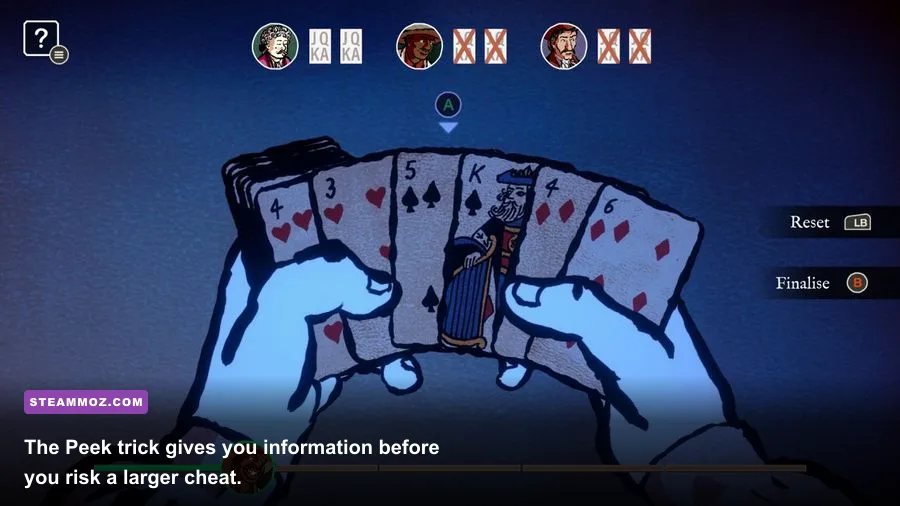
Let’s clear up the terminology before the rankings get messy. Card Shark does not give the protagonist a sword, pistol, outfit with stats, accessory slots, or a loadout menu. There are no attack values, critical-hit chances, elemental effects, durability numbers, or gear upgrades. Your character’s progression comes from story chapters and newly learned card techniques, not from picking up better equipment.
The game also doesn’t present a formal tier system. The S, A, and B labels below are editorial rankings based on consistency, usefulness across different table situations, and how much punishment a failed attempt can cause. They are not hidden values extracted from the game files.
| Category | What Card Shark Actually Uses | What It Does Not Have | Ranking Implication |
|---|---|---|---|
| Core tool | Standard playing-card deck | Weapon rarity or damage stats | Deck control matters more than damage |
| Progression | Story lessons and new cheats | Experience points and gear levels | Practice improves execution |
| Combat equivalent | Cheat prompts and table decisions | Attacks, dodges, and armor | Timing is your defensive stat |
| Equipment | Input device and accessibility options | Equippable items and inventory bonuses | Comfort and precision affect results |
That makes Card Shark closer to a rhythm game wrapped in a historical adventure than a traditional RPG. The screen tells you what gesture or input comes next, but the pressure comes from maintaining the sequence without telegraphing your intent. A failed cheat can cost money, expose the scheme, or force you to restart a tense encounter.
For the official baseline, check the game’s Steam page for Card Shark. It describes the core experience accurately: learning tricks, practicing them, and using them to win games rather than collecting conventional combat gear.

🎮 Card Shark
Looking to experience this game? Grab your digital key directly on our store for $3.99.
View on Steammoz Store →Card Shark Cheat Tier List From S to B
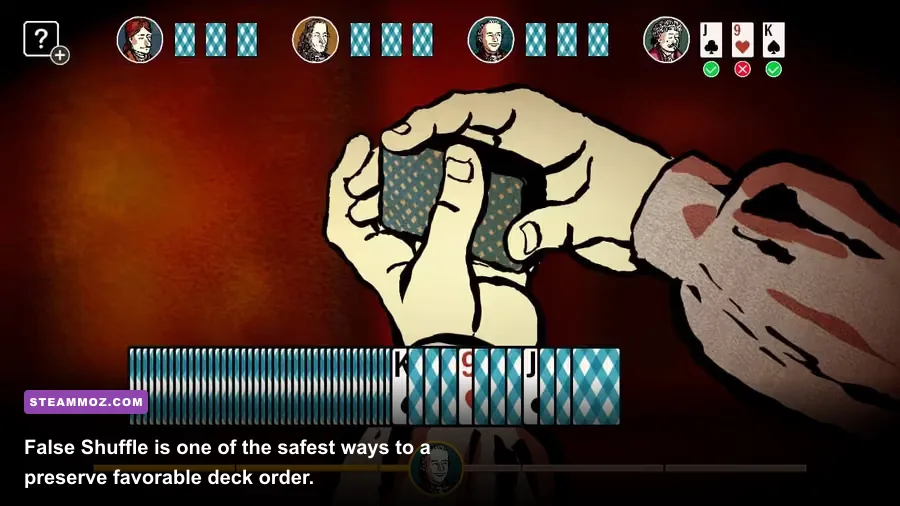
The best techniques are the ones that create an advantage before the game reaches its decisive moment. Information cheats and deck-preservation tricks therefore outperform dramatic moves that can win instantly but demand perfect execution. Your personal comfort still matters, but this list is a strong starting point for a first playthrough.
| Tier | Technique | Why It Ranks Here | Best Use |
|---|---|---|---|
| S | Peek | Provides information before a risky decision | Reading hands and planning the next cheat |
| S | False Shuffle | Preserves a known order while looking legitimate | Keeping favorable cards in place |
| S | False Cut | Maintains deck control with a convincing motion | Resetting suspicion after a shuffle |
| A | Deal Second | Directly controls who receives the next card | Constructing a winning hand |
| A | Deal Bottom | Powerful access to a planned card | Late-game precision and prepared deals |
| A | Hold Back | Useful for retaining or controlling a card | Protecting a key card from the normal deal |
| B | Palming and switches | Strong payoff but more demanding timing | Recovering from a bad hand or changing evidence |
| B | Marked-card style information | Helpful only when the table state supports it | Recognizing targets before the decisive round |
S-Tier: Peek, False Shuffle, and False Cut
Peek earns S-Tier because knowledge is the safest advantage in the entire game. It doesn’t automatically win the hand, but it tells you whether a planned cheat is worth the risk. If the opponent’s cards are weak, you may not need to stack several tricks. If the information is dangerous, you can choose a more conservative line instead of blindly committing to a complicated sequence.
False Shuffle is the backbone of deck control. The point isn’t simply to shuffle cards without changing their order; it’s to make a preserved arrangement appear random. Once you know where important cards are, losing that order to an ordinary shuffle is often the biggest mistake you can make. False Shuffle keeps your plan alive while giving the table a believable visual explanation for the deck’s movement.
False Cut complements it perfectly. A preserved deck can look suspicious if you never cut it, so the false cut lets you create the appearance of fairness without sacrificing the order you worked to establish. It’s less spectacular than a direct deal manipulation, but that’s precisely why it belongs in S-Tier: quiet cheats tend to survive longer.
A-Tier: Deal Second, Deal Bottom, and Hold Back
Deal Second is the first technique that feels like a genuine weapon. When the correct card sits in the right position, dealing the second card instead of the top card can redirect the hand without visibly touching the rest of the deck. Its weakness is timing. You need to understand the sequence, keep your rhythm steady, and avoid rushing the input because the outcome looks obvious in hindsight.
Deal Bottom offers similar control from the opposite end. It becomes increasingly valuable when a planned card has been pushed toward the bottom and the table expects an ordinary deal. The technique is powerful, but it’s not a universal answer. If you haven’t prepared the deck first, a bottom deal may give you nothing useful and expose you to unnecessary risk.
Hold Back is less glamorous but excellent for managing a hand. Treat it as a control tool rather than a win button. It helps maintain a favorable card position and can give you another chance to execute a later cheat. The main reason these three stay in A-Tier is that they depend more heavily on setup than the S-Tier information tools.
B-Tier: Palming, Switching, and Information Tricks
Palming and card switches can produce enormous swings, but they demand more precise sequencing. They’re also harder to use when you’re already under pressure. A player who has learned the motion can absolutely promote these tricks to A-Tier, but the average player will get more victories from a clean Peek followed by careful deck preservation.
Marked-card-style information is similarly situational. It shines when you have time to inspect or identify the relevant cards, then exploit that knowledge later. It’s weaker when the game throws a rapid sequence at you and the table changes before your information becomes useful. Don’t confuse complexity with strength. In Card Shark, a simple trick executed cleanly beats an ambitious trick executed one prompt too early.
Best Techniques for Different Table Situations
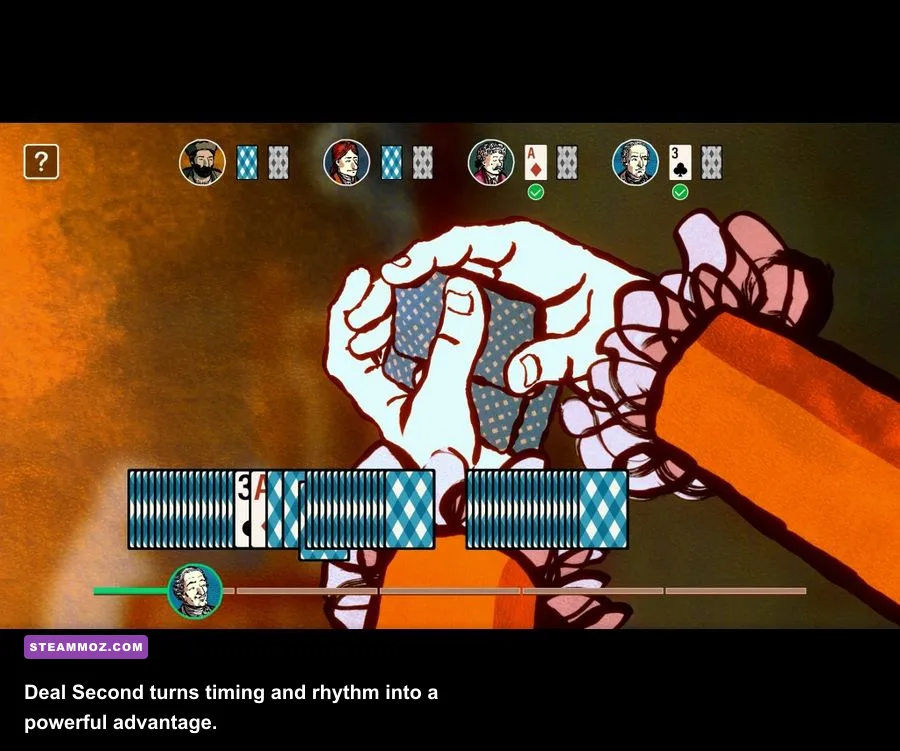
A tier list is useful, but Card Shark’s encounters reward adapting to the current table. The strongest sequence depends on whether you’re trying to learn the hand, preserve a known order, force a particular deal, or survive a suspicious opponent. Think in short chains rather than isolated tricks.
| Situation | Preferred Sequence | Reason | Main Risk |
|---|---|---|---|
| You don’t know the hand | Peek, then preserve the deck | Information prevents unnecessary gambles | Taking too long and missing the prompt |
| You know the winning card position | False Shuffle, False Cut, controlled deal | Keeps the arrangement intact | Breaking the order with a normal shuffle |
| You need one specific card | Prepare the deck, then Deal Second | Redirects the next important card | Attempting the deal without setup |
| The table is suspicious | Short, believable cheats | Reduces the number of visible oddities | Repeating the same motion too obviously |
| You made an early mistake | Hold Back or switch into recovery | Protects the remaining plan | Trying to force a perfect recovery |
The most reliable opening is usually Peek when the game gives you the opportunity. Information lets you decide whether to spend your attention on deck manipulation or simply play the situation straight for a moment. That restraint is important. Card Shark occasionally tempts you to cheat because you can, not because you should.
After you know the useful cards, False Shuffle and False Cut are your safest preparation tools. Use them to maintain an order you have already created. Then choose Deal Second or Deal Bottom only when the card position makes the attempt worthwhile. This is the same logic strong players use in a real card routine: prepare first, execute second, and never perform a complicated flourish without a reason.
When the prompt sequence becomes dense, prioritize rhythm over speed. The game’s animations communicate the intended flow. Watch the hand, the deck, and the next input rather than mashing through the sequence. A fast player who misses one transition is less effective than a slower player who maintains control.
For a useful contrast, Steamoz’s Children of Silentown guide covers another game where players often search for weapons that simply aren’t part of the design. The lesson applies here too: identify the actual progression system before trying to optimize it.
Best Equipment Ranking and Input Setup
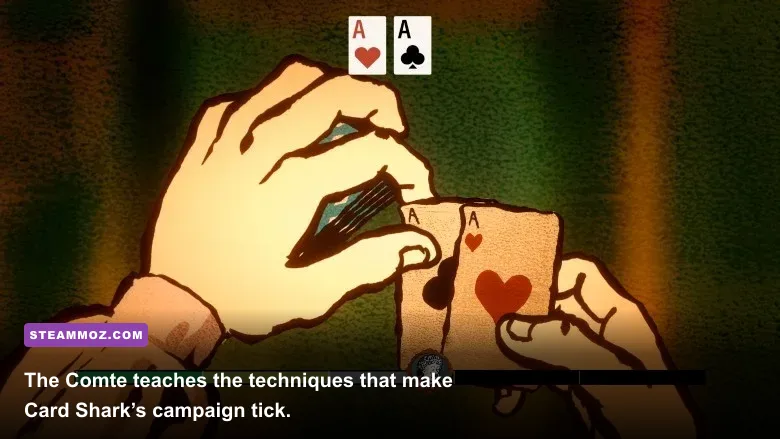
Since there is no in-game equipment screen, the practical Card Shark equipment ranking is really a ranking of ways to play. Your deck is fixed by the encounter, but your display, input device, and comfort settings can affect how consistently you read and complete the hand motions.
| Rank | Setup | Strength | Best Player Type |
|---|---|---|---|
| S | Gamepad with comfortable triggers | Natural tactile feedback during gesture prompts | Players who prefer relaxed couch play |
| S | Mouse and keyboard at a stable desk | Precise, responsive input and clear screen focus | Players who favor direct PC control |
| A | Large monitor or handheld at readable brightness | Makes card details and motion cues easier to follow | Players who struggle with small visual prompts |
| A | Headphones or clear speakers | Improves awareness of scene feedback and pacing | Players who rely on audiovisual timing |
| B | Small, dim display | Portable, but harder to read during busy scenes | Travel play with adjusted brightness |
There isn’t a damage advantage attached to a controller, and the game doesn’t hide stronger card decks behind a hardware choice. The ranking is about reducing friction. Pick the input method that lets you perform the gestures without tension, then use a display large enough to make the table state obvious.
On PC, keep the game at a stable frame rate and avoid background applications that cause stutter during input-heavy scenes. Card Shark isn’t a competitive shooter, so you don’t need a high-refresh monitor or aggressive graphics tuning. Consistent animation is more valuable than chasing a maximum frame-rate number. If your PC struggles with older games generally, Steamoz’s PC crash and low-FPS troubleshooting guide offers broadly useful steps, although Card Shark itself is far less demanding.
Use brightness and scaling adjustments if card symbols or hand motions are difficult to read. Don’t sit too far from the screen, either. Several prompts are easy to understand visually but much harder to interpret when the game window is tiny. Comfortable posture also matters because repeated tense inputs make you more likely to rush a sequence.
How to Progress Without Wasting Attempts
Card Shark’s progression curve is built around learning one new deception at a time, not farming currency for a superior loadout. The Comte de Saint-Germain introduces the logic behind each technique, and later encounters test whether you can combine those lessons under pressure. Treat every new trick as part of a system rather than a replacement for the old ones.
Start by mastering recognition. Before worrying about the perfect outcome, identify what the game is asking you to do and which part of the sequence caused the failure. Was the problem the initial gesture, the timing between prompts, or the deck position? Separating those mistakes prevents random retries from becoming frustrating guesswork.
Next, practice the low-risk portion of the routine. Peek, False Shuffle, and False Cut are valuable because they teach the central Card Shark skill: controlling information without drawing attention. Once those actions feel automatic, Deal Second and Deal Bottom become much easier to understand. They are not magic tricks you fire at random; they are finishing moves for a prepared deck.
Don’t reload immediately after every imperfect result. Some encounters teach you how opponents react when a cheat goes wrong. That information is valuable, especially when a later table changes the order of prompts or asks you to manage several actions in one sequence. Learn the shape of the challenge before trying to perform it flawlessly.
| Progression Stage | Focus | Recommended Priority | Common Mistake |
|---|---|---|---|
| Early lessons | Reading prompts and basic hand motions | Accuracy over speed | Mashing through the tutorial |
| Deck preparation | False Shuffle and False Cut | Preserve order consistently | Using a real shuffle after setup |
| Controlled dealing | Deal Second and Deal Bottom | Know the target card position | Attempting the deal without preparation |
| Complex encounters | Combining information and manipulation | Plan a short, repeatable chain | Adding unnecessary cheats |
| High-pressure tables | Recovery and suspicion management | Stay calm after a missed input | Forcing a risky recovery immediately |
The game’s visual style can make the deception feel theatrical, but the underlying rule is wonderfully simple: every extra action is another opportunity to fail. If a Peek gives you enough information to win with one controlled deal, don’t stack three more flourishes on top. The best “build” is often the shortest line that produces the result.
For more examples of how to judge a game on its actual systems rather than expected RPG conventions, see Steamoz’s Crossing Souls weapon ranking. Card Shark demands a different vocabulary, but the same editorial discipline applies: rank what the game really offers.
The Final Card Shark Ranking
So, what is the final answer to the Card Shark weapon tier list question? There is no weapon tier list because the protagonist never equips weapons. There is also no conventional best equipment ranking. The strongest practical setup is a reliable input device, a readable display, and a technique package built around Peek, False Shuffle, False Cut, and one controlled dealing method.
Choose Peek when you need information, False Shuffle when you need to preserve a known order, and False Cut when you need that order to look legitimate. Add Deal Second or Deal Bottom only after the deck is prepared. Keep palming, switches, and other more demanding tricks for situations where the payoff justifies the risk.
That’s why Card Shark remains so satisfying. A typical tier list asks which sword has the highest damage or which rifle has the best recoil. Card Shark asks whether you can maintain a believable rhythm while lying to everyone at the table. Its best equipment isn’t hidden in a chest. It’s the calm timing and precise planning that let a simple deck become the most dangerous object in the room.
For the developer’s background and broader catalogue, visit Nerial’s official website and Devolver Digital’s official site. If you approach Card Shark as a cheating-technique game rather than a combat RPG, its progression becomes much clearer—and the S-Tier choices above will carry you through far more tables than any imaginary weapon could.