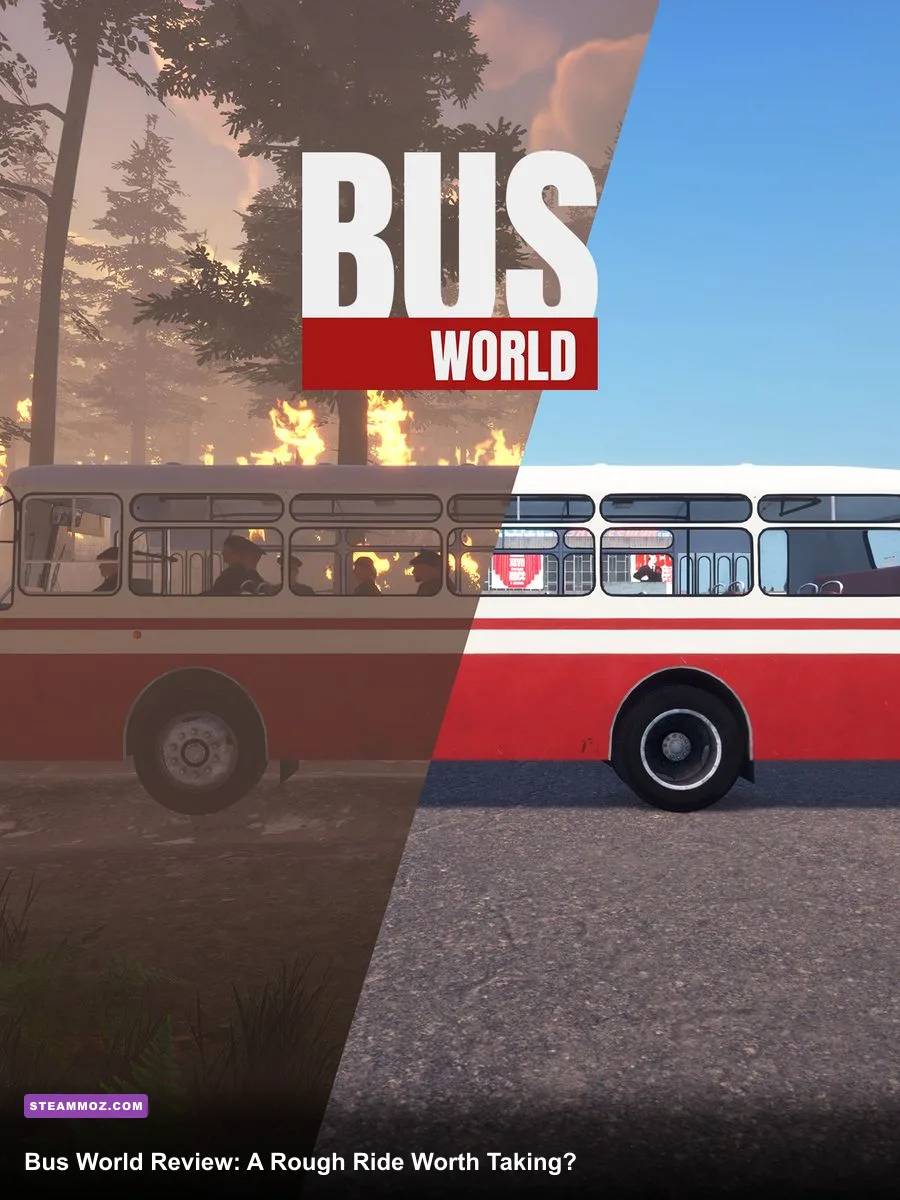
Bus World is worth playing in 2026 only if you want a compact, rough-edged driving simulator with unusual disaster scenarios. It isn't a polished rival to Bus Simulator 21 Next Stop, and it doesn't have the deep fleet management of a full trucking sim. What it does have is a memorable premise: transport passengers through places such as the Chernobyl exclusion zone, then switch from routine driving to emergency work when fires, wrecks, and stranded civilians turn a normal route into a rescue mission. At a discounted price, that strange mixture still has charm. At full price, the thin progression, dated presentation, and uneven AI make the recommendation much harder.
My 2026 verdict on Bus World
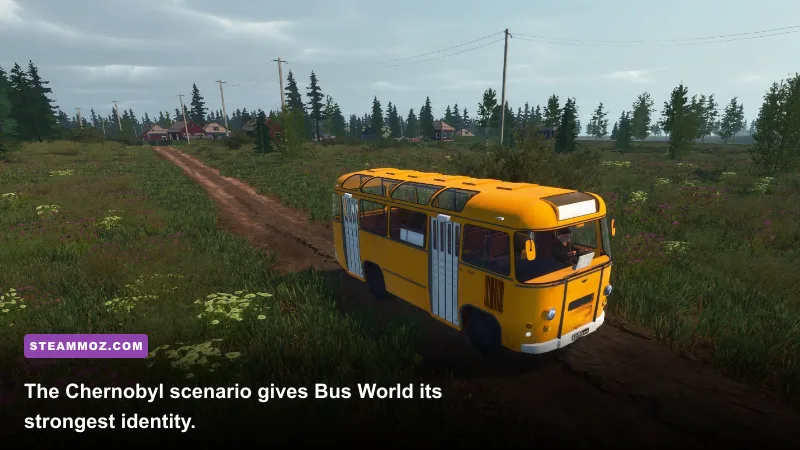
Bus World feels like a promising smaller simulator that never quite received the refinement its ideas deserved. The steering is readable, the buses have enough weight to make braking and cornering matter, and the Chernobyl setting gives the opening hours a mood most bus games never attempt. Driving past abandoned buildings with passengers aboard is a far more distinctive hook than another generic European city route.
The problem is consistency. Road surfaces can look unfinished, traffic behavior is basic, and the campaign does not build toward a satisfying management layer. You drive, stop, load passengers, complete objectives, and move to the next assignment. That loop can be relaxing when the route is flowing, but it becomes repetitive once the novelty of the locations wears off.
| Category | 2026 assessment | Why it matters |
|---|---|---|
| Driving feel | Good, but basic | Steering and braking have enough weight to reward care. |
| Mission variety | Mixed | Rescue objectives break up passenger routes, but the patterns repeat. |
| Visual quality | Functional | Atmospheric locations are held back by dated assets and effects. |
| Progression | Thin | There is little long-term management or fleet strategy. |
| Value | Discount purchase | Best for players who specifically enjoy unconventional simulators. |
My short version is a 6/10: interesting enough to recommend on sale, too underdeveloped to call essential. If you prefer narrative experiments and oddball premises over immaculate simulation systems, Bus World is easier to defend. If you expect a deep career mode, extensive customization, or highly authentic commercial driving, look elsewhere.
Before buying, check the current official Steam listing for the latest build notes, price, and player feedback. That matters more here than with a heavily supported AAA simulator because the game's condition and value depend heavily on what you expect from a small project.

🎮 Bus World
Looking to experience this game? Grab your digital key directly on our store for $3.99.
View on Steammoz Store →What Bus World actually offers
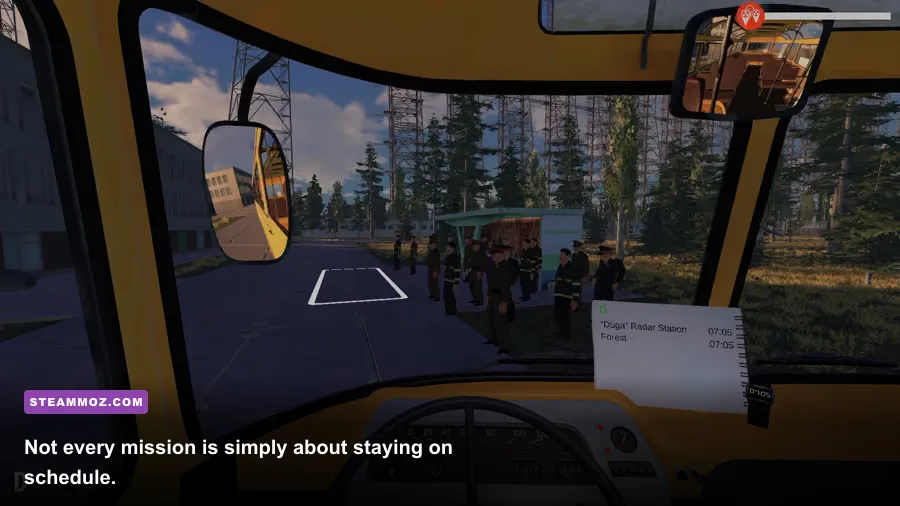
Bus World is built around scenario-based driving rather than an endlessly expanding transport company. Its headline locations include the Chernobyl exclusion zone, China, and Nepal. Each setting changes the visual tone and the kind of road you spend time navigating, but the central task remains familiar: follow a route, obey the objective, collect or deliver passengers, and keep the vehicle under control.
The Chernobyl material is the standout. It isn't a detailed historical reconstruction or a survival-horror game, but the abandoned infrastructure gives ordinary bus work an uneasy atmosphere. You are not just threading through a downtown grid; you are driving through a place associated with evacuation, contamination, and disaster. That contrast helps even straightforward passenger objectives feel more purposeful.
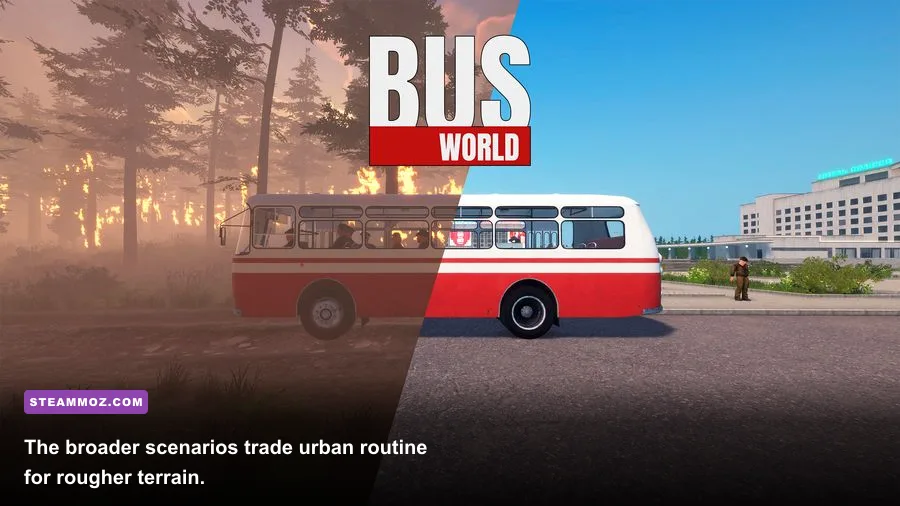
China and Nepal broaden the scenery and introduce more demanding roads. The mountain routes are particularly useful because they expose the game's driving model. A careless approach to a bend, excessive speed on a descent, or a late braking decision can turn a clean route into a collision. Bus World doesn't simulate every mechanical system with hardcore precision, but it does ask you to respect the size and momentum of the vehicle.
That limited scope is important. You are not buying an enormous sandbox with licensed operators, a living economy, and dozens of buses. You are buying a focused set of driving scenarios with light progression. Players who enjoyed the compact challenge of checking a game's practical PC requirements will appreciate the relatively accessible setup, but Bus World should not be mistaken for a giant content machine.
The driving is better than the presentation
Bus World works best when you treat the bus like a large, awkward object rather than a racing vehicle. The game rewards smooth inputs: brake before the corner, turn progressively, and avoid correcting the wheel with sudden movements. That sounds obvious, but the narrow mountain roads make impatience expensive. A bus that looks safely aligned at the front can still clip a barrier with its rear section.
Passenger comfort is part of the challenge, even when the game communicates it more simply than a specialist simulator. Hard braking and careless impacts can damage the flow of a mission, while reckless speed makes hazards harder to read. The safest routine is to lift off early, use measured braking, and accelerate only after the vehicle is straight. You lose less time driving cleanly than you do recovering from a crash or missed checkpoint.
How to approach each route
- Read the route before moving. Identify tight bends, steep descents, stop locations, and any obvious road blockage. The first run should be reconnaissance, not a time trial.
- Use exterior camera views sparingly. Third-person view helps with tight turns and reversing, while cockpit view gives better immersion and a clearer sense of lane position. Swap views instead of forcing one camera to do everything.
- Brake for the road, not the objective marker. A navigation icon may tell you where to go, but it won't judge your stopping distance. Begin slowing before the visual hazard arrives.
- Leave room for the rear axle. On switchbacks, steer later than you would in a car and allow the back of the bus to track around the corner.
- Restart bad runs early. If you take severe damage near the start, continuing usually creates more frustration than value. Bus World is at its best when you replay a route with a better plan.
The emergency missions add welcome texture. Fires, blocked roads, and rescue-oriented objectives give you a reason to care about the route beyond simply reaching the next stop. They are not as systemically deep as a dedicated rescue game, but they stop the campaign from becoming an uninterrupted sequence of identical passenger transfers.
That design sits somewhere between a traditional bus simulator and a light vehicle adventure game. If you want the methodical business side, you may find the systems too shallow. If you want a pure arcade experience, the braking, turning, and route discipline may feel too slow. Bus World lives in the awkward middle, but that middle is also where its personality comes from.
Performance settings that make the ride smoother
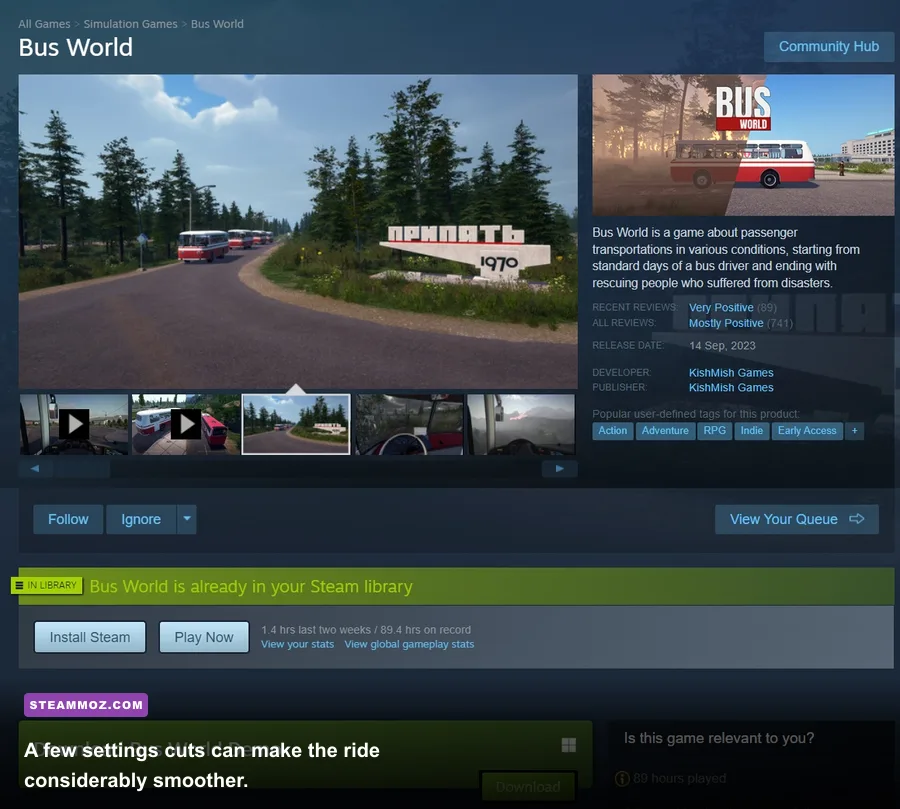
Bus World is not visually cutting-edge in 2026, but its outdoor scenes can still punish weaker hardware. Dense vegetation, weather effects, shadows, and distant scenery are the settings most likely to affect frame pacing. A stable 60 frames per second is more useful than a handful of prettier trees because inconsistent performance makes precise braking and cornering harder.
The Steam listing has historically positioned the game as relatively accessible, with a minimum target around a Core i3-class processor, 4GB of memory, and a GTX 750-class graphics card, while a Core i5-class CPU, 8GB of RAM, and a GTX 1060-class GPU provide a more comfortable baseline. Treat those figures as a starting point rather than a guarantee for every modern patch or resolution.
| Setting | Recommended value | FPS impact | Visual trade-off |
|---|---|---|---|
| Resolution | Native 1080p | High | Use 900p or 720p before cutting every quality option on low-end hardware. |
| Shadows | Medium | High | Lower settings reduce depth around roads and buildings but improve consistency. |
| View distance | Medium to High | High | Keep this higher if mountain roads look too visually compressed. |
| Vegetation | Medium | Medium | Lower foliage density is one of the least distracting performance cuts. |
| Effects and weather | Medium | Medium to High | Rain, smoke, and emergency effects can cause noticeable dips. |
| Anti-aliasing | Medium | Low to Medium | Lowering it can produce shimmering on road edges and poles. |
| V-sync | On if frame pacing is uneven | Low | May add input latency, but removes distracting tearing during turns. |
For a modest gaming PC, start at 1080p with medium shadows, medium vegetation, and medium effects. If performance still falls below a comfortable level, reduce view distance next and then resolution. Do not immediately drop textures unless the game is running out of video memory; blurry scenery makes the already-dated environments look substantially worse.
Players on Steam Deck or similar handheld hardware should expect to experiment. A locked 30 FPS may feel better than an unstable higher target, especially on winding Nepal routes. Use a moderate screen resolution, cap the frame rate, and avoid maximum shadows. The game is playable as a relaxed handheld sim when the frame pacing is stable, but it is not the sort of title where every preset behaves perfectly across every device.
For comparison, our Dragonkin graphics settings guide covers a similar principle: protect frame consistency first, then spend performance on the details you actually notice while playing.
Progression, replay value, and the biggest limitation
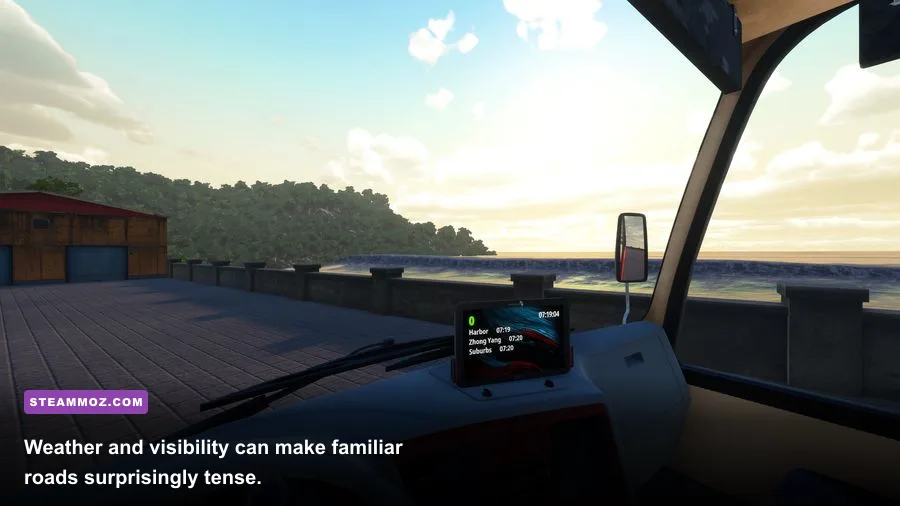
Bus World's biggest weakness is not the handling. It is the lack of a compelling reason to keep playing after you have seen its strongest scenarios. The campaign gives you objectives and new routes, but it does not develop into the kind of management game where every decision changes the future of your company.
There is no deep staff structure to optimize, no elaborate network planning, and no robust economy that makes one route financially essential. That absence keeps the game approachable, but it also flattens the progression curve. You are mostly improving your own route execution rather than building a transport operation.
| Player type | Fit | What you will enjoy | Likely frustration |
|---|---|---|---|
| Casual driving fan | A-Tier | Simple controls, unusual locations, short scenario structure | Some rough edges and repeated objectives |
| Hardcore sim player | C-Tier | Braking discipline and vehicle positioning | Limited systems, shallow economy, basic traffic AI |
| Open-world explorer | B-Tier | Chernobyl, China, and Nepal scenery | Not a truly expansive free-roaming sandbox |
| Rescue-game fan | B-Tier | Fire and emergency transport scenarios | Rescue mechanics are straightforward rather than deep |
| Completionist | C-Tier | Route mastery and replaying cleaner runs | Few long-term unlocks to chase |
Replay value comes from self-imposed goals: complete routes without collisions, keep speed under control, avoid damaging the bus, or replay a difficult mountain section until every stop feels routine. That can be satisfying, but it is a different kind of value from unlocking new buses, expanding a company, or reshaping a map.
This is where expectations decide the verdict. Someone coming from an older game that succeeds through atmosphere and a focused loop may be comfortable with Bus World's limited ambitions. Someone expecting the structure of a modern management simulator will probably bounce off it quickly.
What holds up in 2026, and what does not
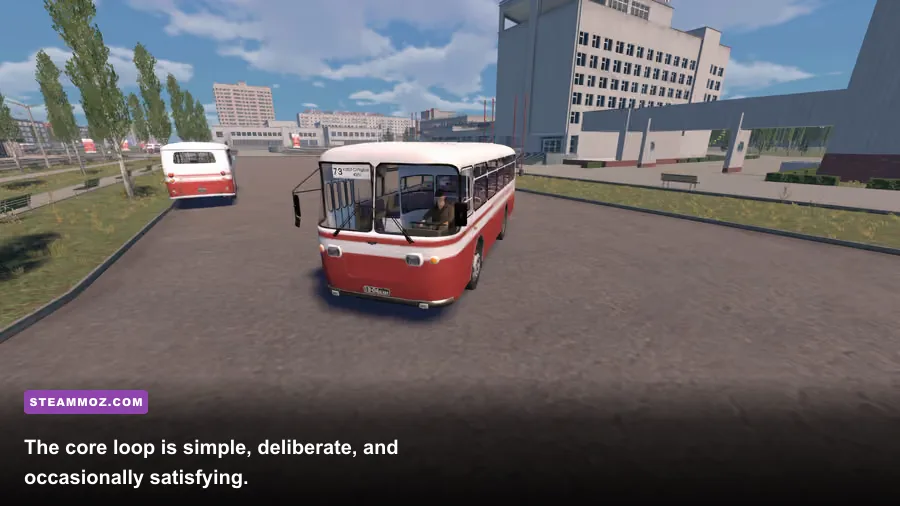
The atmosphere holds up best. Chernobyl remains an unusual backdrop for a driving game, and the contrast between normal passenger service and disaster response gives the campaign a hook that still feels fresh. The game also asks just enough of the driver to make route knowledge meaningful. You notice where you braked too late, where you cut a corner, and where a wider line would have saved the bus from a barrier.
The presentation has aged less gracefully. Environmental detail is inconsistent, animations can feel stiff, and traffic lacks the convincing behavior that makes a premium simulator feel alive. The world often seems like a collection of route pieces rather than a fully inhabited place. Weather and lighting help, especially at night, but they cannot hide every low-detail asset.
Updates and community discussion are worth checking before purchase. Use the Steam community hub to confirm controller behavior, current bugs, and recent player reports. You can also visit the KishMish Games official website for information about the developer's broader projects. Those are more useful checks than relying on launch-era impressions alone.
Bus World also benefits from being played in the right mood. It is not a game I would boot up for a frantic hour of constant rewards. It is better suited to a quiet evening, a controller, and a willingness to repeat a route until the corners become familiar. That slower rhythm is either the appeal or the deal-breaker.
Should you play Bus World in 2026?
Yes, if you want an affordable, atmospheric bus-driving game with Chernobyl, China, Nepal, and light rescue scenarios. The core driving is competent enough to support careful play, and the setting gives it more character than many small simulators. Buy it on sale, keep your expectations focused, and you can get several enjoyable hours from its best routes.
No, if you want a polished commercial simulator. Bus World does not match the presentation, traffic simulation, accessibility options, or long-term management depth of larger bus games. Its progression is modest, its objectives repeat, and its technical roughness is visible throughout.
That makes the 2026 recommendation straightforward: Bus World is a niche recommendation, not a must-play. Think of it as a curious road-trip simulator with a strong setting and an underpowered career structure. If that sounds appealing, the game still earns a place in your Steam library at the right price. If you need deep systems and immaculate authenticity, spend your money elsewhere—and perhaps browse our other reviews for more focused recommendations first.
My final score remains 6/10. The ride is bumpy, but the destination is unusual enough to make the trip worthwhile for the right passenger.