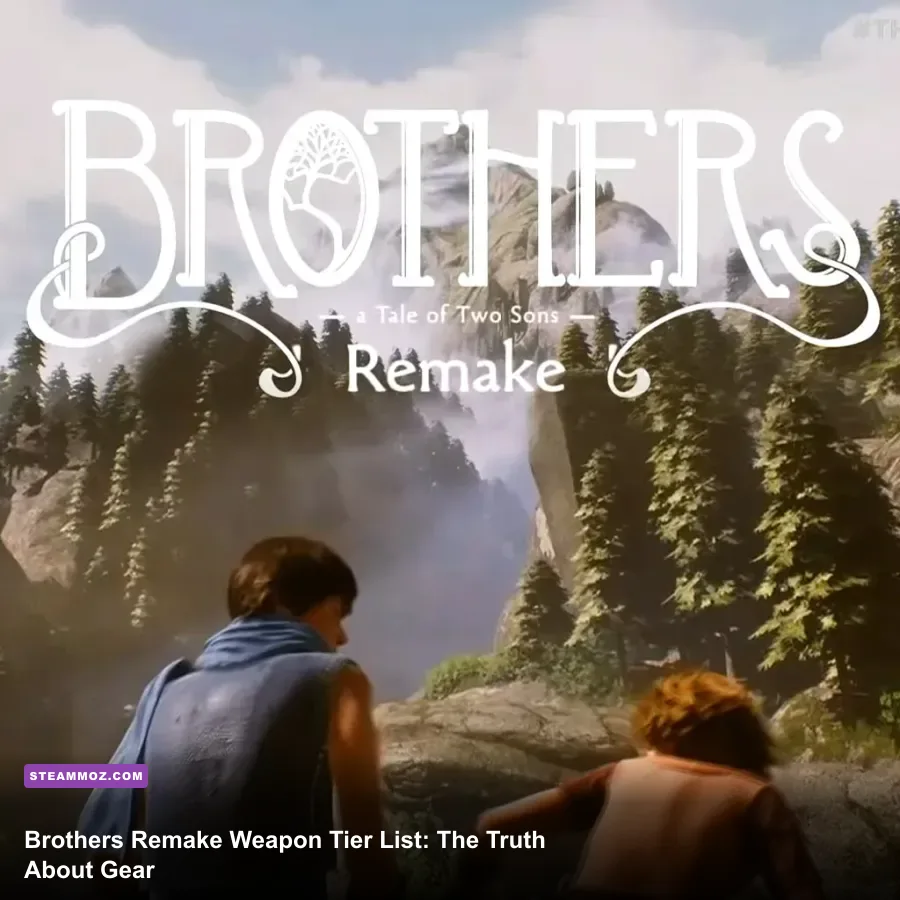
Brothers: A Tale of Two Sons Remake has no weapons, armor, stats, or equipment menu to rank. That is the most important answer for anyone searching for a weapon tier list. Naia and Naiee never collect swords, bows, shields, or damage upgrades; the remake is a story-driven puzzle adventure built around two fixed character abilities and whatever objects the environment gives you. If you want the best “equipment,” prioritize Naia’s strength and swimming, Naiee’s smaller size, the brothers’ combined interactions, and the temporary tools placed in each chapter. Ranked that way, the best option is almost always the ability that solves the current obstacle—not an item with higher numbers.
This distinction matters because guides that invent weapon damage, rarity, or gear drops are describing a different game. The official Steam listing presents the remake as a single-player or local co-op adventure. Its progression is environmental and narrative, with both brothers controlled simultaneously in solo play or split between two players in co-op. There is no combat build, loot screen, character level, or equipment economy waiting behind the next checkpoint.

🎮 Get Brothers: A Tale of Two Sons Remake
Ready to dive in? Grab your copy today for just $7.99.
Check OfferWhat the Brothers Remake weapon tier list really ranks
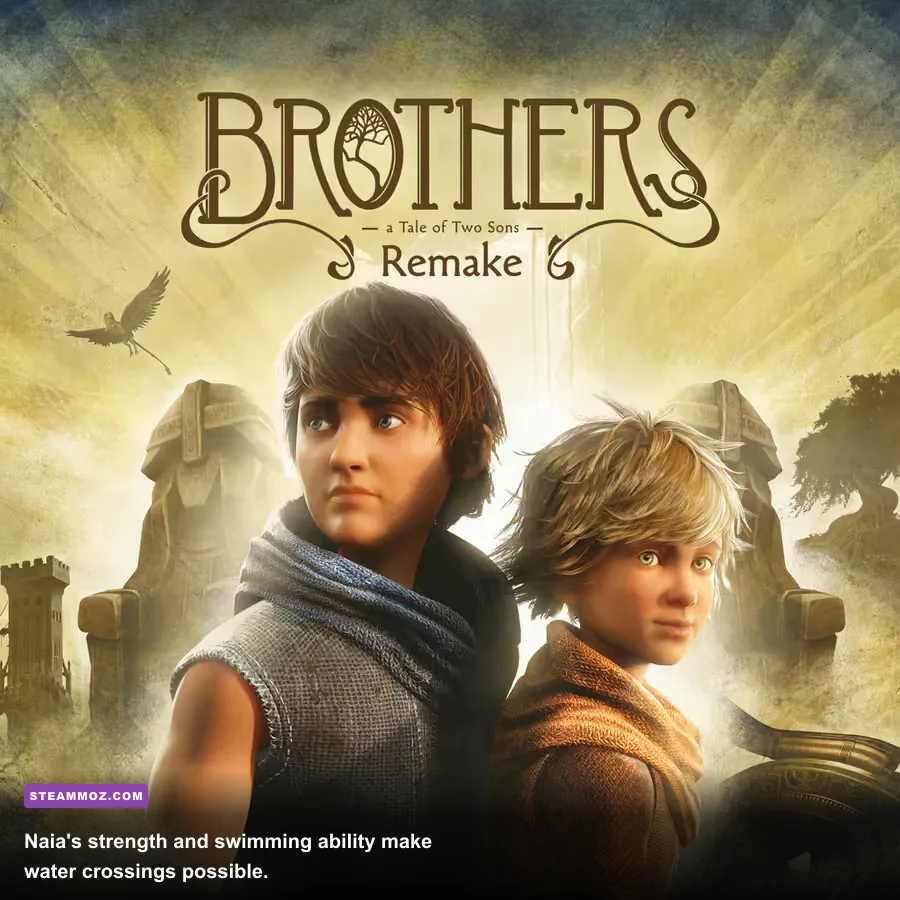
To make the search term useful without pretending the game has an RPG system, this ranking treats “equipment” as every repeatable gameplay tool and character function that lets you advance. The tier is based on three things: how often the ability is required, how many puzzle types it affects, and how badly progress stops when players misuse it.
| Rank | Ability or tool | What it does | Why it matters |
|---|---|---|---|
| S-Tier | Naia’s strength and swimming | Moves heavy objects, reaches water routes, carries Naiee | Required for major traversal sequences and several cooperative puzzles |
| S-Tier | Naiee’s small frame | Passes through narrow spaces and reaches child-sized routes | Unlocks paths Naia cannot access; often triggers the next puzzle state |
| S-Tier | Brother-to-brother boosts | Uses one brother as a lift or climbing aid | Converts the pair’s positioning into vertical progress |
| A-Tier | Levers, ropes, wheels, and handles | Changes gates, lifts, bridges, and machinery | Reliable environmental equipment, but useful only in its intended area |
| A-Tier | Boats and temporary transports | Moves the brothers through water or hazardous spaces | Excellent traversal tools with no lasting upgrade value |
| B-Tier | Optional village and wilderness objects | Enables side interactions, small scenes, and discoveries | Great for completionists, irrelevant to core progression |
| C-Tier | Imaginary weapon concepts | None; weapons are not part of the remake’s systems | Do not waste time searching for damage, rarity, or weapon vendors |
There are no hidden numeric stats behind these rankings. Naia does not become stronger after collecting a secret item, and Naiee does not gain a new attack after finishing a chapter. The remake’s “progression curve” is the player’s growing ability to read environmental clues, coordinate both characters, and understand which brother owns the relevant interaction.
🎮 Brothers: A Tale of Two Sons Remake
Looking to experience this game? Grab your digital key directly on our store for $7.99.
View on Steammoz Store →S-Tier abilities and the best way to use them
Naia’s strength and swimming
Naia, the older brother, is the practical powerhouse of the pair. His size and strength let him handle interactions that Naiee cannot, while his swimming ability turns water from a hard boundary into a route. When the brothers reach a shoreline, stream, or flooded passage, check Naia first. The correct solution is often to send him into the water, position him near the far side, and use him as the safe link for Naiee.
The carrying interaction is especially important. Naia can transport Naiee through water instead of asking the younger brother to make a risky crossing alone. That is not just a convenience: many sequences are designed around separating the brothers briefly, placing Naia in a strong position, and then bringing Naiee across once the route is secure. If you keep trying to force both characters through the same opening, you are probably ignoring Naia’s traversal role.
Strength also has a puzzle value beyond moving heavy objects. A lever may need continuous pressure, a mechanism may require a large handle, or a blocked route may demand a physical interaction. Naia should take the first pass at every oversized object. Naiee’s smaller body is not a weaker version of Naia; the two abilities are deliberately complementary.
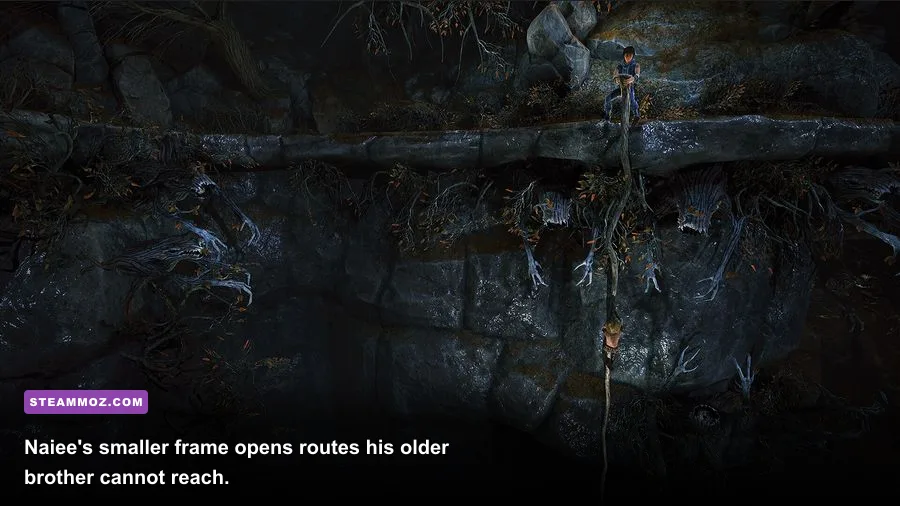
Naiee’s smaller frame
Naiee is the precision tool in this unofficial tier list. His smaller body allows him to slip through tight gaps and access routes that are visibly too small for Naia. Whenever the environment presents a low opening, bars, or a narrow side path, move Naiee toward it before experimenting with complicated machinery.
The best habit is to stop treating the brothers as one character with two sticks. Look at the scene from each brother’s perspective. Naia may be responsible for holding a wheel or activating a large mechanism while Naiee moves through the newly opened passage. In other situations, Naiee reaches the far side first and creates the access point that lets Naia continue. That order matters, and reversing it can make a simple puzzle feel broken.
Brother-to-brother boosts
Combined movement is the closest thing Brothers has to a signature “weapon combo.” The brothers can use one another to climb, reach elevated ledges, and cross gaps that neither could handle alone. The game normally frames these interactions clearly, but camera angles can hide the correct approach. If an obvious ledge sits just outside reach, position the stronger or taller brother below, then move the other into the interaction point rather than jumping repeatedly.
In solo play, use the two control sides deliberately. The remake’s standard control scheme lets you move each brother independently, so avoid rushing both sticks in the same direction. Place one character, release that input, and then adjust the second. This reduces accidental movement and makes timed lifts, simultaneous handles, and paired climbing sequences much easier.
A-Tier equipment: environmental tools that actually matter
Levers, ropes, wheels, and handles
These objects are A-Tier because they change the world state. They are not loot, but they function like equipment for the duration of a puzzle. A lever may open a gate, a wheel may reposition a bridge, and a rope may create a route between two platforms. Their value is absolute in the room where they appear and zero once that section is complete.
Before touching a mechanism, scan for its full consequence. Ask which brother can operate it, whether it needs to be held continuously, and what route opens when it moves. Many mistakes come from activating a lever and immediately following the most obvious path without noticing a second opening elsewhere. Brothers rewards observation more than speed, so take a few seconds to watch doors, lifts, bridges, and moving platforms after every interaction.
Boats and temporary transports
Boats and other transport objects rank highly because they remove hazardous traversal from the equation, but they are not upgrades. You will not keep a faster boat or unlock a reinforced hull. The object exists to get the brothers through one environmental challenge, then the game moves on.
Use transport sections as positioning puzzles. Keep both brothers aligned, watch the edges of the route, and avoid overcorrecting when the camera swings. In co-op, decide who handles movement before entering a narrow channel. Two players giving simultaneous corrections is a fast way to turn a calm crossing into needless restarts.
Why there is no combat loadout
Brothers includes danger, pursuit, and dramatic set pieces, but it is not structured around defeating enemies with a loadout. You are generally escaping, climbing, hiding, timing movement, or solving an environmental sequence. Searching for a “best weapon” for the troll, a wolf, or any other threat will send you in the wrong direction. Read the space, identify the safe route, and follow the brothers’ interaction prompts.
That design is also why there are no weapon-specific frame data, damage multipliers, elemental weaknesses, or critical-hit builds to optimize. If you are troubleshooting performance on PC, the useful target is stable frame pacing rather than a combat benchmark. Our PC crash and FPS fixes cover general Unreal Engine troubleshooting habits that can help when a game stutters, but they do not reveal a secret Brothers arsenal.
B-Tier discoveries and optional “equipment”
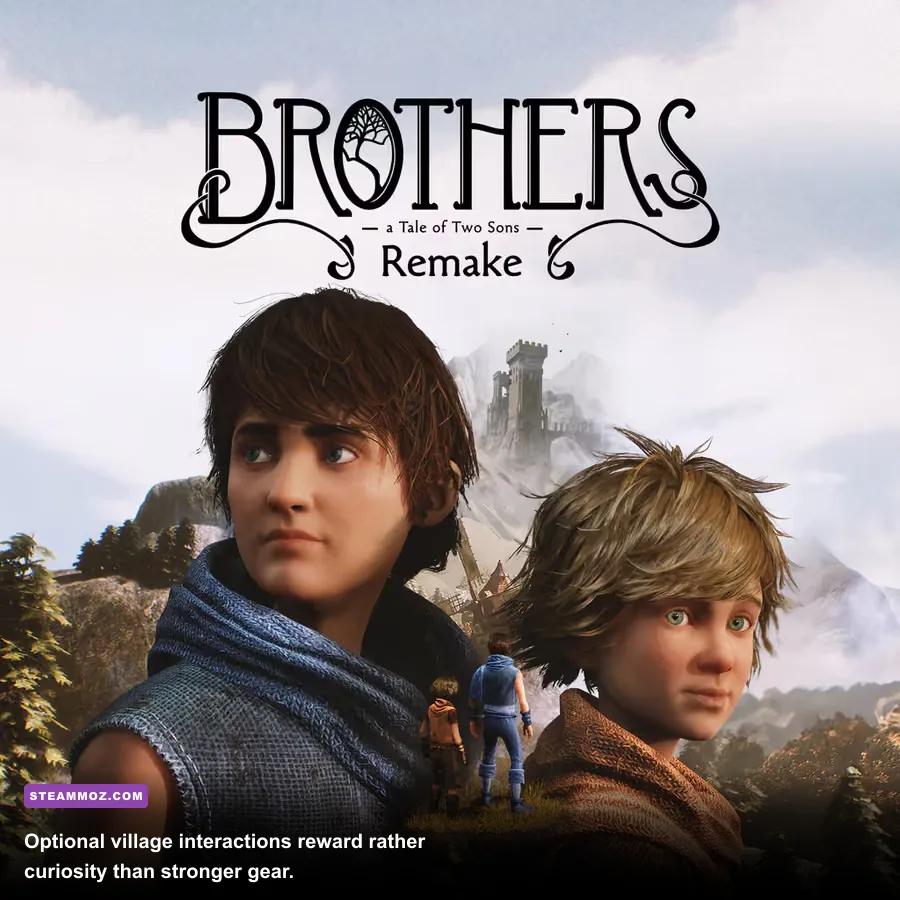
Optional objects and side interactions sit in B-Tier because they do not improve combat or traversal stats. They can trigger charming vignettes, environmental details, or achievements, and they are absolutely worth finding if you care about the remake’s world and completion percentage. They simply do not make the brothers more powerful.
The village is a good example. Speak to people, inspect unusual objects, and explore side paths before leaving an area. These moments are easy to miss if you sprint directly toward the next objective, especially when the camera points you toward the main route. There is no penalty for slowing down, and the game’s emotional impact is stronger when you allow these smaller interactions to breathe.
Use the same approach in wilderness areas. A suspiciously open side path, a distinct landmark, or an object separated from the main route is usually an invitation to investigate. Optional discoveries are often short, so they do not require a special build or a secret item. The real reward is context, not a stat increase.
For comparison, this is the opposite of a loot-driven adventure such as Everspace’s weapon economy or a shooter’s weapon tier system. Brothers wants you to notice people, places, and animation details. A collectible cannot increase Naia’s health because health upgrades are not part of the remake.
Best progression route for every chapter
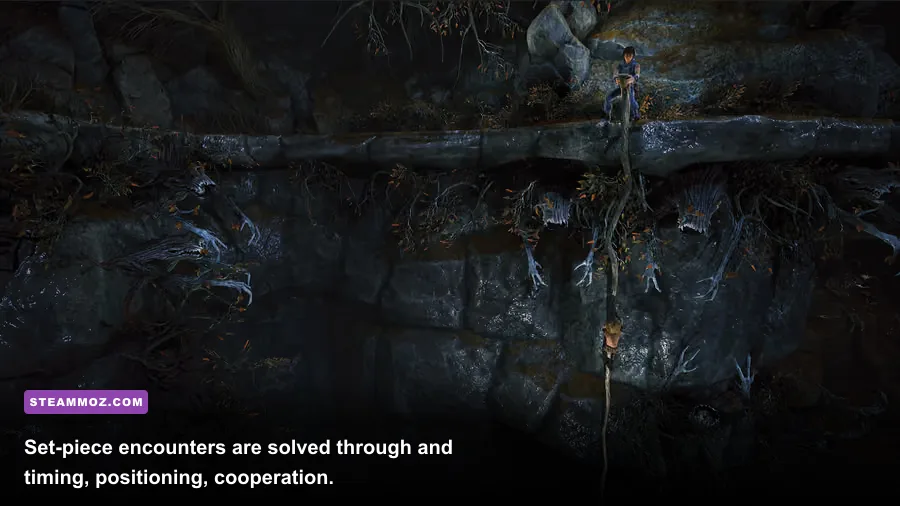
Step one: identify the blocked route
Start each new area by finding the obvious obstruction: a locked gate, high ledge, water crossing, heavy mechanism, or narrow passage. This tells you which ability the puzzle expects. Do not randomly pull every handle. First establish what must change, then search for the brother who can cause that change.
Step two: assign roles before moving
Use Naia as the strength, water, and heavy-object solution. Use Naiee as the narrow-route and access solution. If the obstacle is vertical, look for a brother boost. If it is horizontal and blocked by a gap, look for a side route for Naiee. If it involves water, position Naia first and bring Naiee through safely.
Step three: separate, then reunite
Many puzzles become easier once you accept that the brothers are supposed to split up. Send one through the opening, leave him in place, and return to the other. The game’s simultaneous control can make this feel awkward at first, but it is the central skill. In solo play, make small inputs and release the stick as soon as a character reaches the correct spot.
Step four: test the environment after every change
When a gate opens or a platform moves, stop and observe. Look above, below, and behind the brothers. The newly available route is not always directly in front of the character who activated the mechanism. If you are stuck, retrace the last object you touched and check what changed rather than assuming you need a new tool.
Players who enjoy methodical puzzle progression may also appreciate our hidden-reward guide for Dungeons 4, though Brothers is far less systems-heavy. There is no resource farming here, no upgrade currency, and no reason to replay a room for a stronger item.
Solo versus local co-op: which setup ranks highest?
| Play style | Best use | Main advantage | Main drawback |
|---|---|---|---|
| Solo | Story completion and precise puzzle control | You control both brothers and can pause to plan every position | Managing two characters takes practice, especially during timed movement |
| Local co-op | Shared first playthrough | Each player focuses on one brother and reacts naturally to the world | Communication problems can cause accidental movement and missed cues |
| Completionist solo | Optional discoveries and achievements | You can revisit areas at your own pace and inspect every side path | Constantly switching attention can slow exploration |
Solo play is arguably the strongest “build” because it gives you complete control over both halves of every puzzle. Assign one brother a position, release the input, and move the other. This approach is slower but extremely reliable. It also makes optional exploration easier because you do not need to coordinate a second person’s attention.
Local co-op is more immediate and often more memorable. The remake supports two-player control, allowing each person to inhabit one brother rather than juggling both. Agree on roles out loud: “Naia holds the wheel; Naiee goes through,” is enough to prevent most confusion. If the scene requires simultaneous movement, count down together instead of relying on guesswork.
For PC players, use a controller setup that gives both players consistent input and check the Steam system and controller information before starting. The remake’s presentation is built around Unreal Engine 5 lighting and environments, so a stable, responsive frame rate helps with platforming and timing even though there is no competitive combat. If your machine struggles, our settings guide for maximizing FPS explains the general order to lower demanding options: resolution scale and shadows usually matter more than small texture adjustments.
For official development context, check the 505 Games site and Avantgarden’s official website. Those sources are more useful than fan-made pages claiming that the remake contains a hidden sword tree or character-stat screen.
Final ranking: Naia’s strength and swimming, Naiee’s narrow-space access, and the brothers’ combined boosts are S-Tier. Levers, ropes, wheels, handles, and temporary transport objects are A-Tier environmental tools. Optional interactions are B-Tier for progression but priceless for players chasing the remake’s atmosphere. Everything else belongs in C-Tier because Brothers: A Tale of Two Sons Remake simply does not have weapons or permanent equipment. The best gear is the brother you have not positioned correctly yet.