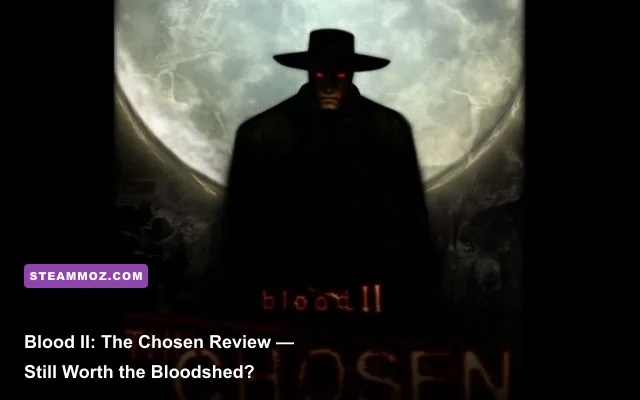
Blood II: The Chosen is worth playing in 2026—but only if you can tolerate a rough, inconsistent shooter that never reaches the terrifying brilliance of the original. Its gunplay still has bite, Caleb remains one of PC gaming's most entertaining antiheroes, and The Nightmare Levels expansion adds a worthwhile extra campaign. The catch is brutal: dated level design, awkward enemy behavior, occasional technical friction, and a story that feels more like connective tissue than a reason to keep playing.
That makes this a recommendation with conditions. If you want a polished retro FPS, start with these games like F.E.A.R. 2 instead. If you enjoy excavating flawed late-'90s shooters and learning their quirks, Blood II still offers enough personality and weapon experimentation to earn a place on your hard drive.
What Blood II gets right—and where it stumbles
Released by Monolith Productions in 1998, Blood II follows Caleb, the resurrected gunslinger from the first game, as he battles the Cabal and the deity Tchernobog's lingering influence. The setting shifts from the original's dusty occult western atmosphere toward a more industrial, cyberpunk-inflected city. That change gives the sequel a distinct identity, but it also strips away some of the first game's tight, haunted pacing.
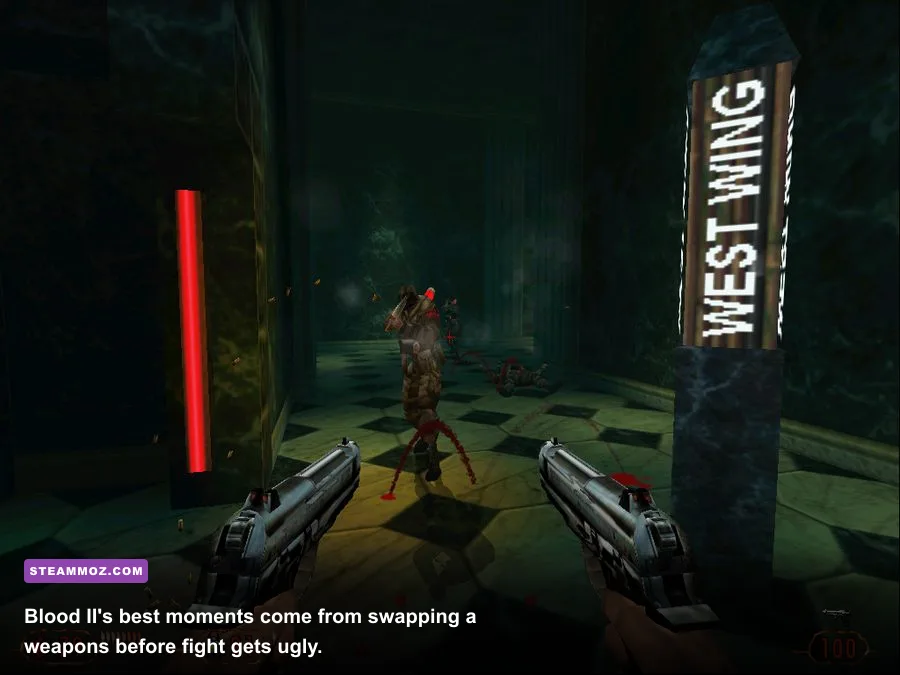
The strongest element is still the feel of the arsenal. Caleb's shotgun has the satisfying close-range punch you expect, while the Tommy Gun turns human enemies into a storm of hit reactions and debris. The Tesla Cannon is the real star: it rewards lining up groups and makes armored targets feel vulnerable without reducing every encounter to a hitscan lottery. The Napalm Launcher is less versatile, but its area denial is excellent in narrow corridors and stairwells.
Blood II also understands the pleasure of alternate fire. The shotgun's secondary mode fires both barrels, giving it a panic-button role that is powerful but expensive in ammunition. The flare gun is similarly useful beyond raw damage, especially when enemies are packed into rooms or hiding behind cover. You are constantly deciding whether to spend an explosive option now or save it for the next arena.
Unfortunately, the game often fails to frame those weapons inside equally strong encounters. Some rooms are smartly layered with vertical threats, explosive objects, and crossfire. Others are long, boxy corridors where enemies simply absorb punishment. Combat feels excellent when the level design creates pressure; it feels dated when the game asks you to clear another identical hallway.
| Weapon | Best Use | Main Weakness | 2026 Verdict |
|---|---|---|---|
| Shotgun | Close-range burst damage | Limited reach and ammo efficiency | Essential |
| Tommy Gun | Human targets and sustained fire | Burns ammunition quickly | Reliable workhorse |
| Tesla Cannon | Groups and tougher supernatural enemies | Rare ammunition | Top-tier weapon |
| Napalm Launcher | Chokepoints and area denial | Slow projectile and splash risk | Situationally excellent |
| Flare Gun | Softening clustered enemies | Weak against fast targets | Useful utility pick |
🎮 Blood II: The Chosen + Expansion
Looking to experience this game? Grab your digital key directly on our store for $0.99.
View on Steammoz Store →How the campaign feels after 25 years
Blood II's campaign is a study in uneven momentum. Caleb's one-liners and the grimy visual design keep the early hours moving, but the mission structure frequently loses focus. Objectives can feel arbitrary, key hunts sometimes slow the pace, and backtracking is more common than it should be in a shooter built around forward aggression.
The city, subway, factory, and occult-industrial spaces do have memorable ideas. You will move through environments that mix mundane infrastructure with grotesque supernatural threats, and the contrast occasionally lands perfectly. A cramped maintenance route can suddenly open into a wide combat space filled with elevated enemies and explosive hazards. Those moments show what the game could have been with another round of encounter polishing.
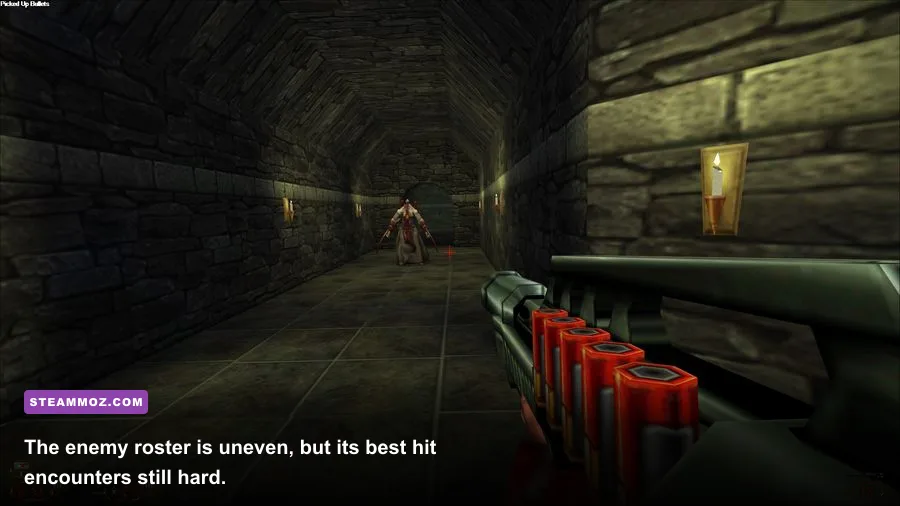
Enemy design is just as inconsistent. Cultists and other human opponents are readable enough, but their artificial intelligence can be erratic. Some enemies react convincingly to gunfire and repositioning; others stand in place, collide with scenery, or fail to pressure you. Supernatural enemies are more memorable visually than tactically. Gargoyles and similar flying threats can make open areas dangerous, but their movement sometimes feels floaty rather than threatening.
That is why difficulty selection matters. On easier settings, the campaign's weaker encounters become harmless target practice. On higher settings, ammunition management and enemy damage make the same spaces more interesting, but technical oddities become more punishing. Veteran players should begin above the default difficulty if they are comfortable with classic FPS conventions, while newcomers should avoid turning the first playthrough into an endurance test.
Compared with the original Blood, the sequel has less compact level rhythm and less consistent atmosphere. Compared with modern retro shooters, it has less precise movement and fewer quality-of-life features. Still, Caleb's weapon handling gives it a specific charm. It is closer to an experimental bridge between Build-engine brutality and late-'90s 3D action than a forgotten masterpiece.
Is The Nightmare Levels expansion worth buying?
The Nightmare Levels is worth playing if you already own Blood II, but it does not transform the base game. The expansion adds a new set of single-player levels, additional multiplayer content, and more chances to use the campaign's strongest weapons. Its best contribution is simply more Blood II: more industrial spaces, more Cabal opposition, and more opportunities for the arsenal to shine.
The expansion's biggest weakness is that it inherits the original's design problems. It does not suddenly make enemy AI sharper, movement smoother, or objectives clearer. The levels can feel like a bonus chapter rather than a confident second campaign. That is not necessarily a deal-breaker—many players will appreciate the extra maps—but expectations need to stay realistic.
Buy it as part of a bundle or collection, not as a premium standalone purchase. The value is strongest for players who finish the main campaign and still want more Caleb. Multiplayer is historically interesting, but the modern player base is too small to make it a serious reason to purchase the expansion in 2026. Treat that component as archival bonus material unless you already have friends ready to organize a session.
| Version | What You Get | Best For | Value in 2026 |
|---|---|---|---|
| Blood II base game | Full Caleb campaign and original multiplayer | First-time players | Good at a low price |
| The Nightmare Levels | Additional campaign and multiplayer maps | Players who finish the base game | Worth bundling |
| Original retail setup | Period-accurate experience with old PC quirks | Collectors and historians | Not recommended for convenience |
| Modern digital release | Fast installation and easier access | Most players in 2026 | Best starting point |
Before buying, check the official Steam listing for Blood II: The Chosen and confirm exactly which edition or bundle is being sold. Store packaging for older PC games can be confusing, and expansion availability may differ by storefront.
Best settings and fixes for playing Blood II in 2026

Blood II was designed for hardware radically slower than a current budget laptop, so raw performance is rarely the problem. Compatibility is. The original renderer, old display modes, input behavior, and operating-system assumptions can create more trouble than the game's modest geometry ever could.
Start with the digital version from a reputable storefront, run the executable with administrator permissions only if Windows blocks file access, and avoid forcing modern widescreen behavior before confirming that the game launches correctly. A stable 4:3 resolution can look better than a stretched image with broken menus. If you use a source port or community wrapper, change one setting at a time and keep a clean backup of the original configuration files.
Mouse sensitivity also deserves attention. Classic acceleration can make the game feel slippery, particularly during close-range shotgun fights. Lower sensitivity than you use in modern shooters, disable operating-system pointer enhancement, and test horizontal turning in a safe room before committing to a long session. Blood II's encounters reward fast target switching, but they do not require the extreme sensitivity common in competitive FPS games.
| Setting or Tweak | Recommended Value | Performance Impact | Visual or Gameplay Note |
|---|---|---|---|
| Display mode | 4:3 first, widescreen after testing | Negligible | Preserves menus and original framing |
| Resolution | 800x600 or 1024x768 for authentic scaling | Negligible | Higher modes may expose UI stretching |
| Texture filtering | Nearest or light filtering | Negligible | Nearest keeps sprites and surfaces crisp |
| Mouse acceleration | Off | None | Makes shotgun flicks more predictable |
| Frame pacing | Use a stable cap if your wrapper supports it | Low | Consistency matters more than high FPS |
For broader retro-PC troubleshooting, our guide to settings that actually fix low FPS covers the same basic rule: diagnose the wrapper and frame pacing before turning every visual option down. Blood II does not need a powerful GPU. It needs a clean, predictable software environment.
Final verdict: a flawed classic with real personality
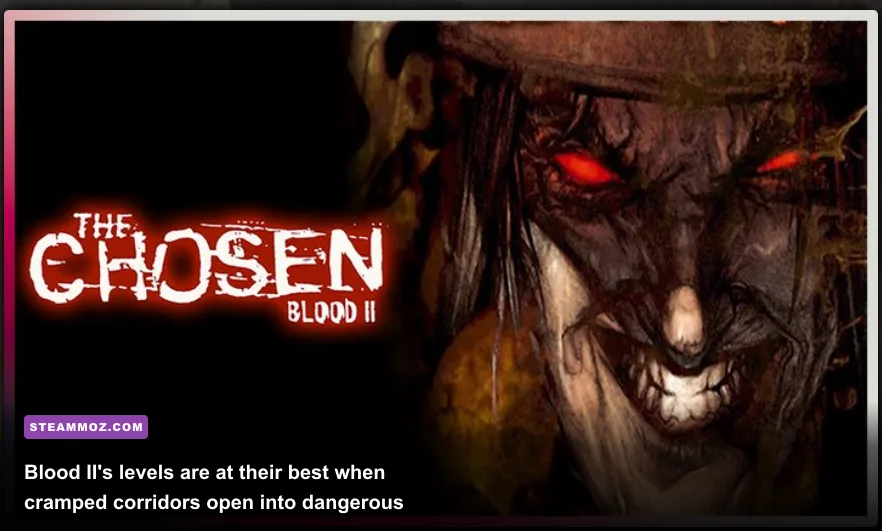
Blood II: The Chosen is not the hidden masterpiece that will suddenly replace Doom, Quake, or its own predecessor in your personal shooter canon. Its campaign drags, its enemy AI can be clumsy, and its late-'90s technology shows through in awkward ways. The Nightmare Levels adds quantity more reliably than quality.
But dismissing it outright would also be a mistake. Caleb's voice, the Tesla Cannon, the explosive weapon interactions, and the game's strange blend of occult horror and industrial science-fiction still create moments that modern shooters rarely replicate. When a room gives you multiple targets, limited ammunition, a useful chokepoint, and enough space to improvise, Blood II becomes wonderfully nasty.
My recommendation is a cautious 7/10 for retro FPS fans, with the expansion included if the price is low. Play it on PC, approach it as a historically interesting and mechanically uneven shooter, and keep your expectations below the original Blood's level. If you want a smoother modern experience, check out our ranked action-game recommendations or revisit these older games that still hold up.
Bottom line: Blood II is worth playing in 2026 for fans of classic PC shooters, especially when purchased with The Nightmare Levels in a cheap bundle. It is not essential, it is not consistently polished, and it absolutely requires patience—but its weapons and unapologetically weird personality still have teeth.
For reference, the Steam store page remains the easiest modern entry point, while the official Steam Community hub is useful for checking current player reports and compatibility discussions. If you want the developer and publisher history behind the game, the archived game listing provides additional release context.