Blackguards becomes dramatically easier once you stop treating it like a damage race. Save action points for positioning, build each companion around a clear job, exploit terrain and objectives, and use control effects before your biggest attacks. These ten tips cover the decisions that matter most, from the opening fights around Neetha to the campaign’s nastier arena battles.
Daedalic’s tactical RPG uses rules inspired by The Dark Eye, so a bad turn can snowball quickly. Attacks can miss, movement costs resources, enemies punish exposed targets, and healing is rarely strong enough to erase careless play. If you want a smoother first campaign, keep the Blackguards Steam page nearby for version details, then use these principles in every encounter.
1. Learn What Action Points Can’t Do
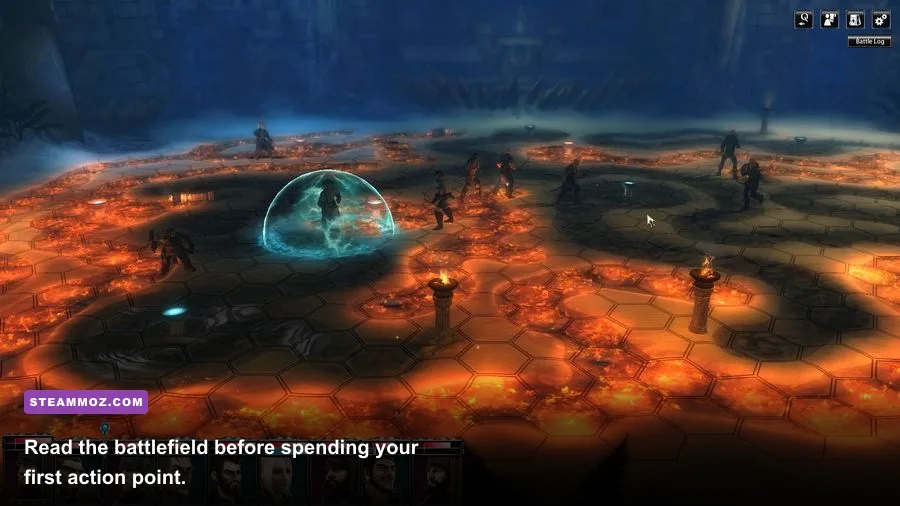
Action points, or AP, are the currency behind almost every meaningful turn. Moving, attacking, using abilities, and interacting with objects compete for the same limited pool. The beginner mistake is spending everything on a long approach, then discovering that the character has no AP left to attack or retreat.
Before moving, identify the turn’s priority. If an enemy can be killed with one attack, spend AP on that attack first and use leftover points to adjust position. If the target is out of range, move only as far as necessary. Don’t automatically run a fighter across the entire map just because an enemy is visible.
Ranged characters and mages need especially careful budgeting. A spell that fails to finish its target can leave the caster stranded in the open. Sometimes the best turn is a short move behind cover followed by a defensive action, not a low-percentage attack. Blackguards is happy to let you waste an entire round while an enemy closes the gap.

🎮 Blackguards
Looking to experience this game? Grab your digital key directly on our store for $0.99.
View on Steammoz Store →2. Build Every Character Around One Job
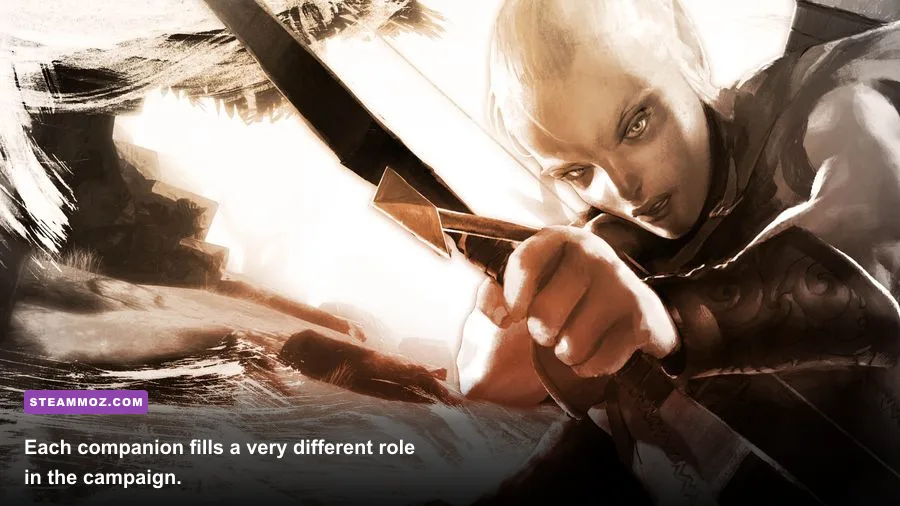
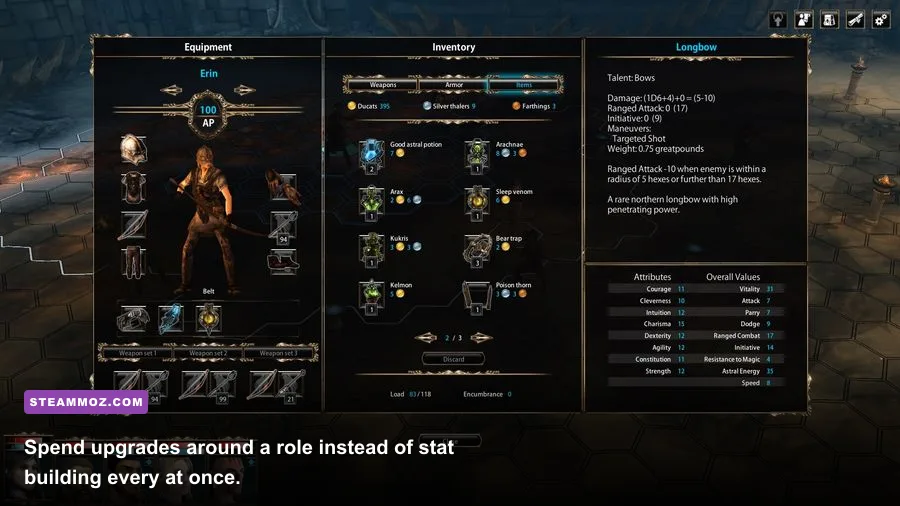
Blackguards gives you room to experiment, but spreading every upgrade across every weapon and talent creates mediocre characters. Decide whether a unit is a front-line bruiser, ranged attacker, healer, or controller, then spend points to reinforce that purpose.
Naurim is the obvious physical anchor. His dwarf identity and strong melee presence make him a natural fit for heavy weapons and close combat. Keep him in the lane where enemies must deal with him before reaching your fragile units. Takate works well as a mobile damage dealer who can reach vulnerable targets, while Zurbaran is best protected and developed around magic rather than used as a substitute melee fighter.
| Role | Priority | Useful Tools | Main Risk |
|---|---|---|---|
| Front-line bruiser | Weapon skill, durability, reliable melee damage | Naurim, heavy weapon attacks, defensive positioning | Being surrounded or isolated |
| Mobile striker | Attack skill, mobility, target access | Takate, flanking routes, finishing weakened enemies | Ending a turn inside enemy range |
| Ranged attacker | Ranged weapon skill, accuracy, safe sight lines | Bow attacks, elevation, choke points | Low damage when enemies reach them |
| Mage or support | Intelligence, spell access, resource management | Ignifaxius, Balsam Salabunde, Armatrutz | Wasting actions on low-impact casts |
Before buying an upgrade, ask what problem it solves. More damage is useful, but a character who cannot reach a target, survive one hit, or land a spell still needs a different investment.
3. Spend Early Talent Points on Reliability
New players often chase flashy abilities and ignore the less exciting upgrades that make turns dependable. In Blackguards, a missed attack at the wrong moment is not just lost damage; it can leave an enemy alive to surround an ally or activate an objective.
Prioritize the weapon category your character actually uses. A melee fighter should not divide early points between swords, axes, and ranged weapons. Pick one lane and make its attacks trustworthy. The same logic applies to magic: build Zurbaran toward a small collection of useful spells instead of unlocking everything and lacking the power or resources to cast any of it well.
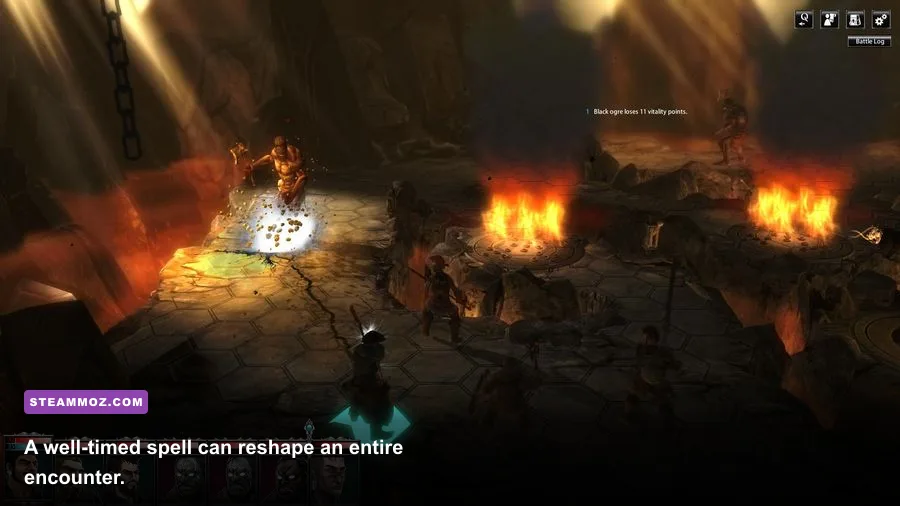
Control and support abilities can outperform raw damage. Armatrutz is valuable before a dangerous exchange because preventing damage is better than repairing it afterward. Balsam Salabunde helps stabilize a wounded ally, while Ignifaxius gives your mage a direct answer to a priority target. Don’t cast simply because the spell is available. Cast when it changes the next enemy turn.
4. Treat Terrain as a Weapon
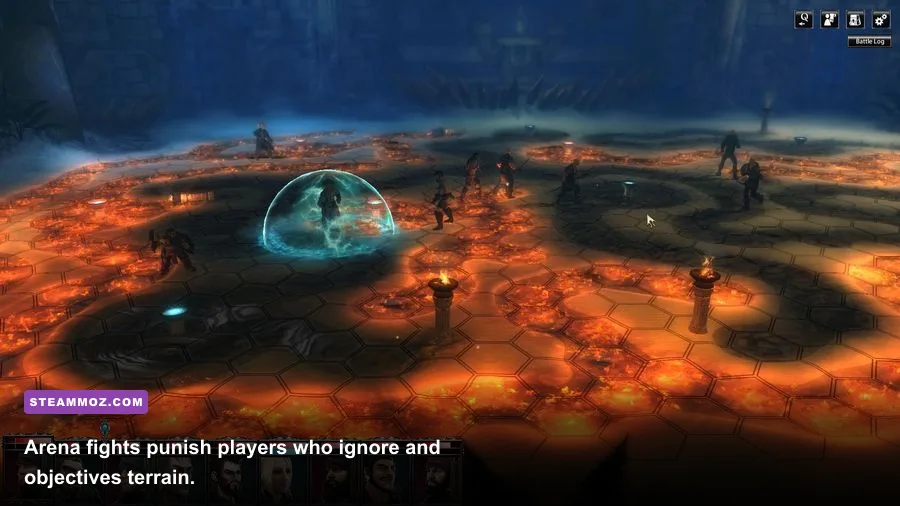
Battlefields in Blackguards are puzzles disguised as arenas. Barrels, crates, fences, elevation, narrow passages, hazards, and interactive objects can matter more than a few points of weapon damage. Walk the map mentally before committing the party.
Use Naurim to hold a doorway or narrow route while ranged units attack around him. Keep fragile characters behind obstacles whenever line of sight allows it. A choke point reduces the number of enemies able to attack at once, which effectively gives your party extra turns. If a map contains explosive objects or environmental hazards, test whether they can be triggered before sending a character into melee.
Elevation and line of sight deserve special attention. A perfect firing lane is worthless if the shooter must spend the next turn moving into it. Conversely, a mage tucked behind a corner may survive longer but lose access to every useful target. The best position is usually one that offers an attack now and an escape route next turn.
5. Focus Fire Instead of Spreading Damage
Four injured enemies are usually more dangerous than one dead enemy and three untouched ones. Focus the whole party on the target that can be removed fastest, especially if it is a ranged attacker, spellcaster, or unit standing close to an exposed ally.
Start by checking health, armor, distance, and likely hit chance. Let the most reliable attacker open, then use weaker or more expensive attacks only if they can finish the target. Don’t spend a high-cost spell on an enemy that Naurim can already kill with a normal swing.
This is also where Takate’s mobility matters. He can threaten weakened targets that would otherwise survive behind the front line. Keep a route open so his finishing move doesn’t become a suicide run. If a kill is impossible, switch to the next-best objective: disable a caster, block a corridor, or retreat outside counterattack range.
6. Save Before Every Dangerous Choice
Blackguards is old-school about consequences. A fight can look comfortable until a missed attack, unlucky critical hit, or badly chosen movement order turns it into a reload. Save before entering a new battle, before an arena challenge, and before spending a large amount of money or experience.
Use quick saves during difficult encounters, but don’t reload every single miss automatically. Reload when the plan failed because of a mistake: a mage was exposed, a character crossed a hazard, or you committed AP before checking the objective. If you reload until every attack lands, you’ll learn less about the encounter and make later battles harder than they need to be.
Check the victory condition as soon as combat begins. Some encounters care about survival, reaching a location, protecting a unit, or interacting with an object rather than killing every enemy. A perfect wipe can still be the wrong strategy if it burns your healing and leaves the party out of position for the actual objective.
7. Use Companions as Specialists
Your campaign party is more flexible when companions aren’t forced into identical builds. Naurim can absorb pressure, Takate can exploit openings, and Zurbaran can support the group with magic. The protagonist should fill the gap your current roster lacks instead of copying the strongest existing role.
A second melee character can make early battles safer, but too many front-line units create traffic jams on narrow maps. Likewise, several ranged characters may look powerful until enemies close the distance. A balanced party normally wants at least one durable blocker, one dependable damage dealer, one source of healing or protection, and one character who can attack from a safe angle.
Equipment should follow the same rule. Give the best weapon to the character with the skill to use it effectively, not automatically to whoever has the highest level. A slightly weaker weapon in trained hands is often more valuable than a powerful item attached to a character who misses constantly.
8. Don’t Hoard Healing and Defensive Magic
Healing feels expensive because resources are limited, but refusing to use it creates a worse economy. A wounded character deals less effective damage when forced to retreat, and a near-death unit can make the whole formation collapse. Use Balsam Salabunde when restoring an ally keeps them active and safe; don’t wait until the target is one hit from defeat.
Defensive spells such as Armatrutz are strongest before the enemy’s burst turn, not after it. Put protection on the character who must hold a choke point or draw attacks. If a spell’s effect lasts several rounds, cast it while the party is about to enter the engagement rather than spending a turn in the middle of a crisis.
Carry conventional healing items as a backup for moments when the mage needs to attack or control instead. A support character who spends every round repairing damage is often treating the symptom. Better positioning, focus fire, and protection prevent more damage than another emergency heal.
9. Handle Arena Battles Like Puzzles
The arena portions can be harsher than normal story fights because they combine unusual objectives, hazards, and enemy waves. Don’t rush toward the center. Identify spawn points, interactable objects, escape lanes, and the position where your party can concentrate fire.
Read enemy behavior for one round if the objective allows it. Some opponents commit to predictable routes, while others reveal themselves as melee threats or ranged support. Open with control, terrain denial, or a defensive buff rather than immediately scattering the party. Once the arena’s rhythm is clear, remove the unit that most threatens your formation.
If a scenario asks you to survive, survival is the victory condition. Retreating behind a choke point and using ranged attacks is not cowardice; it’s the correct solution. For more tactical RPG recommendations, Steamoz’s guide to saving your convoy in Badlands Crew applies the same useful rule: protect the objective before chasing kills.
10. Fix Performance Before It Ruins Combat
Blackguards is not demanding by modern standards, but older PC games can behave badly with unusual resolutions, overlays, or display scaling. Stable input and readable movement tiles matter in a turn-based game, so don’t accept stutter or blurry UI as harmless.
| Setting or Fix | Recommended Starting Point | Why It Matters | Trade-Off |
|---|---|---|---|
| Resolution | Native monitor resolution | Keeps text and tactical markers sharp | Higher GPU load on integrated graphics |
| Display mode | Fullscreen first, borderless if needed | Can reduce focus and scaling problems | Alt-tab behavior varies by system |
| V-sync | Enable if tearing appears | Produces a cleaner battlefield image | May add input latency |
| Overlays | Disable unnecessary overlays | Reduces compatibility conflicts | You lose overlay shortcuts |
| Windows scaling | Test 100% or application override | Improves older UI scaling issues | May affect other applications |
Keep the game updated through its official Steam listing, and check Daedalic Entertainment’s site if you need publisher information. If your wider library suffers from frame-rate problems, Steamoz’s A Year of Rain settings guide and Aragami: Nightfall performance guide offer useful troubleshooting habits.
The Winning Blackguards Mindset
Blackguards rewards preparation, not panic. Build specialists, preserve AP, use Naurim to control space, let Takate finish exposed targets, and keep Zurbaran protected until a spell can swing the fight. Focus fire, respect objectives, and reload for genuine tactical mistakes rather than every unlucky dice roll.
Most importantly, inspect the map before acting. The strongest move is often the one that prevents the enemy’s next turn from happening: a blocked corridor, a dead caster, a protected ally, or a retreat that preserves your formation. Once you start seeing battles that way, Blackguards stops feeling unfair and starts feeling like the sharp, demanding tactical RPG it was built to be.