
Yes, Biped 2 is worth playing in 2026—but mainly if you have a patient co-op partner and a controller for each player. Its independent-leg controls remain wonderfully unusual, the colorful platforming is easy to read, and the sequel expands the cooperative format without burying it under RPG systems or busywork. Solo players get a clever physics platformer, but the real magic is watching two robots fail the same jump in completely different ways.
Biped 2 follows the same basic idea as the original: you control a cute two-legged robot, with each leg mapped separately to an analog stick. Walking is not a normal left-stick action. You push, place, and recover each foot, then use that awkward rhythm to cross gaps, climb routes, activate mechanisms, and survive moving platforms. The result feels closer to operating a tiny pair of mechanical stilts than playing a conventional mascot platformer.
That concept still carries the game. Biped 2 does not need a weapon tier list, a character build, or a damage spreadsheet because there are no traditional weapons, stats, or skill trees driving progression. Its challenge comes from momentum, positioning, timing, and communication. If that sounds refreshing, the game has a lot to offer. If you want combat depth or a long-term progression treadmill, look elsewhere.

What makes Biped 2 different from other platformers?
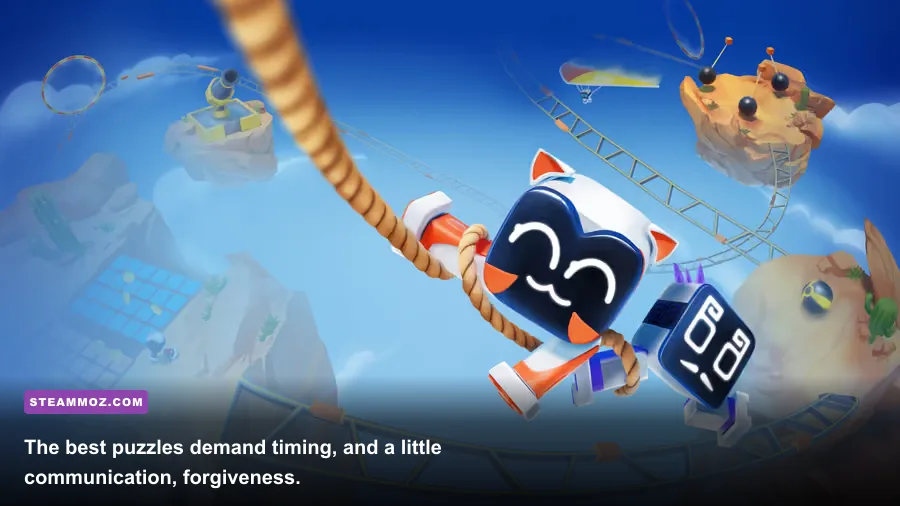
The defining mechanic is simple to explain and surprisingly difficult to master: each analog stick controls one leg. Your robot's body follows the feet, so a bad step can leave you leaning, sliding, or completely off-balance. The control scheme creates a constant conversation between intention and recovery. You may know exactly where you want to go, but the game still asks whether you can place both feet there without toppling.
That makes ordinary actions feel fresh. Crossing a narrow bridge is no longer a matter of holding forward. You need to alternate your legs, keep the robot's center of mass over the surface, and avoid overcorrecting when the camera shifts. On slippery surfaces, the same input produces a different result, so muscle memory helps—but never completely solves the problem.
In co-op, both players occupy the same puzzle space and must coordinate their movement. One player might need to hold a pressure plate while the other crosses a rotating platform. Another sequence may require both robots to move in rhythm, use shared objects, or avoid knocking each other into a hazard. The game is at its best when the solution is obvious but execution is just awkward enough to make success feel earned.
| Core element | How it works | Why it matters |
|---|---|---|
| Independent legs | Each analog stick places one foot | Creates Biped 2's distinctive movement challenge |
| Shared puzzles | Players activate, carry, or time objects together | Turns communication into a gameplay tool |
| Physics traversal | Momentum and footing affect movement | Makes familiar platforming feel unpredictable |
| Visual customization | Robots can be personalized with cosmetic items | Adds personality without changing combat power |
The important distinction is that Biped 2 is not difficult because enemies have huge health bars or because checkpoints are stingy. It is difficult because your hands are learning a new language. The first hour can feel clumsy. After that, your brain starts reading a ledge, a slope, or a moving platform in terms of foot placement rather than simple directional movement.
🎮 Biped 2
Looking to experience this game? Grab your digital key directly on our store for $8.24.
View on Steammoz Store →How good is Biped 2 in solo and co-op?
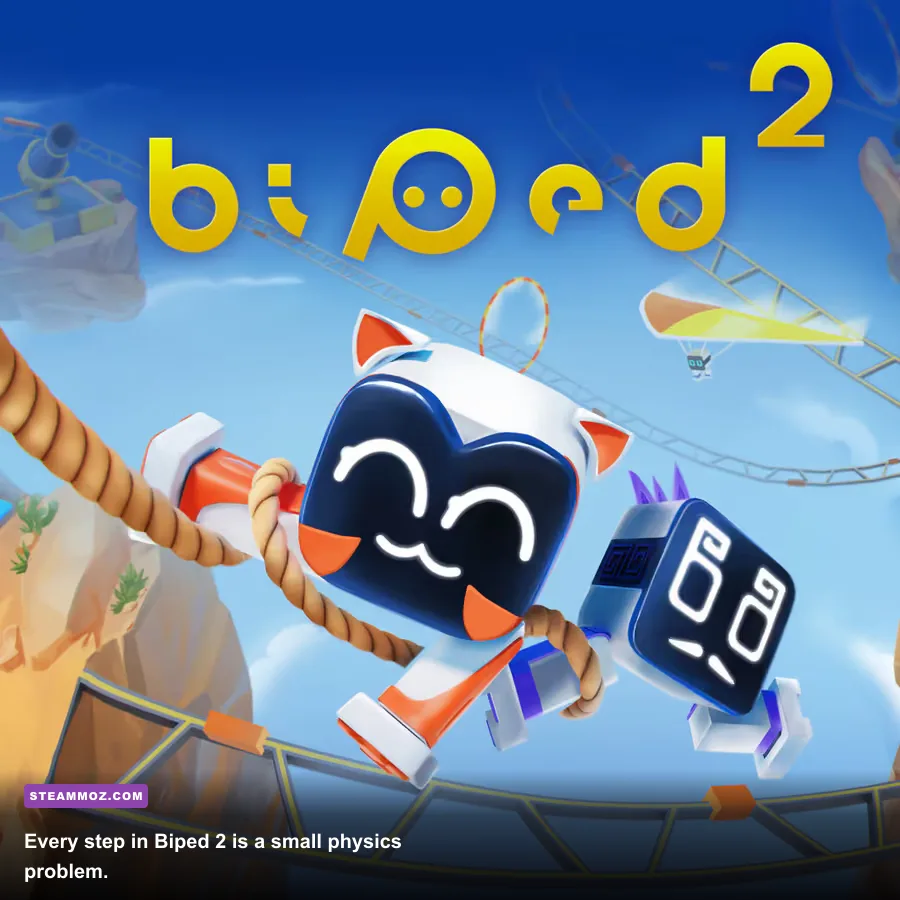
Solo play is perfectly viable, and it is the cleaner way to learn the controls. You can focus on one robot, study each route, and repeat a troublesome crossing without negotiating every mistake with another person. For players who enjoy precision platforming, solo mode can feel almost meditative once the controls click.
Still, solo play exposes the limits of the formula. Some cooperative moments are naturally more entertaining when another human is making decisions beside you. The humor comes from shared panic: one player reaches a platform, the other swings wide, and suddenly the rescue attempt becomes a second disaster. That kind of chaos is difficult to reproduce with a solo experience.
Local co-op is the strongest format because communication is immediate. You can point at the route, call out a timing cue, or simply yell when your partner moves too soon. Online co-op is more convenient for distant friends, but the small delays and less precise communication can make already-finicky movement feel harsher. Use voice chat if you play online; silent coordination is needlessly frustrating here.
The game also works best with two players who are willing to swap roles and experiment. Biped 2 is not a traditional competitive co-op game where one player carries the team. A confident player can explain timing, but they cannot directly fix the other robot's footing. That is a strength. Each person has to understand the movement system.
Before buying, check the current Steam store listing for the latest multiplayer details, controller support, and platform availability. A controller is strongly recommended. Keyboard input can work for some players, but the analog precision required for small foot placements is much more comfortable with sticks.
Does Biped 2 have enough content for the price?
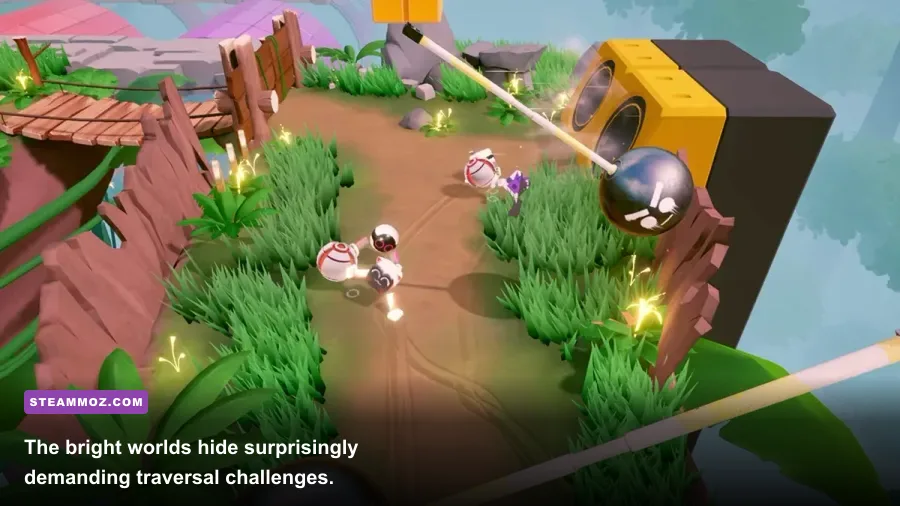
Biped 2's campaign is built around replayable traversal rather than a huge open world. You move through colorful stages, solve environmental puzzles, collect optional items, and revisit difficult sections to improve your execution. That structure keeps the pace brisk, but it also means the game is better measured by the quality of its challenges than by raw hour count.
Most of the meaningful progression happens in your hands. There is no conventional experience-level curve that turns a failed jump into a solved one through better equipment. You improve because you learn how far a leg can reach, when to stop pushing an analog stick, and how quickly the robot regains balance after a stumble. That makes repeat attempts satisfying rather than pointless.
Optional collectibles and cosmetics provide a reason to replay stages, though they are not a substitute for a deep endgame. Completionists will get more value from mastering routes and collecting everything than players who only want to rush from beginning to end. If you are comparing Biped 2 with a 30-hour action game, its campaign may feel compact. If you are comparing it with a focused co-op puzzle game, the length is much easier to accept.
| Player type | Expected value | Best way to play |
|---|---|---|
| Solo platforming fan | High | Use campaign repetition to master movement |
| Local co-op group | Very high | Play with two controllers and voice communication |
| Online friends | High, connection-dependent | Use voice chat and agree on timing cues |
| Completionist | High | Replay stages for collectibles and cleaner runs |
| Combat-focused player | Low to moderate | Only buy if movement puzzles sound appealing |
That compact design is also why the sequel avoids the padding that hurts many co-op games. There is less incentive to grind, fewer systems competing for your attention, and a clearer sense of what each level wants you to learn. For more co-op recommendations, our coverage of Badlands Crew's convoy-saving tips shows a very different kind of teamwork built around planning rather than footwork.
How does Biped 2 perform on PC?

Biped 2's clean, stylized presentation is a good fit for modest gaming PCs. The environments are colorful rather than photorealistic, and the readable shapes help you identify platforms, hazards, switches, and interactive objects quickly. That clarity matters more than cinematic detail because a busy background can make a narrow landing harder to judge.
For most players, a stable 60 frames per second is the right target. Smooth input makes balancing easier, especially when you are correcting a slide or stepping onto a moving surface. Higher refresh rates can make camera movement feel nicer, but they will not compensate for a poor controller connection or inconsistent frame pacing.
| Setting profile | Recommended use | Performance effect | Visual trade-off |
|---|---|---|---|
| 1080p, medium preset | Older gaming laptops | Lowest load | Reduced lighting and effects |
| 1080p, high preset | Most mainstream PCs | Moderate load | Sharper environment detail |
| 1440p, high preset | Modern mid-range GPUs | Higher GPU load | Cleaner edges and wider detail |
| 60 FPS cap | Reliable puzzle play | Improves consistency | Limits high-refresh output |
| V-sync enabled | Displays prone to tearing | May add slight latency | Cleaner image during camera movement |
Don't chase maximum settings before checking input latency. If your PC is struggling, lower resolution or shadows first, then keep the frame rate stable. Our Bionic Dues performance settings guide covers the same general principle: consistent frame delivery is often more valuable than a prettier screenshot.
For troubleshooting, start with the basics: update your GPU driver, disconnect unused controllers, test another USB port, and verify the game's files through Steam. If the game crashes or stutters, our guides to Beacon Pines PC fixes and BioShock Infinite PC fixes offer useful general Windows troubleshooting steps.
Who should play Biped 2 in 2026?
Biped 2 is an easy recommendation for two people who want a co-op game that feels genuinely different. Its independent-leg controls are not a gimmick that disappears after the tutorial; they shape every bridge, button, slope, and moving platform. The sequel earns its name by making cooperation part of the physical problem, not just a second character added to the screen.
It is less convincing as a purchase for solo players who dislike repetition. Failed attempts are part of the experience, and the game expects you to learn through awkward movement rather than unlock a stronger ability. There is also no combat system to break up the traversal. If your ideal co-op session involves weapons, builds, or enemy encounters, you may prefer something like the ranked loadouts in our Borderlands 3 weapon guide.
The final verdict is a solid 8/10 for co-op players and a more conditional 7/10 for solo players. Biped 2 is charming, inventive, and refreshingly focused, but its appeal depends almost entirely on whether you enjoy learning an unusual control scheme. Buy it for the laughs, the teamwork, and the satisfying moment when a route that seemed impossible suddenly becomes routine. Skip it if you want a combat-heavy adventure or a long progression system.
For official information, compare the current release details on the official Steam page and follow updates from NEXT Studios. In 2026, Biped 2 remains a small but memorable co-op platformer—one where the funniest failures are usually the ones you create together.