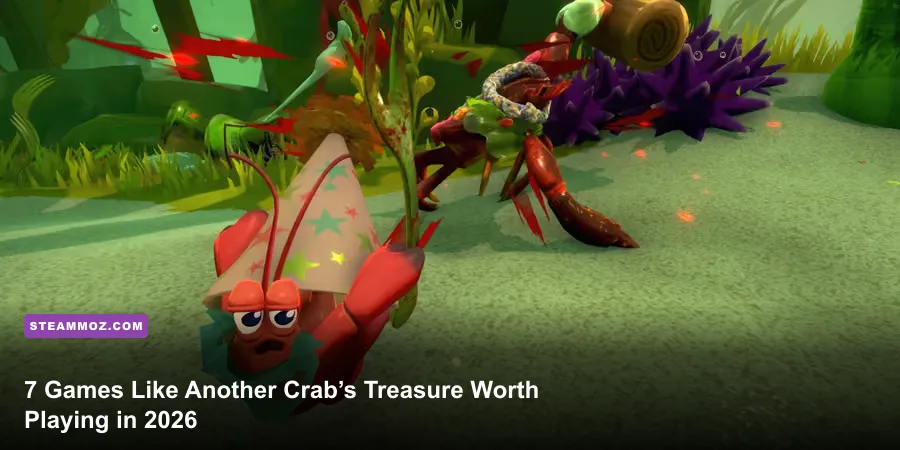
If Another Crab’s Treasure hooked you with forgiving Soulslike combat, inventive shell swapping, and a surprisingly sharp environmental message, start with Lies of P, Tunic, and Death’s Door. They capture the same satisfying loop of learning enemy patterns, finding clever upgrades, and pushing through colorful worlds, while Sekiro is the best choice for players ready for a much tougher skill check and Elden Ring is the obvious pick for build freedom.
Another Crab’s Treasure is unusual because it doesn’t simply copy Dark Souls. Kril’s shells act as armor, each shell has its own defense value and special ability, and the Umami system lets you equip magical adaptations such as Electrocute, Bubble Bullet, and Fin Attack. Losing your shell changes the rhythm of a fight immediately. That mix of comedy, accessibility, and real mechanical depth is what these recommendations are chasing.
For a broader look at demanding action RPGs, our coverage of Dungeon Siege’s classic RPG design is worth a detour. It’s a different kind of adventure, but it shows how much atmosphere and build experimentation can carry a long campaign.
The best games like Another Crab’s Treasure at a glance
The table below ranks these games by the specific parts of Another Crab’s Treasure they replicate. This isn’t a list of games that merely contain swords and difficult bosses. The strongest matches offer a similar combination of readable encounters, meaningful exploration, and a world with a strong visual identity.
| Game | Closest shared feature | Difficulty | Best for |
|---|---|---|---|
| Lies of P | Precision dodges, parries, shortcuts, boss learning | High | Players wanting a polished traditional Soulslike |
| Tunic | Secrets, exploration, compact dodge combat | Medium to High | Players who love discovering systems themselves |
| Death’s Door | Colorful world, fast attacks, approachable progression | Medium | Players wanting a shorter, cleaner adventure |
| Elden Ring | Build variety, exploration, optional bosses | Variable | Players who want hundreds of hours of freedom |
| Sekiro | Telegraph reading and aggressive defense | Very High | Players who want mastery over character stats |
| The Last Hero of Nostalgaia | Satirical Soulslike structure and equipment | High | Players who want comedy with their corpse runs |
My overall order for a newcomer is Lies of P first, Tunic second, and Death’s Door third. That sequence gradually raises the mechanical demand without throwing you straight into Sekiro’s posture system. If what you loved most was Kril’s ridiculous personality and the ocean-plastic satire, The Last Hero of Nostalgaia is the funniest follow-up, even though its combat and level design are rougher.

🎮 Another Crab's Treasure
Looking to experience this game? Grab your digital key directly on our store for $11.99.
View on Steammoz Store →Lies of P is the closest full Soulslike replacement

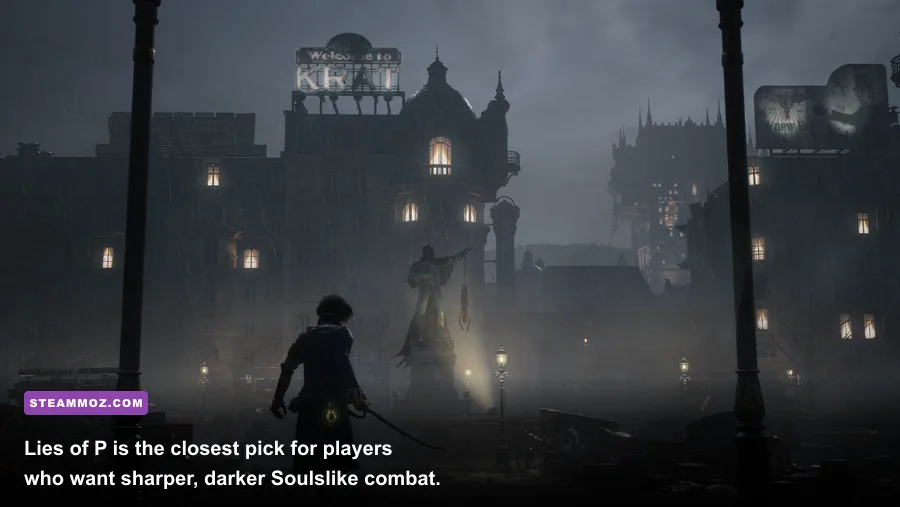
Lies of P on Steam is the strongest recommendation if you want Another Crab’s Treasure’s combat loop, but with a gothic setting, heavier weapons, and more demanding bosses. You play as Pinocchio in Krat, a puppet navigating a city destroyed by the Puppet Frenzy. The story is more theatrical than funny, yet both games understand that a memorable setting can make repeated deaths feel worthwhile.
Why the combat feels so good
Lies of P rewards three defensive answers: guarding, perfect guarding, and dodging. A normal guard reduces incoming damage but leaves you with recoverable health; landing attacks soon after lets you regain that lost portion. A perfect guard, triggered by pressing guard at the impact moment, prevents the hit and builds the enemy’s stagger meter. Once the enemy’s health bar gains a white border, a heavy attack can create a Fatal Attack opening.
That system makes the game more deliberate than Another Crab’s Treasure. You can’t casually mash light attacks and expect a shell ability to bail you out. Against the Scrapped Watchman, for example, the key is to perfect-guard the first phase’s broad electric baton swings, then create space when the boss starts charging. In phase two, the lightning-infused body slam has a clearer audio cue than its visual animation, so listening matters.
Build advice for a first playthrough
Use the Motivity path if you like Kril’s heavier shell weapons, or Technique if you prefer fast pokes and quick recovery. The Electric Coil Stick Head and Handle is excellent against early puppets because electric damage fills the Shock status quickly. Later, the Live Puppet’s Axe Blade paired with a fast handle gives you high stagger potential without committing to the slowest animations.
Spend Quartz in the P-Organ on extra Pulse Cell capacity, guard regain, and stagger-window improvements before chasing flashy bonuses. That progression is less instantly readable than shell swapping, but it pays off over a full campaign. If you want another demanding sequel with a bleak tone, compare it with our Don’t Be Afraid 2 review.
Tunic turns exploration into the real boss fight

Tunic looks like a cute Zelda-inspired adventure starring a tiny fox, but don’t let the isometric camera fool you. Its combat can be brutally exact, and its most rewarding puzzles depend on information you discover in the game’s partially translated instruction manual. That makes it a terrific match for Another Crab’s Treasure players who enjoyed finding hidden routes, optional upgrades, and odd tools rather than following a straight critical path.
How Tunic differs from a normal Soulslike
The fox has a sword, shield, dodge roll, and stamina bar. Holding the shield slows movement and consumes stamina when it blocks, while a mistimed dodge leaves you exposed. Enemies telegraph attacks clearly, but arenas are often cramped enough that camera positioning becomes part of the challenge. The Garden Knight is the early reality check: its long sword sweeps punish panic rolls, while its lunge gives you a safe counterattack window if you stay just outside its reach.
Rather than collecting a dozen weapons, you improve through permanent stat upgrades, consumables, and pages of the manual. Some pages reveal obvious instructions, while others quietly explain hidden rules. The ice dagger can slow targets, bombs create different damage profiles, and magic requires careful resource management. The game’s late secrets go far beyond normal treasure-chest hunting, so keep screenshots or notes when a page seems to describe a strange symbol.
Tunic is also the best choice here for players who want discovery without a huge open world. The Overworld, East Forest, Ruined Atoll, and Quarry are compact, interconnected spaces. You’ll repeatedly revisit them with new knowledge rather than simply unlocking a larger map marker. That design gives every shortcut more personality.
| Tunic tool | Best use | Main risk | Practical tip |
|---|---|---|---|
| Shield | Blocking physical strings | Stamina drain and slow movement | Release it before the final hit to preserve stamina |
| Ice Dagger | Slowing aggressive enemies | Limited magic resource | Save casts for elite targets and bosses |
| Fire Bomb | Reliable ranged damage | Slow throw animation | Throw after a boss whiffs a heavy attack |
| Dodge Roll | Evading unblockable attacks | Bad timing causes full damage | Roll toward wide swings, not directly away |
Death’s Door is the approachable pick

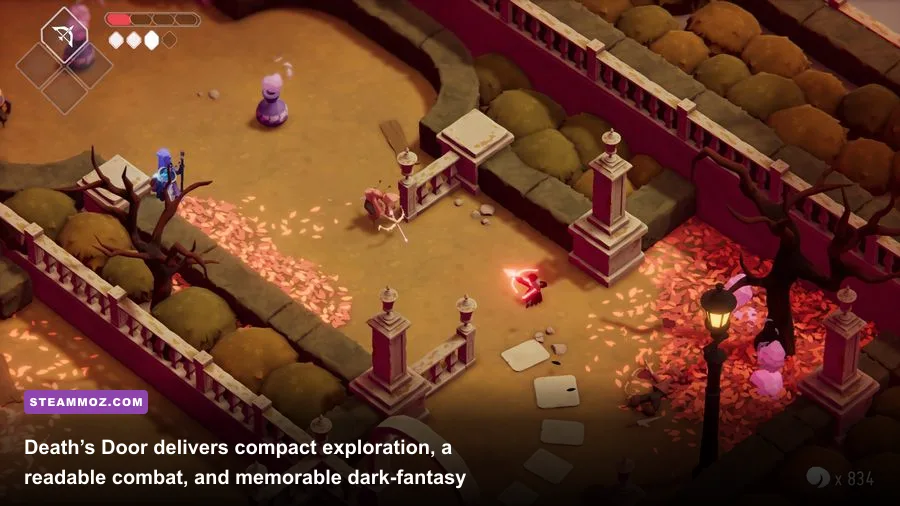
Death’s Door is shorter and less punishing than Another Crab’s Treasure, but it nails the same appeal of a strange, colorful world built around clean action. You play a Crow working for the Reaping Commission, collecting souls in a realm where death has become suspiciously bureaucratic. The tone jumps from dry office humor to genuinely haunting ruins without losing its grip.
Combat, upgrades, and boss pacing
Your basic kit includes a sword, dodge, bow, and magic abilities. Arrows are limited by default, but striking enemies with melee attacks restores ammunition. That small rule creates a strong rhythm: fire an arrow to interrupt or soften a target, close in for sword hits, then retreat before the counterattack. It’s less complicated than Umami adaptations, but it’s wonderfully readable.
The Forest Settlement, Urn Witch’s Estate, Overgrown Ruins, and Stranded Sailor each introduce a different movement or combat emphasis. The Urn Witch’s Ceramic Manor, for instance, uses teleporting urns and arena transitions to keep you moving. Bosses don’t drown you in effects; their attack patterns are usually clear enough to learn after two or three attempts.
Prioritize the Haste upgrade if you’re struggling with dodge timing, then improve Magic if you rely on ranged interrupts. The umbrella weapon makes the campaign harder by reducing melee damage, but it’s a fun challenge run once you understand enemy spacing. Unlike Kril’s shell system, Death’s Door rarely asks you to rebuild your character. Its strength is momentum: explore, find a shortcut, fight a boss, and immediately understand what changed.
For players who prefer a longer grind with more loot, our guide to Dragonkin’s hidden rewards covers a more traditional action-RPG progression model.
Elden Ring gives you the most freedom
Elden Ring is the right answer if the thing you loved in Another Crab’s Treasure was experimentation. It doesn’t have shell durability or Kril’s adaptations, but its weapons, Ashes of War, spirit summons, sorceries, incantations, and status effects create an enormous number of viable solutions.
What to carry into the Lands Between
A beginner-friendly setup is a Strength and Faith hybrid using the Claymore, Golden Vow, and a medium shield. The Claymore’s 2,000-rune purchase price from the Nomadic Merchant in Castle Morne’s area is easy to manage, its upward heavy attack catches many humanoid enemies, and its Ash of War can be replaced as your build develops. Keep Vigor at roughly 40 before pushing a damage stat too far; extra health is more valuable than a small increase in weapon scaling when you’re still learning boss timing.
Explore Limgrave and the Weeping Peninsula before rushing Margit, the Fell Omen. Spirit Ashes such as the Lone Wolf Ashes create openings, but they shouldn’t replace learning attack cues. Margit’s delayed hammer strike is designed to punish early rolls, while his glowing holy dagger can interrupt healing. Wait for the release rather than reacting to the wind-up.
| Player priority | Recommended option | Why it works | Trade-off |
|---|---|---|---|
| Survivability | 40 Vigor and medium armor | Lets you survive common two-hit strings | Lower early damage output |
| Stagger | Claymore heavy attacks | Strong poise damage from a safe range | Slow recovery if whiffed |
| Boss control | Lone Wolf Ashes | Splits enemy attention | Less effective against area attacks |
| Elemental damage | Golden Vow plus Flame Grant Me Strength | Boosts physical and fire-focused setups | Needs Faith investment and buff timing |
Elden Ring’s major downside is its scale. Another Crab’s Treasure keeps its secrets tightly authored; Elden Ring can bury a vital upgrade behind a cave, a quest step, or a location you never visit. Use the open world as a toolbox rather than a checklist. If you’ve been enjoying gear-focused games, our Everspace 2 secret-location guide has the same kind of reward-hunting mindset.
Sekiro is the ultimate mastery test
Sekiro: Shadows Die Twice is the least similar game here on the surface and perhaps the best mechanically. There are no build stats, weapon classes, or shell swaps to soften a bad matchup. You play as Wolf, and the game expects you to learn one combat language: attack, deflect, pressure posture, and execute.
Posture is your real damage bar
Most enemies have a vitality bar and a posture bar. Reducing vitality makes posture recover more slowly, but you can also fill posture by repeatedly deflecting attacks. A perfect deflect has a tight timing window and produces a distinct metallic impact. Blocking too early still protects you, but it drains your posture and eventually leaves you vulnerable.
Against Genichiro Ashina, staying aggressive is safer than retreating. His posture recovers quickly when you create distance, and his jumping bow attack can be answered with a shuriken or a well-timed deflect. In the third phase, lightning reversal turns his lightning attack into a punishment opportunity: jump, absorb the lightning before landing, and attack to send it back.
The Mikiri Counter is the skill you should learn immediately. When an enemy thrusts, press dodge toward the attack rather than away. Wolf steps onto the weapon, deals major posture damage, and remains close enough to continue pressure. Sekiro’s difficulty feels harsh for the first few hours because it refuses to let you hide behind levels. Once deflect timing clicks, though, its boss fights become almost musical.
That’s why I’d save Sekiro for after Lies of P. The latter teaches you to watch animations and respect recovery windows; Sekiro then demands that you act on that information faster and more confidently. For PC performance tweaks in other demanding games, see our Dragonkin settings guide.
Which game should you play first in 2026?
If you want the closest mechanical substitute, choose Lies of P. Its guard system, boss-run learning curve, shortcuts, and weapon assembly make it the natural next step after Kril’s underwater adventure. Choose Tunic if the best part of Another Crab’s Treasure was poking into corners and piecing together a world’s rules. Choose Death’s Door for a shorter, friendlier campaign that still respects your ability to learn.
Pick Elden Ring when you want freedom above all else, especially if you’re happy to use summons, respec later, or walk away from a boss until your build improves. Pick Sekiro when you want the cleanest possible test of timing. Finally, choose The Last Hero of Nostalgaia if the comedy matters as much as the combat; its parody of Soulslike conventions gives it a personality few imitators can match.
| If you loved this in Another Crab’s Treasure | Play this first | Reason |
|---|---|---|
| Shell abilities and gear experimentation | Elden Ring | Massive build variety and flexible upgrades |
| Boss pattern learning | Lies of P | Excellent guard, stagger, and weapon systems |
| Exploration and hidden routes | Tunic | Secrets are tied to knowledge, not map clutter |
| Colorful characters and compact levels | Death’s Door | Readable action with a strong comic tone |
| Pure timing mastery | Sekiro | Deflects and posture replace conventional builds |
| Satire of Soulslike traditions | The Last Hero of Nostalgaia | Funny, self-aware, and deliberately familiar |
Another Crab’s Treasure works because it makes a difficult genre feel inviting without sanding away the satisfaction of improvement. These games take different pieces of that formula and push them further. Start with Lies of P for the closest combat, move to Tunic for the smartest secrets, and keep Sekiro waiting until you’re ready to stop dodging the lesson and start deflecting it.