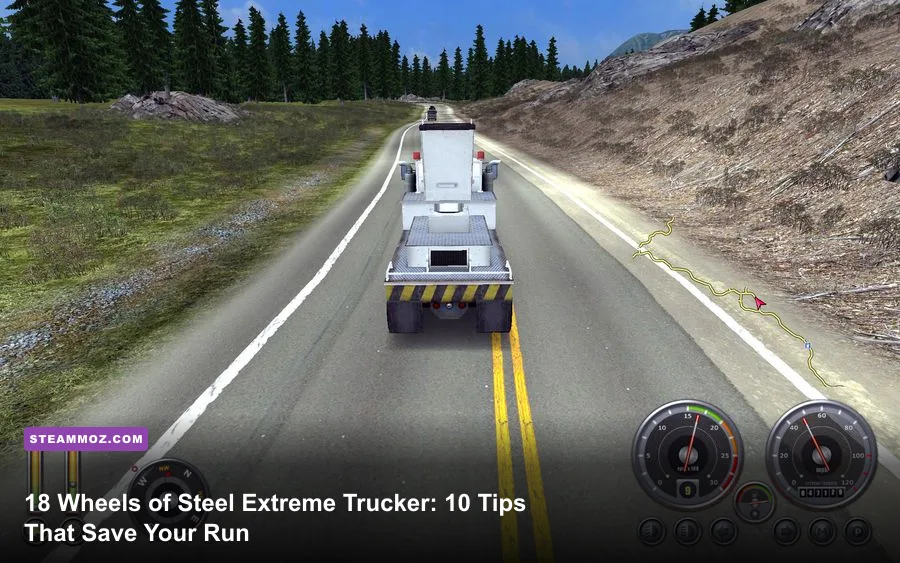
The fastest way to succeed in 18 Wheels of Steel: Extreme Trucker is to treat every delivery as a risk-management job, not a race. Keep your speed under control, inspect the route before accepting difficult cargo, protect your damage percentage, and save money for reliability before chasing a faster truck. The game is old-school, unforgiving, and surprisingly deep once you understand how deadlines, road hazards, fuel, police fines, and trailer physics interact.
Extreme Trucker gives you three very different environments—Montana, Australia, and Bolivia—and each one exposes a different bad habit. Montana tests cornering and heavy-load control. Australia stretches fuel planning and concentration across long, open roads. Bolivia piles steep grades, narrow passes, and dangerous visibility onto the same job. These ten tips apply across the campaign, but the best drivers adjust their priorities from region to region.
If you're returning to classic trucking games, Steamoz's older-PC performance advice is also useful context: Extreme Trucker runs on modest hardware, but stable input and clear visibility matter far more than visual effects.
1. Learn the route before you accept the contract
The contract screen is not just a list of jobs. It is your first safety check. Look at the pickup and destination, the cargo type, the payment, and the deadline before you commit. A high-paying load can be a trap if it sends you through a mountain route with a fragile trailer and barely enough time to stop for fuel.
Start with short, forgiving deliveries in Montana. These jobs let you learn depot entrances, junction layouts, and the behavior of traffic without combining every hazard at once. Once you can complete ordinary cargo without damage, move into oversized or heavy deliveries. The important distinction is that a job's payout doesn't directly tell you how profitable it is. Repair bills, fuel stops, collisions, and missed deadlines can erase a larger reward.
Pause before leaving the depot and study the map. Identify steep climbs, sharp switchbacks, long stretches without obvious services, and junctions where the route bends immediately after an intersection. The game gives you enough information to make a plan; it simply doesn't make the plan for you.
| Contract Factor | Beginner Priority | Why It Matters |
|---|---|---|
| Distance | Short to medium | Less exposure to traffic, fuel use, and random collisions |
| Cargo type | Standard freight | Forgives braking and cornering mistakes better than fragile loads |
| Deadline | Comfortable margin | Leaves time for fuel, navigation, and cautious mountain driving |
| Payout | Secondary concern | Avoids chasing money that disappears into repairs and fines |

🎮 18 Wheels of Steel: Extreme Trucker
Looking to experience this game? Grab your digital key directly on our store for $3.99.
View on Steammoz Store →2. Make smooth inputs your default driving style
Extreme Trucker's trucks feel much worse when you drive them like arcade cars. Sudden steering, late braking, and aggressive throttle inputs make the trailer swing wide and turn a small mistake into a rollover or collision. Use gentle steering corrections and begin braking before the corner, not once the cab is already alongside it.
On keyboard controls, tap steering rather than holding a direction for several seconds. Long key presses create exaggerated corrections, especially when a trailer starts drifting. If you have a gamepad or wheel, lower steering sensitivity until the truck responds predictably around center. The goal isn't a fast turn; it's a stable trailer line.
Brake in a straight line whenever possible. Once the truck is turning, heavy braking can push the trailer outward and make the whole rig feel as if it is folding around the cab. On downhill roads, reduce speed early and use short, controlled braking inputs. Coasting into a bend is usually safer than carrying too much speed and trying to rescue the corner halfway through it.
There is no prize for reaching a bend at the speed limit. In this game, a clean delivery is your real speedrun.
3. Respect the three regions and their different hazards
Montana is the best training ground because its roads teach the fundamentals without the extreme isolation of Australia or Bolivia's brutal elevation changes. Watch for narrow mountain routes, blind bends, and junctions where oncoming traffic appears with little warning. Keep the truck centered without crossing into opposing lanes, and leave extra space before turning into depots.
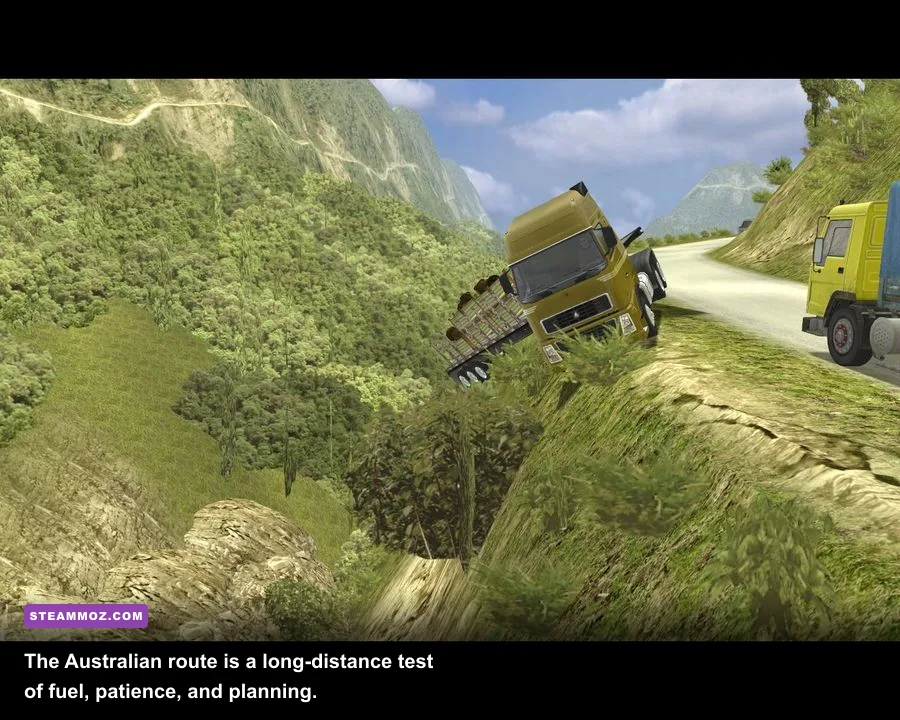
Australia changes the problem from cornering to endurance. Long, relatively straight roads encourage you to relax, but that is exactly when missed turns, fuel neglect, and fatigue-like lapses happen. Check the map regularly, maintain a steady cruising speed, and don't assume an empty-looking road is a safe road. A high-speed collision after several quiet minutes is still a failed delivery.
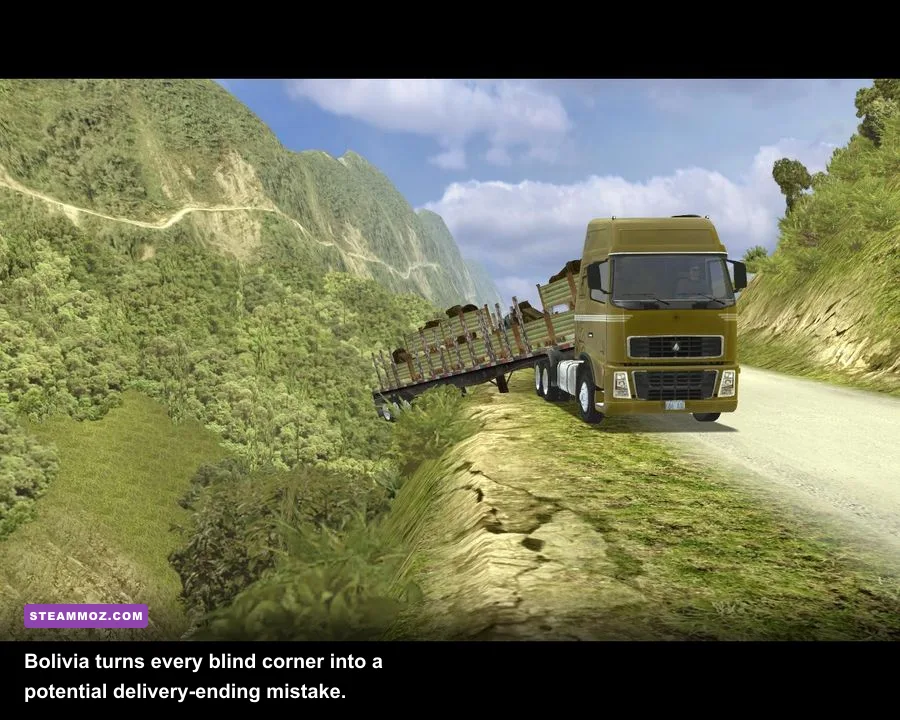
Bolivia is the region where patience pays the largest dividends. Steep grades rob momentum, while downhill sections punish drivers who enter too quickly. Approach mountain passes with a lower speed than feels necessary. On a blind corner, assume another vehicle may be occupying the road. If the trailer is carrying a load with unusual dimensions, give the outer edge even more room because the rear can cut across a different path from the cab.
| Region | Main Threat | Best Habit | Beginner Mistake |
|---|---|---|---|
| Montana | Switchbacks and traffic | Brake before corners and widen turns carefully | Entering bends at highway speed |
| Australia | Distance and navigation | Check fuel and map progress often | Ignoring a missed turn until too late |
| Bolivia | Grades and narrow passes | Build speed before climbs and slow early downhill | Trying to recover speed mid-corner |
4. Use the right speed for the cargo, not the road
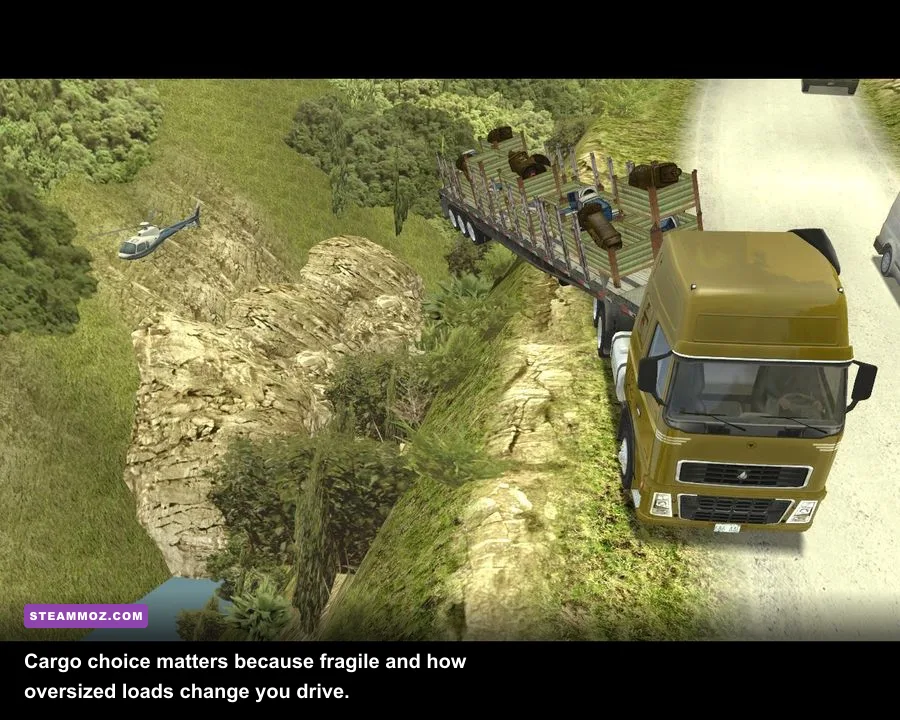
A clear road doesn't mean your current load can safely travel at maximum speed. Trailer weight and cargo sensitivity change how quickly the truck slows, how much room it needs to turn, and how severely a collision damages the delivery. Heavy cargo carries momentum; fragile or oversized cargo demands even more conservative steering.
With ordinary freight, you can maintain a steady pace on open roads and still recover from a minor error. With oversized loads, think of the trailer as a wide moving wall. Avoid clipping signs, parked vehicles, barriers, and the inside of tight corners. Give yourself a larger turning arc, then straighten the truck before accelerating.
For heavy loads on a climb, preserve momentum before the slope rather than waiting until the engine begins to struggle. That doesn't mean flooring the accelerator everywhere. It means reading the road early and choosing a speed that keeps the truck moving without forcing frantic corrections. On descents, the opposite rule applies: slow before gravity takes over.
Make a mental rule that every cargo category gets its own driving profile. Standard cargo is forgiving, heavy cargo needs anticipation, oversized cargo needs space, and fragile cargo needs smoothness. That simple distinction prevents a lot of expensive experimentation.
5. Protect your damage percentage at all costs

Damage is not a cosmetic statistic. A damaged truck handles worse, costs money to repair, and makes the next delivery harder. Damage to the cargo is even more dangerous because it can turn a technically completed trip into a poor-paying or failed contract. The smartest repair strategy is to avoid the first incident rather than planning to fix everything at the end.
Leave extra room at fuel stations and depots. Their entrances are often tighter than they appear, and the trailer can strike a structure after the cab has cleared it. Reverse slowly, use small steering inputs, and don't be embarrassed to pull forward for a second attempt. A three-point correction is cheaper than a crushed trailer.
Traffic collisions are especially avoidable when you stop treating intersections as guaranteed gaps. Slow before junctions, check both directions, and don't accelerate simply because the road looked empty a moment earlier. If a police fine or minor scrape is the alternative to a major crash, take the safe option and keep moving.
After a bad impact, inspect the vehicle before accepting another demanding contract. A truck that feels sluggish or difficult to control may need maintenance before it is ready for Bolivia or a heavy Australian haul.
6. Plan fuel stops before the warning becomes urgent
Fuel management is easy to ignore during a short Montana job and easy to regret on long Australian deliveries. Don't wait until the gauge is nearly empty to think about a station. Route planning is safer when you identify a refueling opportunity before you need it, especially if the next section includes a climb or a remote stretch of road.
Heavy cargo and constant acceleration consume more fuel than calm cruising. That gives you another reason to maintain a steady throttle on open roads. Speeding up and braking repeatedly is not only risky; it wastes fuel and increases the chance of losing control.
When a route offers a choice between a shorter difficult road and a longer predictable one, consider fuel and damage together. The shorter route is not automatically better if it includes steep grades, tight turns, and a difficult depot entrance. A few extra miles can be cheaper than a repair bill, a missed deadline, or a stranded truck.
7. Treat the deadline as a budget, not a target
New players often drive recklessly because the delivery timer looks like a challenge to beat. A better approach is to treat the deadline as a budget of available time. Spend some of it on safe turns, map checks, and fuel. You should still drive efficiently, but never borrow time from your braking distance.
Build a margin from the beginning. If you lose minutes to traffic or a wrong turn, don't panic and start taking blind corners at full speed. The game is designed to make panic costly. A controlled, slightly late arrival can be more valuable than a spectacular crash near the destination.
Before accepting a contract, compare the distance and payout with your familiarity with the route. A job that is easy after two attempts may be a terrible first choice when you don't yet know where the road narrows or where the destination entrance sits.
8. Save before risky contracts and learn from the failure
Use manual saves strategically if the version you're playing allows them. Save before accepting an unfamiliar heavy load, before entering a difficult region, and after completing a clean delivery. This isn't about removing challenge; it's about avoiding a long replay caused by one blind corner you couldn't reasonably know was coming.
When a delivery fails, identify the actual cause. If you rolled over, your problem was probably entry speed and steering timing, not a lack of horsepower. If you ran out of fuel, the issue was route planning. If the cargo took damage at a depot, the solution is a wider setup and slower reversing. Repeating the same route with the same habit is not practice.
Classic games reward this kind of deliberate learning. Steamoz's Dungeons 3 beginner tips make a similar point from a different genre: identify the system causing the failure instead of reacting emotionally to the result.
9. Spend early income on reliability before speed
Early money should make your current truck more dependable. Repairs, fuel, and practical upgrades are better investments than chasing a flashy purchase before you can consistently finish contracts. More power can help on grades, but it won't fix poor braking, bad route choices, or reckless cornering.
Think of your progression in three stages. First, establish a stable income with clean deliveries. Second, invest in the truck's ability to handle the region you're currently playing. Third, pursue higher-paying specialist cargo once your damage and fuel costs are under control. Jumping straight to the hardest contracts creates a vicious cycle: difficult jobs cause damage, damage consumes income, and low income prevents improvement.
| Income Stage | Best Spending Priority | Avoid |
|---|---|---|
| First deliveries | Fuel and essential repairs | Taking every high-payout risky contract |
| Stable career | Useful truck improvements and maintenance | Spending all cash before a difficult route |
| Specialist hauling | Preparation for heavy or oversized cargo | Assuming power replaces careful driving |
10. Tune the game for visibility and control
Extreme Trucker is lightweight, so performance usually isn't the main obstacle. Input delay, poor visibility, and unstable frame pacing are much more damaging than a few missing visual effects. Use a stable resolution, keep the camera comfortable, and choose settings that make road edges, traffic, and trailer clearance easy to read.
Turn down visual effects if they make distant road details muddy or cause stutter. A consistent frame rate helps you judge steering corrections, particularly when reversing or negotiating Bolivia's narrow roads. If you're troubleshooting an older PC, compare the approach in Steamoz's PC performance guide and keep the profile conservative.
Use the external camera when positioning the trailer, then return to the cab view for normal road driving if it gives you better speed awareness. The camera is a tool, not a difficulty setting. Good visibility reduces collisions and makes the game's deliberate physics easier to read.
| Setting or Habit | Recommended Choice | Practical Benefit |
|---|---|---|
| Resolution | Native display resolution if stable | Keeps signs, road edges, and trailer clearance readable |
| Visual effects | Reduce if stutter appears | Improves consistency during busy scenes |
| Camera | Cab view for cruising, external view for reversing | Balances speed awareness with trailer visibility |
| Controls | Low, predictable steering sensitivity | Prevents overcorrection and trailer sway |
The clean-delivery mindset wins Extreme Trucker
The game's best lesson is that every successful haul is built from small decisions: accepting the right contract, preserving momentum before a climb, braking early, leaving room at a depot, checking fuel, and refusing to turn a mistake into a disaster. You don't need to drive slowly everywhere. You need to drive deliberately where the truck is least forgiving.
For official background, check the 18 Wheels of Steel: Extreme Trucker Steam page, the official SCS Software game page, and the Steam community discussions for legacy compatibility notes. If you approach Montana as training, Australia as endurance driving, and Bolivia as precision work, the campaign stops feeling random. It becomes a series of readable problems—and that is when Extreme Trucker finally clicks.