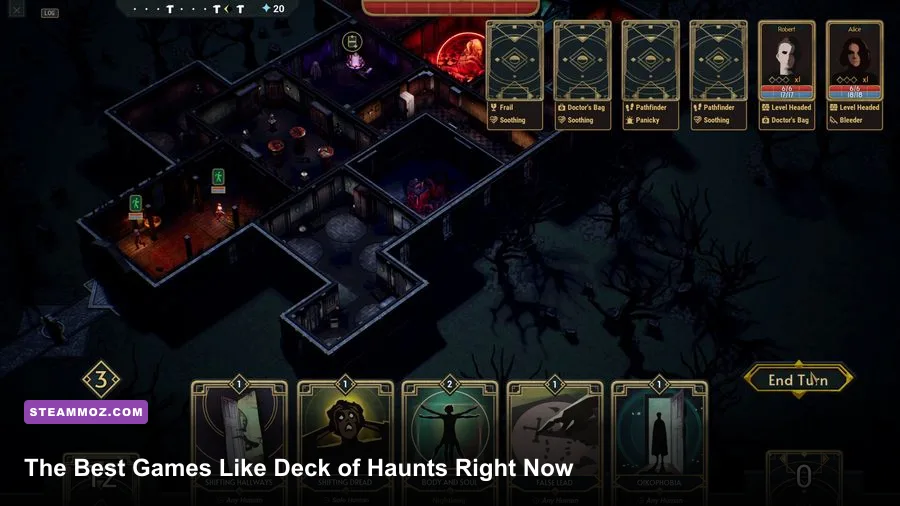
If Deck of Haunts hooked you with haunted-mansion management, card-driven decisions, and the thrill of turning visitors into victims, start with Legend of Keepers. It is the closest overall match, while Dungeons 3 is the better pick for real-time dungeon building, KeeperRL wins on simulation depth, and Cultist Simulator is the strongest choice if the cards themselves matter more than the rooms.
That distinction matters. Deck of Haunts is not simply “Dungeon Keeper with ghosts.” Its appeal comes from compressing an overlord fantasy into a run-based deckbuilding loop: choose the right rooms, draw the right haunt cards, manage your resources, and exploit the fears and weaknesses of intruders before they reach the heart of your mansion. The best alternatives below preserve at least two of those pillars instead of lazily matching the horror aesthetic.
I’ve ranked these games around four things: how much control you have over a hostile space, how meaningful your card or unit choices feel, how sharply difficulty scales, and whether the game remains interesting after the first few successful runs. Some are closer in tone; others are better games for a specific kind of player. Here’s where each one lands.

S-Tier games for Deck of Haunts fans
| Game | Tier | Closest Match | Best For |
|---|---|---|---|
| Legend of Keepers | S-Tier | Run-based dungeon defense | Players who want tactical planning and replayability |
| Dungeons 3 | S-Tier | Building an evil lair | Players who want hands-on construction and combat |
| KeeperRL | S-Tier | Emergent dungeon simulation | Players who enjoy systems over presentation |
| Dungeon Keeper 2 | A-Tier | Classic overlord fantasy | Players who want the genre’s original formula |
| Cultist Simulator | A-Tier | Card-driven occult storytelling | Players who value discovery and narrative mystery |
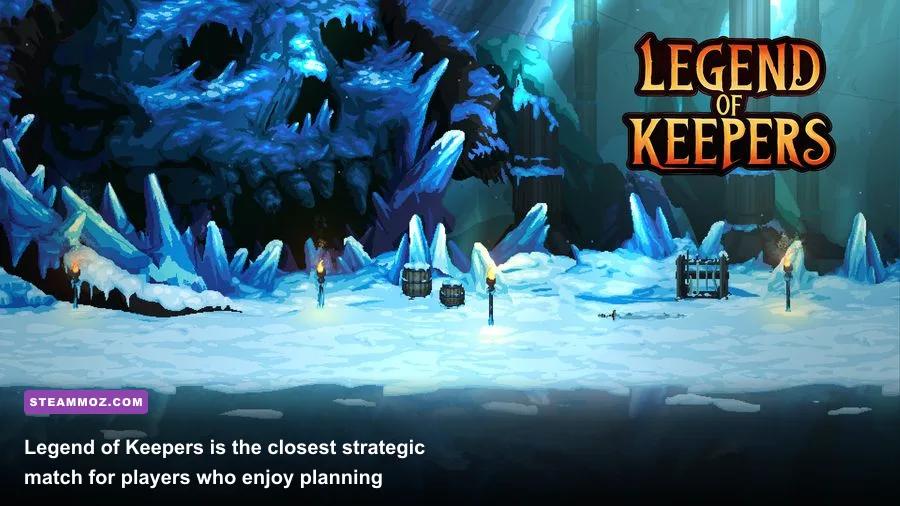
1. Legend of Keepers is the cleanest recommendation
Legend of Keepers on Steam understands the same wicked pleasure as Deck of Haunts: you are not the hero walking into the dungeon. You are the reason the hero needs a healer.
You manage a dungeon company, hire monsters, place traps, and stop adventurers from stealing your employer’s treasure. The campaign is structured as a roguelite, so the permanent progression and random events sit alongside fragile run-by-run decisions. That makes every victory feel earned rather than routine. A party might survive your opening damage room, but the exhaustion, poison, and morale losses they carry into the next encounter can make your second wave lethal.
The game’s most important trick is its three-damage framework: physical, magical, and psychological. A monster that looks weak on paper can become essential when it applies a status effect or attacks a party’s low resistance. Bleeding, burn, poison, and morale pressure are not decorative effects; they are how you convert a mediocre room into a delayed kill. Build encounters around one damage plan instead of scattering every monster type across the dungeon.
The three campaign masters also give the game distinct personalities. The Slaveholder leans toward physical damage and brutal monster options, the Engineer rewards mechanical defenses, and the Druid favors nature-based attacks and regeneration. The exact balance shifts with updates and downloadable content, but the underlying lesson stays consistent: choose a master that reinforces your preferred damage economy rather than grabbing the flashiest creature in the recruitment screen.
Compared with Deck of Haunts, Legend of Keepers is less about one personalized mansion and more about assembling a sequence of encounters. You do not get the same intimate horror-story feeling, but you get sharper combat decisions. If you like planning three rooms ahead and watching a supposedly unstoppable party collapse from accumulated damage, this is the one to buy first.
2. Dungeons 3 is the best full-size alternative
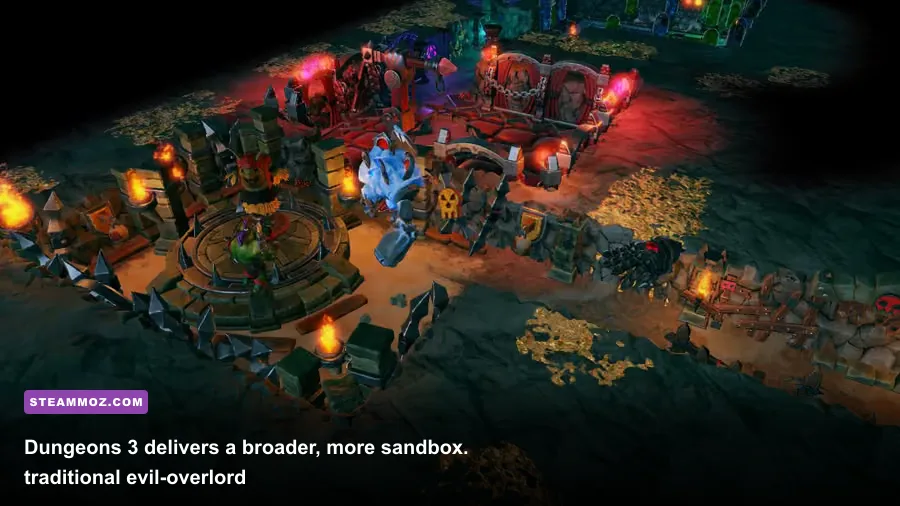
Dungeons 3 is a much more traditional real-time strategy game, but its evil-overlord fantasy is still perfectly aligned with Deck of Haunts. You dig out rooms, build production chains, train creatures, and unleash forces onto an overworld that is usually full of irritating heroes who think they are the protagonists.
The campaign’s humor is deliberately loud, while the underlying base-building loop is more disciplined than the jokes suggest. A Treasury turns mined gold into usable wealth; a Lair gives creatures somewhere to sleep; a Training Room improves your army; and the Torture Chamber generates evilness, the resource used to unlock new construction and abilities. If your dungeon feels poor, the answer is usually not “build more combat rooms.” It is improving the economy that keeps those rooms active.
Dungeons 3 also gives you something Deck of Haunts intentionally avoids: direct control over individual minions. You can pick up creatures, drop them into better positions, and use the Hand of Evil to slap or carry them. That physical control makes the game messier and more immediate. The downside is that it can dilute the clean, tactical rhythm of a card run. You are managing workers, room adjacency, research, combat groups, and surface objectives at the same time.
New players should build the core economy before overcommitting to traps. A compact early layout with a Treasury, Lair, Hatchery, and Training Room is more reliable than an oversized corridor packed with gimmicks. Once your creature count is stable, add defensive rooms that force heroes to fight while hungry, injured, or separated. Our Dungeons 3 overlord tips cover the same principle: the strongest dungeon is a machine, not a collection of impressive-looking rooms.
Pick Dungeons 3 if the part of Deck of Haunts you love most is owning a lair and watching intruders navigate it. Pick Legend of Keepers if your favorite moment is deciding which card or monster creates the perfect counter.
🎮 Deck of Haunts
Looking to experience this game? Grab your digital key directly on our store for $7.99.
View on Steammoz Store →The best deep simulation picks
3. KeeperRL turns every dungeon into a story
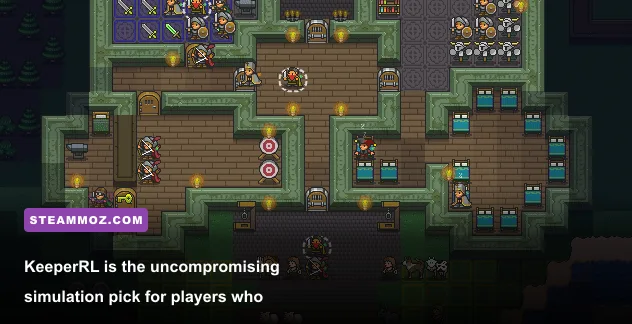
KeeperRL is rougher, stranger, and considerably less forgiving than the other recommendations here. It is also the game most likely to produce a story you’ll remember six months later. You design a fortress, recruit creatures, research spells, raid settlements, and deal with a world that does not wait politely for your next turn.
The key difference is that KeeperRL is a simulation first. Room placement affects defense and workflow, creatures have individual traits, and a failed expedition can permanently remove a useful minion. A vampire, orc, necromancer, or human servant is not merely a line on a roster. Their skills, equipment, injuries, and relationships can change how your fortress operates. A successful run often feels less like executing a build guide and more like maintaining a barely controlled criminal enterprise.
There is no neat card hand telling you what the game wants you to do next. Instead, the meaningful choices are broader: do you research stronger magic or improve infrastructure; do you raid now or fortify the entrance; do you accept a powerful but difficult-to-feed creature; do you expose your strongest unit to capture a rare artifact? These are excellent questions for someone who enjoys Deck of Haunts as a management puzzle rather than as a horror game.
The interface and visual presentation are the main barriers. KeeperRL has improved dramatically, but it still expects patience. Learn the pause controls, inspect creatures individually, and avoid expanding faster than you can defend. Start with a compact fortress and a clear route from workshop to storage to sleeping quarters. Long corridors look defensible, but they also create travel time that can cripple production when an attack begins.
It is a particularly strong recommendation for players who find traditional roguelites too clean. Your dungeon can be ruined by hunger, a bad expedition, an enemy wizard, or a creature that decides it has had enough. That volatility is not always fair, but it creates the same delicious tension that makes a haunted-mansion game work.
4. Dungeon Keeper 2 is still the genre’s essential classic
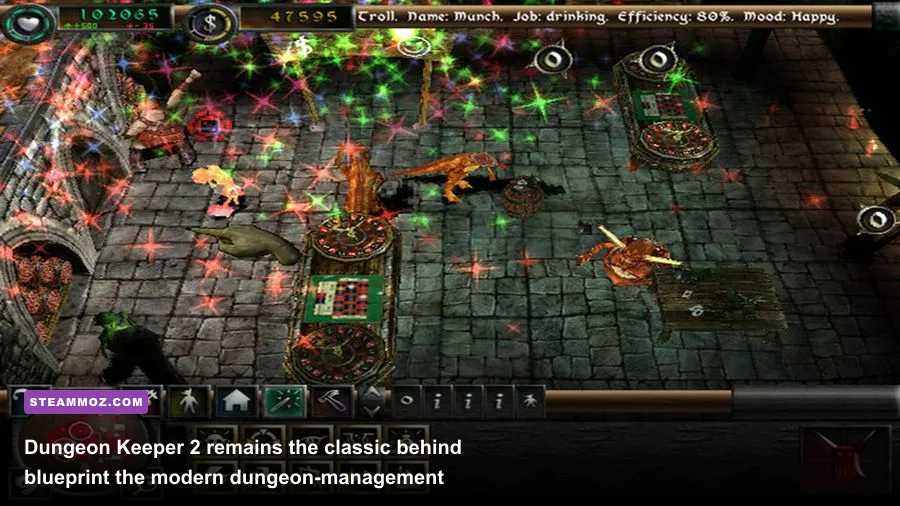
Dungeon Keeper 2 is the historical answer to this entire category. You carve rooms out of underground rock, build a Dungeon Heart, attract creatures, train them, and punish heroes for having the nerve to enter. The famous Hand of Evil lets you pick up creatures, slap them into action, and interact with the dungeon in a way that still feels unusually tactile.
The design is older, but the rhythm remains excellent. Gold is mined from seams, creatures need specific rooms and food, and the dungeon’s layout controls how quickly defenders can respond. Build too wide and your monsters spend their lives walking. Build too narrow and a single breach can become a catastrophe. The game teaches spatial planning without stopping to explain every consequence.
The Bile Demon, Dark Elf, Salamander, Vampire, and Horned Reaper each change how you approach defense. The Horned Reaper is powerful but notoriously difficult to keep happy, while Vampires grow through experience and can become terrifying late-game assets. The point is not to collect every creature. It is to create a stable ecosystem where the right creatures can train, sleep, eat, and reach the front line before heroes destroy your infrastructure.
Dungeon Keeper 2 is not as tightly balanced around repeatable runs as Deck of Haunts, and its original PC presentation can require community fixes on modern systems. Still, its personality is unmatched. If you want the source code of the evil-dungeon fantasy rather than a modern card interpretation, this is mandatory. Players who enjoy the broader series can also browse our Dungeons 2 weapon tier list and beginner build guide for a more approachable modern cousin.
The strongest card-driven alternative
5. Cultist Simulator makes every card feel dangerous
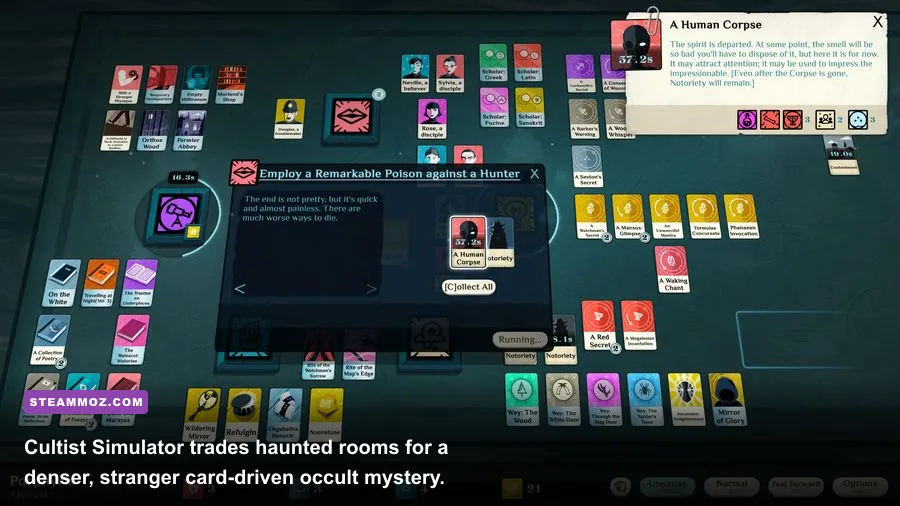
Cultist Simulator is not a dungeon-management game, and pretending otherwise would undersell both titles. It is a card-driven occult narrative where you place cards into action slots, wait for timers, combine concepts, and slowly discover how to transform an ordinary life into something much stranger.
Its connection to Deck of Haunts is structural. Cards are not just abilities with artwork attached; they represent resources, ideas, people, places, and risks. A Passion card can fuel creative work, a Study action can uncover lore, and an Influence card can alter how an operation develops. The game constantly asks you to understand context. The same card can be useful in one verb slot and disastrous in another.
The strongest early-game habit is to treat timers as threats. An occupation, illness, dread, or rival can consume your available actions while you are busy pursuing a ritual. Keep at least one reliable way to generate Funds and avoid spending every resource on lore just because a new card looks exciting. Many first losses happen because players chase the occult before building an ordinary safety net.
There are no conventional combat stats, weapon upgrades, or boss telegraphs. Instead, failure arrives through corrupted cards, escalating notoriety, and limited time. That makes Cultist Simulator a better recommendation for players who love discovering interactions and a worse one for players who specifically want to watch ghosts dismantle an adventuring party.
Its occult writing is also more opaque than most games in this list. You will lose runs while learning what a card does, and the game often treats that loss as part of the intended education. Keep notes. Experiment with verbs. If you enjoy turning a pile of mysterious components into a functioning engine, Cultist Simulator is arguably the most sophisticated card game here.
How these games compare in progression and difficulty
The biggest mistake is assuming that every game below offers the same kind of progression. Deck of Haunts emphasizes run-level choices and a growing understanding of its card pool. Legend of Keepers gives you roguelite persistence and randomized events. Dungeons 3 is campaign-driven, while KeeperRL creates much of its progression through the survival of your fortress and creatures.
| Game | Progression Model | Difficulty Curve | Main Failure State |
|---|---|---|---|
| Deck of Haunts | Run decisions and deck growth | Steady pressure through escalating visitors | Mansion overwhelmed or core threatened |
| Legend of Keepers | Roguelite master and roster progression | Sharp spikes after weak encounter planning | Adventurers reach the treasure |
| Dungeons 3 | Campaign objectives, research, and rooms | Mission-specific rather than purely systemic | Army or economy collapses |
| KeeperRL | Emergent fortress growth and research | Unpredictable and often brutal | Fortress destroyed or ruler killed |
| Dungeon Keeper 2 | Level-based campaign and creature growth | Classic RTS escalation | Dungeon Heart destroyed |
| Cultist Simulator | Knowledge discovery and occult ascension | Very steep during the learning phase | Death, arrest, obsession, or collapse |
For a smoother first ten hours, choose Dungeons 3. Its campaign provides objectives and teaches room functions at a reasonable pace. For the most demanding opening, choose KeeperRL or Cultist Simulator. Both punish blind experimentation, though in completely different ways: KeeperRL destroys your infrastructure, while Cultist Simulator quietly turns your own card economy against you.
Before buying, check the official Deck of Haunts Steam page for its current Early Access status and patch notes. Systems-heavy games can change substantially between balance updates, especially when developers add rooms, monsters, or new campaign rules. It is also worth reading the Dungeons 3 system details before assuming an older PC will run every recommendation comfortably.
Which game should you play in 2026?
Choose Legend of Keepers if you want the closest mechanical replacement for Deck of Haunts. Its encounter construction, damage types, status effects, and roguelite structure reward the same kind of malicious planning. It is the game I’d recommend to someone who says, “I want to build a defense that looks harmless on turn one and becomes impossible to survive by turn three.”
Choose Dungeons 3 if the mansion itself is the star. It offers more direct control, more construction freedom, and a campaign that feels like a playable evil-overlord comedy. It is less compact and less card-focused, but it gives you a stronger sense of ownership over the entire dungeon.
Choose KeeperRL if you want every room, creature, and expedition to create consequences. It has the highest ceiling and the roughest learning curve. The reward is a dungeon that feels genuinely alive, not because it has the best graphics, but because its systems can produce betrayal, catastrophe, and unlikely recovery without scripted theatrics.
Choose Dungeon Keeper 2 if you want to understand the fantasy that modern games keep remixing. Its age shows, but so does its confidence. The Hand of Evil, the Dungeon Heart, creature needs, and physical room layout still form an exceptionally readable loop.
Finally, choose Cultist Simulator if your favorite part of Deck of Haunts is the card table. It does not give you a haunted building, but it gives every card a strange weight and every decision a chance to reveal a deeper rule. That is a different flavor of horror, and arguably the one that stays in your head longest.
My overall ranking for 2026 is simple: Legend of Keepers is the best direct follow-up, Dungeons 3 is the best accessible dungeon sandbox, and KeeperRL is the best long-term obsession. Start with the first, then move outward depending on whether you want tighter runs, bigger construction, or a simulation that can ruin your evening in wonderfully unpredictable ways.
For more dungeon-focused recommendations, see Steamoz’s Dungeons 4 hidden rewards guide and our breakdown of the fastest Dungeons 2 leveling route. They are useful reminders that the best evil lair is rarely the one with the most traps. It is the one where every resource, room, and monster supports the same nasty plan.