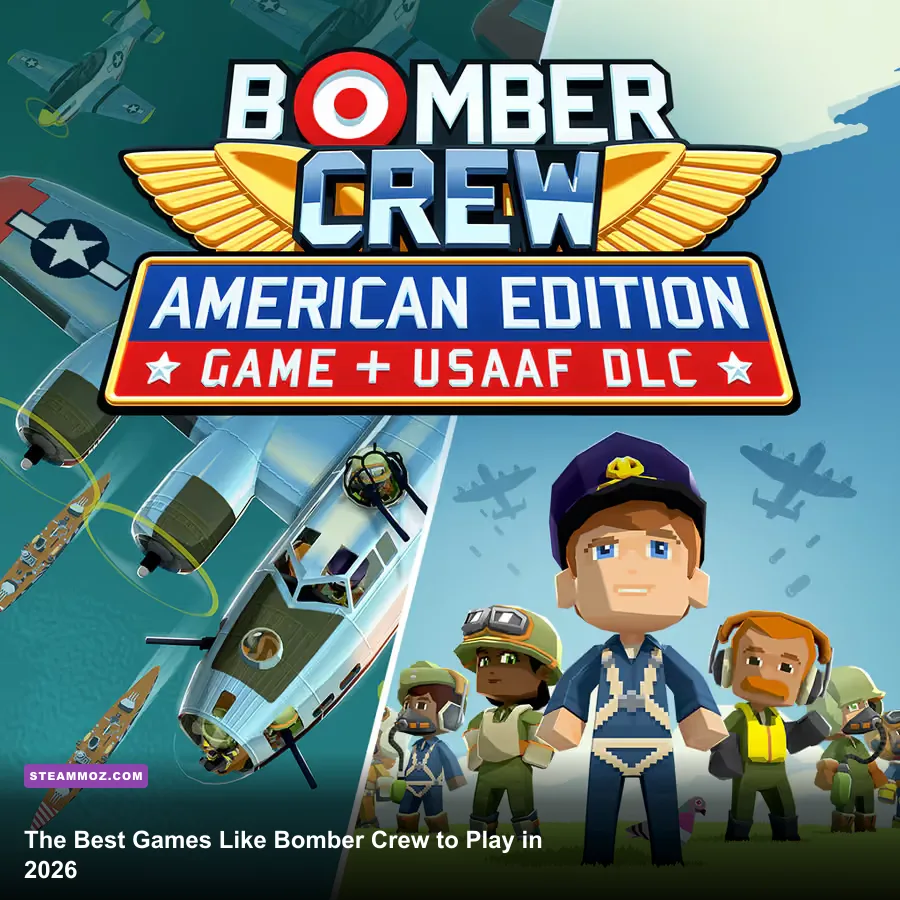
If you love Bomber Crew for its frantic crew assignments, escalating missions, and wonderfully cruel chain reactions, start with FTL: Faster Than Light, Space Crew, and UBOAT. FTL is the sharpest pure systems challenge, Space Crew is the closest direct follow-up, and UBOAT delivers the most convincing military crew simulation. The rest of this list expands that formula into role-playing, survival, and ship-building territory without losing the constant pressure that makes Bomber Crew so addictive.
Bomber Crew is deceptively approachable. Its bright art and simple mouse controls hide a game about oxygen, fuel, ammunition, heat, panic, injuries, and timing. A gunner moving to the wrong station can leave a bomber exposed. A pilot who loses focus during a tight turn can ruin an otherwise perfect sortie. The best alternatives understand that the fun isn't simply commanding a vehicle; it's watching a plan unravel and improvising before the disaster becomes permanent.
For this ranking, I looked at four things: how much direct control you have over individual crew members, how clearly the game communicates danger, whether missions create memorable stories, and how punishing the progression curve feels in 2026. If you want more advice for difficult strategy games, our Dins's Curse survival tips cover a similar lesson: preparation matters, but adaptation saves the run.
How these Bomber Crew alternatives rank

The S-Tier games below capture the core fantasy: several people, too many jobs, and one machine that starts failing at the worst possible moment. A-Tier recommendations are excellent but lean harder into a specific niche, such as role-playing or survival. B-Tier games are still worth your time if you want to build, automate, or emotionally complicate the formula.
| Game | Tier | Closest Bomber Crew feature | Best for |
|---|---|---|---|
| FTL: Faster Than Light | S-Tier | Real-time crew movement and cascading system failures | Players who want hard, replayable strategy |
| Space Crew | S-Tier | Directly manages a crew aboard a military ship | The closest overall replacement |
| UBOAT | S-Tier | Assigning sailors to stations during combat patrols | Simulation fans who want more depth |
| Star Traders: Frontiers | A-Tier | Crew roles, injuries, upgrades, and mission risk | Players who want a huge RPG sandbox |
| This War of Mine | A-Tier | Resource pressure and painful crew-level decisions | Story-driven survival strategy |
| The Last Starship | B-Tier | Ship layouts, crew stations, and damage control | Players who enjoy designing systems |
S-Tier: the games that understand the panic
FTL: Faster Than Light is still the gold standard. Your Kestrel Cruiser begins with a crew, an engine, shields, weapons, and a hyperspace route that ends at the Rebel Flagship. During each real-time encounter, you pause constantly, assign crew, reroute power, and decide whether to repair a damaged oxygen system or keep the weapons online. A fire in Shields can become a hull breach; a breach can kill the only crew member qualified to fix it.
Space Crew is the obvious recommendation for anyone who wants Bomber Crew in space. You recruit crew members, assign stations, upgrade a spaceship, and launch missions against hostile forces. The familiar jobs remain: pilots fly, engineers repair, gunners operate weapons, and medical crew treat injuries. It doesn't have FTL's same level of emergent brutality, but its third-person ship interior makes movement and task assignment feel immediately familiar.
UBOAT is less instantly readable but considerably more detailed. You command a Type VII submarine, manage officers and sailors, plot patrols, monitor torpedoes, and deal with fatigue, morale, flooding, and mechanical damage. Instead of clicking a single crew member onto an icon, you build watch schedules and work through a chain of command. That makes UBOAT slower than Bomber Crew, but the payoff is stronger immersion when a carefully planned torpedo attack succeeds.

🎮 Bomber Crew
Looking to experience this game? Grab your digital key directly on our store for $2.39.
View on Steammoz Store →1. FTL: Faster Than Light is the essential pick
FTL is the first game to install if what you remember most is not the bomber itself, but the decisions made under pressure. Its eight playable sectors lead to a final encounter with the Rebel Flagship, and every jump presents a risk calculation. You can visit a distress beacon, explore a store, accept a risky event, or rush toward the exit beacon before the Rebel fleet catches you.
The crew system is beautifully legible. Humans have no special bonus, but they train faster and are useful everywhere. Engi repair systems at 1.5 times the normal speed, making them excellent engineers. Mantis crew deal double combat damage and move 50 percent faster, while Rockmen have 150 health and immunity to fire but move more slowly. Zoltan crew provide one power when stationed in a room, though they explode for 15 damage when killed. These aren't cosmetic differences; they determine which rooms you can afford to leave unattended.
A strong early setup usually puts a crew member in Engines, Shields, and Weapons, with a fourth person rotating between Doors and Medbay. The moment you unlock a second shield layer, your survival odds improve dramatically against early laser volleys. Burst Laser II is a priority weapon because three shots for two power offers exceptional value, while Heavy Laser I pairs well with a weapon that can remove shields. Save missiles for dangerous targets rather than spending them on a weak pirate with one shield bubble.
| FTL crew or system | Exact advantage | Best assignment | Bomber Crew lesson |
|---|---|---|---|
| Engi | Repairs at 1.5x speed | Engines, Weapons, or damaged systems | Specialists prevent repair bottlenecks |
| Mantis | Double combat damage, 50% faster movement | Boarding defense or enemy ship assaults | Keep a response unit mobile |
| Rockman | 150 health and fire immunity | Doors, Sensors, or fire-prone rooms | Durability matters during emergencies |
| Zoltan | Adds one power while stationed | Engines or Weapons | Power efficiency can be stronger than raw stats |
FTL's biggest warning is its lack of a gentle learning curve. You will lose runs because a Beam Drone hits your oxygen room, because a solar flare starts a fire, or because you accepted a blue-text event without the required system. That's the point. Like the best Bomber Crew sorties, failure teaches you which resource you treated as optional.
Read the official FTL Steam page for the complete edition details. It remains lightweight on PC, runs smoothly on modest hardware, and is the easiest game here to recommend without qualification.
2. Space Crew is the closest direct successor
Space Crew takes the Bomber Crew blueprint and swaps the Lancaster for a spacecraft. You recruit specialists, customise uniforms, upgrade ship modules, and take on missions involving enemy fighters, boarding parties, and dangerous objectives. The camera follows your crew inside the vessel, so the important action is often a few rooms away from the combat outside.
Its best missions create the exact rhythm Bomber Crew fans want. A hostile fighter damages your engines, an engineer runs to repair them, a boarding party appears in the airlock, and suddenly your gunner is pulled away to fight intruders. You can't solve every problem immediately, so prioritisation becomes the real combat system. Keep your pilot at the helm unless you have a compelling reason to move them; losing flight control while under fire is rarely worth the extra repair speed.
Start by improving the ship's survivability rather than chasing maximum weapon damage. Hull upgrades give you more room for mistakes, while engine improvements increase evasion and reduce the number of hits that become emergencies. Give your fastest crew member the engineer role and avoid scattering experienced specialists across too many stations. A levelled gunner who leaves the weapon room to handle every small fire may save one compartment while allowing the ship's main damage source to go offline.
Space Crew is not as unpredictable as FTL and its interface can feel busy when multiple alerts arrive together. Still, it is the cleanest answer to the question, what should I play after Bomber Crew? The visual presentation, mission structure, and crew-first design all point in the same direction. Check the official Space Crew listing before buying, especially if you want to confirm current platform support.
3. UBOAT delivers the deepest crew simulation
UBOAT is where you go when Bomber Crew's simplified management leaves you wanting a real chain of command. You don't merely tell a sailor to repair an engine. You decide which officers supervise the crew, organise watches, manage fatigue, and select the equipment needed for a patrol. A submarine that looks fine on the surface can become a nightmare after hours underwater.
The tactical loop begins before combat. Plot a route from your home port, patrol a designated grid, keep an eye on fuel and provisions, and use the periscope only when the tactical situation justifies the risk. Torpedoes aren't magic delete buttons. You must account for target speed, range, angle, and the weapon's firing solution. A rushed launch can waste a valuable torpedo and alert an escort that would otherwise pass by.
Damage control is even more compelling. Flooding lowers buoyancy, electrical failures remove important tools, and exhausted sailors perform poorly. Officers with relevant skills should supervise the stations that matter most, but removing them from navigation or observation can create a different vulnerability. UBOAT rewards routines: keep one watch rested, rotate duties before fatigue becomes severe, and don't remain submerged simply because the current target is tempting.
The trade-off is time. A single patrol can last far longer than a Bomber Crew mission, and the menus demand patience. If you enjoy historical detail, UBOAT is outstanding. If you want instant action every five minutes, begin with FTL or Space Crew instead. The official UBOAT Steam page shows how much more simulation-focused its design has become.
4. Star Traders: Frontiers turns crew management into an RPG
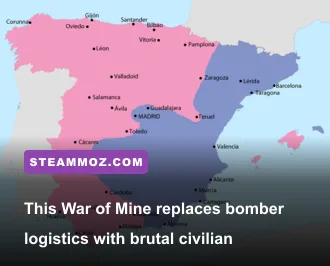
Star Traders: Frontiers is the most ambitious recommendation here. You command a starship, recruit officers, trade goods, explore systems, take contracts, and fight ship-to-ship battles across a procedurally generated sector. It doesn't replicate Bomber Crew's minute-to-minute room movement, but it captures the long-term pleasure of building a crew whose strengths and weaknesses shape every mission.
Each officer can develop through specialised jobs such as Pilot, Doctor, Engineer, Military Officer, and Zealot. Careers determine talents, traits, and combat abilities, while contacts and faction reputation open or close mission opportunities. A strong pilot reduces the danger of navigation tests, an engineer improves ship operations, and a doctor keeps injuries from turning into permanent attrition. The crew is not a collection of interchangeable icons; it is your campaign's strategic identity.
Ship combat happens through a turn-based range system. Weapons have different ranges and accuracy profiles, and talents can manipulate initiative, disable components, or improve boarding actions. Lasers are dependable against shields, torpedoes punish unprotected hulls, and plasma weapons can pressure both systems and crew. Don't over-invest in cargo or weapons early. A balanced ship with a dependable escape route is more valuable than an impressive build that collapses after one unlucky encounter.
| Build direction | Priority careers | Core advantage | Main danger |
|---|---|---|---|
| Trade runner | Pilot, Merchant, Engineer | Reliable travel and profitable contracts | Weak in prolonged combat |
| Boarding ship | Military Officer, Soldier, Doctor | Disables enemy ships through crew combat | Requires strong medical support |
| Hunter-killer | Gunner, Pilot, Engineer | Excellent weapon accuracy and ship damage | Expensive repairs and ammunition pressure |
| Explorer | Explorer, Doctor, Scientist | Strong discovery and long-range survivability | Less efficient against dedicated warships |
Its learning curve is steep, but the campaign stories can be richer than anything in Bomber Crew. A promising officer can die during a boarding action, a faction can become an enemy because of one contract, and a profitable route can disappear after a political shift. Players who enjoyed the progression planning in our DeltaZea starting build guide will appreciate how much room Frontiers gives you to optimise a crew.
5. This War of Mine makes every decision hurt
This War of Mine is not a vehicle-management game, but it belongs on this list because it understands Bomber Crew's most important idea: limited people cannot cover every crisis. You control civilians trapped in a war-torn city, scavenging during the night and managing a shelter during the day. Food, medicine, fuel, weapons, and emotional stability all compete for attention.
Each survivor has a defined personality and a different set of strengths. Pavle is fast, which makes him useful for scavenging dangerous locations. Zlata helps with morale and music, while Bruno cooks efficiently and saves fuel. A character who becomes depressed may stop working, refuse tasks, or leave the shelter. This is not a simple efficiency puzzle because the best short-term choice can create long-term psychological damage.
The night phase rewards preparation. Take a crowbar or saw when a locked door contains enough supplies to justify the noise and risk. Bring a weapon only when the location has a real threat; carrying one can protect a survivor but also encourages violent solutions. During the day, prioritise beds, a stove, and basic security before luxury crafting. A wounded survivor who cannot sleep is a future crisis, not merely a temporary debuff.
This War of Mine is emotionally heavier than Bomber Crew and far less playful. Its interface is slower, its victories are quieter, and some events are designed to make you uncomfortable. That discomfort is precisely why it works as an alternative: both games make you care about a small group of people before asking you to choose who gets the scarce resource.
6. The Last Starship is for builders who want total control
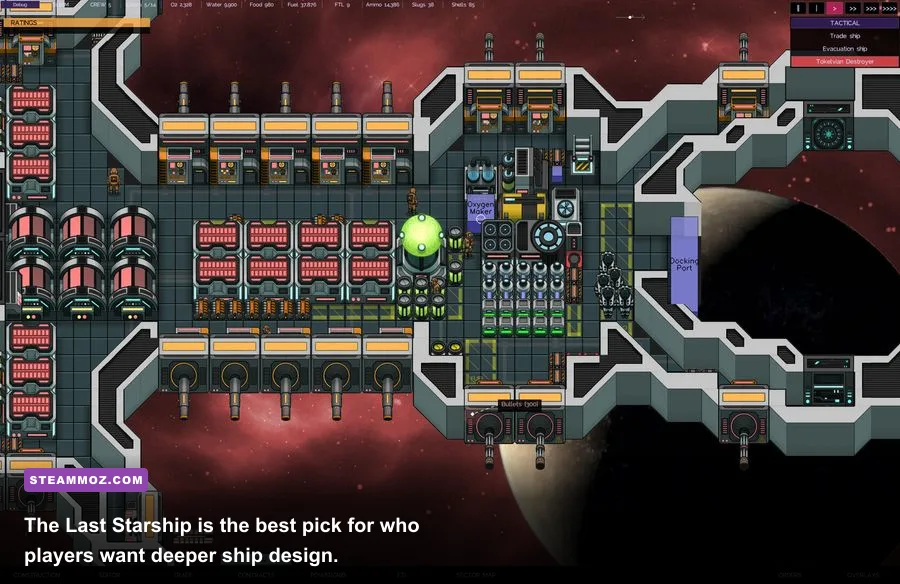
The Last Starship is the most systems-focused game in the group. You design a vessel from the hull outward, place corridors and rooms, install reactors, connect power, position weapons, and assign crew to operate the ship. Instead of inheriting Bomber Crew's fixed aircraft layout, you create the problems your crew will later have to solve.
That freedom changes the tactical question. A reactor placed far from the bridge may save space but create a dangerous route during a fire. A weapon with poor access can remain offline while crew cross the ship. Engines, shields, sensors, and life support all compete for power and physical space. The strongest layouts put essential systems near short crew paths while separating volatile components from living quarters where possible.
Combat rewards preparation more than reflexes. Pause frequently, watch for incoming threats, and keep enough power reserve to respond to damage. Automated systems can handle routine tasks, but a fully automated ship is expensive and less flexible than a crew that can move where the crisis is happening. If you enjoyed positioning Bomber Crew's crew members before an emergency rather than reacting after it starts, The Last Starship offers that idea at a much deeper level.
It is still more of a construction sandbox than a tightly authored campaign, so don't expect the same character-focused attachment as Space Crew. Its appeal is the engineering puzzle: build a ship that looks clever on paper, then discover that one badly placed door turns a minor fire into a catastrophe. Players who like optimisation should also see our Dragonkin performance settings guide for a practical look at balancing visual ambition and smooth play.
Which Bomber Crew alternative should you play first?
Choose FTL if you want the purest test of decision-making, replayability, and emergency crew movement. Choose Space Crew if you want the closest mechanical and visual successor to Bomber Crew. Pick UBOAT if you want schedules, officers, historical equipment, and long patrols. Star Traders: Frontiers is the right choice for a campaign-sized RPG, while This War of Mine is the strongest story-driven survival option.
There is no single replacement that duplicates Bomber Crew perfectly. That's good news. Bomber Crew's special charm comes from combining accessible controls with cruel logistics, and these games each isolate one part of that formula. FTL sharpens the emergencies, Space Crew preserves the crew fantasy, UBOAT deepens the simulation, Frontiers expands progression, This War of Mine intensifies the human cost, and The Last Starship hands you the blueprint.
| If you want... | Play this first | Why it fits | Difficulty warning |
|---|---|---|---|
| The closest overall experience | Space Crew | Direct crew control aboard a combat ship | Can become chaotic during boarding events |
| The best strategy challenge | FTL | Every system and crew choice has consequences | Expect frequent campaign-ending failures |
| The deepest simulation | UBOAT | Orders, fatigue, patrols, and equipment interact | Requires patience and menu literacy |
| The biggest progression sandbox | Star Traders: Frontiers | Careers, factions, ships, and procedural campaigns | Its systems take time to learn |
| The strongest emotional story | This War of Mine | Resource decisions directly affect survivors | Bleak subject matter and limited forgiveness |
| The best ship-design puzzle | The Last Starship | Build the entire vessel and solve its logistics | More sandbox than character-driven campaign |
For most Bomber Crew players in 2026, my personal order is FTL first, Space Crew second, and UBOAT third. FTL has the cleanest design and the strongest replay value, Space Crew delivers the familiar rush, and UBOAT is where you go when you want the fantasy to feel almost uncomfortably real. Start there, keep your crew moving, and remember the golden rule of this entire genre: the emergency you prepare for is never the one that actually kills you.
For another tactical recommendation, Steamoz's Desperados III review explores a different kind of squad control, while the Dungeon Siege classic RPG review is worth reading if you want a more traditional party-based alternative after managing ships and shelters.