
Doggo Estates system requirements are not currently published in a complete, verifiable form, so there is no honest minimum or recommended PC spec list to quote yet. The safest buying advice is to check the game's live Steam store page immediately before purchase, avoid treating third-party requirement cards as official, and keep your expectations conservative if your computer relies on integrated graphics or has less than 8GB of RAM. Until the developer posts CPU, GPU, memory, storage, and operating-system targets, any precise FPS promise would be guesswork.
That may sound like a frustrating answer, but it is far more useful than inventing a Core i5, GTX 1060, or 8GB requirement and presenting it as fact. Smaller simulation and cozy games can be deceptively demanding: a static menu may run perfectly while a busy estate fills the screen with animated dogs, pathfinding, shadows, decoration objects, and background effects. Doggo Estates system requirements therefore need to be judged against the game's actual build, not against its charming art style alone.
Doggo Estates system requirements status

At the time of writing, the public information available for Doggo Estates on Steam does not provide a dependable, full hardware target that can be independently confirmed here. That means the following details remain unconfirmed: the minimum processor, minimum graphics card, required RAM, storage footprint, DirectX or Vulkan version, supported Windows version, and the hardware expected for a stable 60 frames per second.
Steam listings sometimes show a formal System Requirements section before launch, while other games add it later during development. A page can also change as the developer replaces placeholder text with tested specifications. Check the listing's requirements panel rather than relying on a retailer description, an automatically generated database, or a search snippet that may be outdated.
| Requirement area | Officially confirmed target | What PC players should do |
|---|---|---|
| Operating system | No complete verified target available | Use a supported 64-bit Windows installation and keep drivers current |
| Processor | Not safely confirmable | Do not assume a low-end dual-core chip will handle simulation workloads |
| Memory | Not safely confirmable | 8GB is a sensible floor for testing; 16GB is safer for background apps |
| Graphics card | Not safely confirmable | Integrated graphics should be treated as a risk until tested |
| Storage | Not safely confirmable | Leave extra SSD space for updates, shader caches, and saves |
| Performance target | No verified FPS target | Expect to tune settings after launch rather than rely on a spec label |
This is also why the answer may differ between the game's early-access build and its eventual release. Asset compression, lighting quality, NPC behavior, draw distance, and save-system overhead can all change during development. If the official listing later publishes specifications, those should replace this provisional assessment.

🎮 Doggo Estates
Looking to experience this game? Grab your digital key directly on our store for $1.99.
View on Steammoz Store →Provisional minimum PC specs for Doggo Estates

There is no official minimum configuration to certify, but a cautious provisional baseline can still help you decide whether your computer is worth testing. For a small 3D management game, I would start with a modern 64-bit quad-core processor, 8GB of system memory, and a dedicated graphics card in the older entry-level gaming class. That is not a developer-issued requirement. It is a risk-managed starting point based on the kinds of workloads an estate-building game can create.
A PC around an Intel Core i3-10100 or AMD Ryzen 3 3100, paired with a GTX 1650, Radeon RX 570, or a newer equivalent, should be considered a testing baseline, not a guaranteed minimum. These parts have enough headroom for ordinary 1080p rendering, but the final result depends on whether Doggo Estates uses demanding real-time shadows, dense foliage, high-quality ambient occlusion, or a large number of independently animated animals.
The CPU matters more than the screenshots suggest. A quiet estate with one dog on screen may be easy to render, while a populated property can stress the main thread with pathfinding, behavior updates, object placement, and simulation ticks. A six-core processor is not mandatory by default, but older two-core or four-thread chips could produce stutter even when the average FPS looks acceptable.
| Component | Cautious provisional minimum | Why it matters | Confidence |
|---|---|---|---|
| CPU | Core i3-10100 or Ryzen 3 3100 | Provides a reasonable modern baseline for simulation and streaming | Unofficial estimate |
| GPU | GTX 1650 or Radeon RX 570 | Suitable starting point for 1080p low-to-medium settings | Unofficial estimate |
| RAM | 8GB | May run the game, but leaves less room for browsers and launchers | Practical floor |
| Storage | SSD with at least 20GB free | Allows room for the game, patches, saves, and shader data | Safety allowance, not a quoted size |
| OS | 64-bit Windows 10 or newer | Modern drivers and current runtime support reduce compatibility problems | Conservative guidance |
Integrated graphics are the biggest question mark. Recent Radeon 680M, Radeon 780M, and Intel Arc integrated solutions are much stronger than older Intel UHD chips, but their performance changes sharply with dual-channel memory, laptop power limits, and cooling. If you are using integrated graphics, start at 720p or 900p, disable expensive shadows, and cap the frame rate to 30 or 40 FPS. A locked, stable frame rate is preferable to an unstable 60 FPS target that collapses whenever the estate becomes busy.
For additional context, our Deadfall Adventures PC specs breakdown shows why published requirements should always be read alongside the intended resolution and frame-rate target. A “minimum” label usually means “boots and plays with compromises,” not “runs beautifully.”
Recommended specs for a smoother 1080p experience
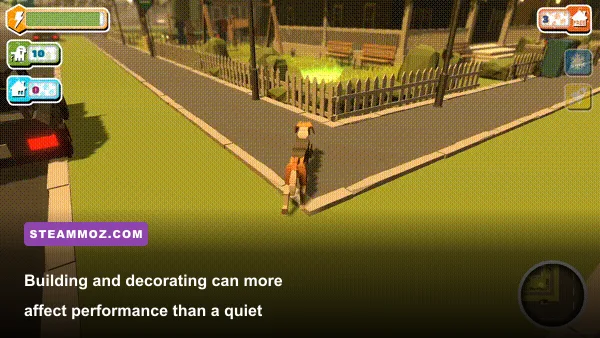
If you want Doggo Estates to feel smooth at 1080p without immediately dropping every visual setting, aim higher than the provisional floor. A Core i5-12400 or Ryzen 5 5600, 16GB of RAM, and an RTX 2060, RTX 3060, Radeon RX 6600, or equivalent would be a sensible recommended class for testing. Again, these are editorial targets, not official Doggo Estates system requirements.
This tier gives the game breathing room for the features that usually cause trouble in management sandboxes. Six processor cores help with background simulation and reduce the chance of a frame-time spike when multiple animals are active. Sixteen gigabytes of RAM gives Windows space for Steam, a browser, voice chat, and recording software. The graphics cards listed above can handle 1080p medium or high settings in many contemporary indie 3D games, though the final result will depend heavily on the game's engine and optimization.
Don't confuse a high average frame rate with smooth performance. If Doggo Estates runs at 80 FPS while the camera is still but dips to 35 FPS every time you rotate around a crowded estate, the experience will feel inconsistent. Watch one-percent lows using an overlay such as MSI Afterburner or the Steam performance display. A stable 60 FPS is the meaningful recommended target; chasing 144 FPS is unnecessary unless the game proves unusually light and responsive.
| Component | Recommended class | Expected target | Upgrade priority |
|---|---|---|---|
| CPU | Core i5-12400 or Ryzen 5 5600 | Better 1080p consistency during busy simulation scenes | High if frame-time spikes occur |
| GPU | RTX 2060/3060 or Radeon RX 6600 | 1080p medium-to-high testing headroom | High for shadows and resolution |
| RAM | 16GB dual-channel | More comfortable multitasking and fewer memory-related hitches | High on 8GB systems |
| Storage | SSD with 30GB or more free | Faster loading and room for updates | Medium; capacity matters more than peak speed |
| Display | 1080p, 60Hz or higher | A practical balance for a management game | Low; resolution can be reduced if needed |
Laptops need extra caution. A mobile RTX 3060 is not automatically identical to every desktop RTX 3060, and a thin laptop may throttle after several minutes of play. Plug in the charger, select the performance power profile, and test after the machine reaches its normal operating temperature. If performance degrades over time, the issue may be cooling rather than inadequate specifications.
Graphics settings likely to matter most

Until the game exposes its final options menu, nobody can honestly assign a precise FPS gain to each setting. Still, the hierarchy is predictable enough to build a useful tuning plan. Resolution scale, shadows, ambient occlusion, volumetric effects, and view distance usually have the largest impact. Texture quality is often cheaper to raise if your graphics card has sufficient VRAM.
| Setting | Start on weaker PCs | Start on recommended PCs | Typical performance effect |
|---|---|---|---|
| Resolution scale | 80–90% at 1080p | 100% at 1080p | Very high; directly changes rendering workload |
| Shadows | Low or medium | Medium or high | High, especially with many estate objects |
| Ambient occlusion | Off or low | Medium | Medium; improves contact depth but costs GPU time |
| View distance | Medium | High | Medium to high in large outdoor spaces |
| Textures | Medium | High if VRAM allows | Low FPS cost, higher VRAM use |
| Effects and particles | Low or medium | High | Variable; busy scenes expose the cost |
| Anti-aliasing | FXAA or low TAA | TAA or the game's quality option | Low to medium, depending on implementation |
| Frame cap | 30 or 40 FPS | 60 FPS | Improves consistency and lowers heat |
Use a controlled test rather than changing everything at once. Load the same estate, stand in the same location, rotate the camera through the busiest area, and record average FPS plus one-percent lows. Lower shadows first if the GPU is near full usage. Lower resolution scale if the GPU is saturated across every scene. If the GPU is underused but frame rate remains poor, the CPU or simulation thread is probably the bottleneck; reducing textures will not fix it.
For practical troubleshooting ideas, our guide to fixing crashes and low FPS in City of Gangsters is relevant because simulation games often respond better to driver, overlay, and background-process checks than to random graphics changes. Also consider disabling overlays from recording tools and browsers during your first performance test.
How to check your PC before buying
Start with Windows' built-in hardware information. Press Windows + R, type dxdiag, and check the processor and memory on the System tab. The Display tab identifies the active GPU, but laptops can show both integrated and dedicated graphics, so verify which one games actually use. You can also open Task Manager, select Performance, and record the exact CPU, GPU, RAM, and disk details.
Compare those parts with the provisional tables above, but don't treat a match as a guarantee. The most important missing variable is optimization. A game made in Unity, Unreal Engine, or another engine can behave very differently depending on how aggressively the developer handles culling, lighting, animation updates, and object pooling. A powerful GPU cannot fully compensate for a simulation thread that stalls on one CPU core.
Keep at least 20 to 30GB free on the installation drive even if the eventual download is smaller. Updates may need temporary space, and an SSD that is nearly full can suffer slower write performance. Install the latest graphics driver, restart the system, and close unnecessary launchers before judging performance. If you are on a laptop, check that Windows is not forcing the game onto the low-power integrated adapter.
Players with older hardware should also watch the return policy on the store where they buy the game. Steam generally allows refunds within its stated eligibility window, but the clock and playtime limits matter. Use the first session to test the busiest estate scenario, not to leave the game open in the title screen. That gives you a realistic answer quickly and avoids mistaking menu performance for gameplay performance.
What to watch for after launch
The first trustworthy Doggo Estates system requirements will be the developer's own numbers, followed by hands-on reports from players with clearly identified hardware. Look for separate minimum and recommended targets, an explicit resolution and FPS goal, the storage requirement, and notes about integrated graphics. A list that says only “Windows 10, 8GB RAM” is incomplete; GPU model and CPU generation are essential.
Patch notes will also reveal where optimization work is happening. Mentions of pathfinding, animation ticking, culling, shader compilation, save loading, or memory leaks are especially important for this kind of game. Shader stutter on a first launch may improve after the cache is built, while recurring pauses during camera movement or estate expansion suggest a deeper streaming or simulation issue.
Before increasing visual quality, find a comfortable cap. On a modest machine, 30 FPS can feel perfectly fine for a relaxed management game if frame pacing is stable. On a stronger PC, 60 FPS is the sensible goal. High-refresh targets above 100 FPS should be treated as a luxury rather than a requirement, because the CPU may become the limit long before the GPU runs out of power.
If you enjoy optimizing management games, our Dragonkin settings guide offers a useful reminder: the best profile is not always the preset with the highest visual score. A few expensive effects can consume a large performance budget for a small visual improvement. The same principle should apply here.
Bottom line on Doggo Estates PC specs
There is currently no confirmed minimum or recommended specification list that can responsibly be presented as official for Doggo Estates. For a cautious purchase decision, treat a modern quad-core CPU, 8GB RAM, and a GTX 1650-class GPU as an unofficial testing floor. For a more comfortable 1080p experience, target a six-core Core i5 or Ryzen 5, 16GB RAM, and an RTX 2060, RTX 3060, or RX 6600-class graphics card.
Those estimates are deliberately conservative. They do not guarantee a frame rate, and they should be replaced as soon as the developer publishes tested requirements. Integrated graphics owners should wait for real benchmark reports or a demo where possible. Everyone else should keep the Steam page bookmarked, test the busiest estate scene first, and tune shadows, resolution scale, ambient occlusion, and view distance before touching textures.
That is the honest answer to “can my PC run Doggo Estates?” today: maybe, if your system sits around the modern entry-level gaming tier, but the final verdict depends on requirements the developer has not yet documented. Don't let a confident-looking third-party spec sheet make that decision for you.
For official updates, monitor the Doggo Estates Steam search listing, the developer's announcements when available, and the game's official community posts. Requirements can change before release, and those channels are the places most likely to reflect the tested build rather than an old placeholder.
For more PC-focused reading, see our PC specs analysis, the low-FPS troubleshooting guide, and our practical graphics settings breakdown.