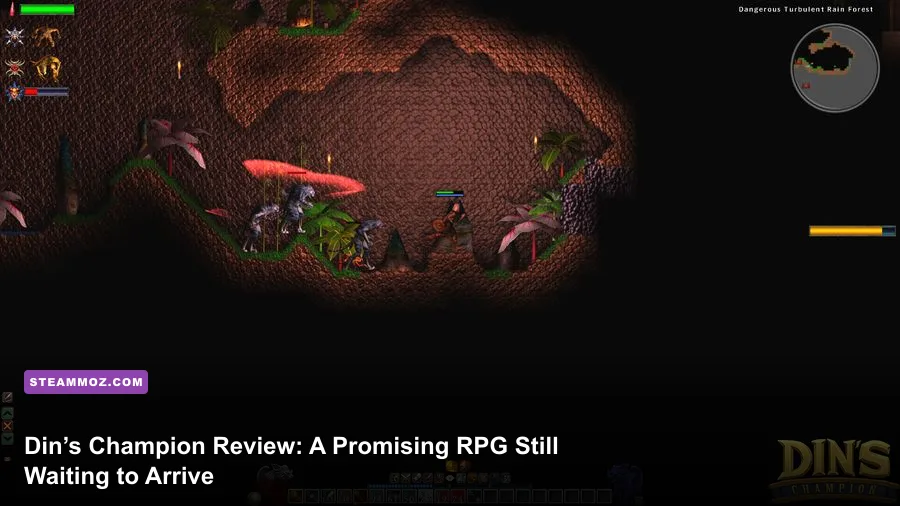
Din’s Champion is not a game I can honestly recommend buying in 2026—because there still isn’t a finished, publicly verifiable release to review. The project has obvious appeal for fans of Soldak Entertainment’s chaotic, simulation-heavy RPGs, but the public information currently falls short of the weapon lists, skill numbers, performance data, and release build needed for a proper score. If you’re shopping for a playable game today, pick up Dungeon Siege or revisit Din’s established catalog instead. Keep Din’s Champion on your watchlist, not in your checkout basket.
What Din’s Champion actually is in 2026
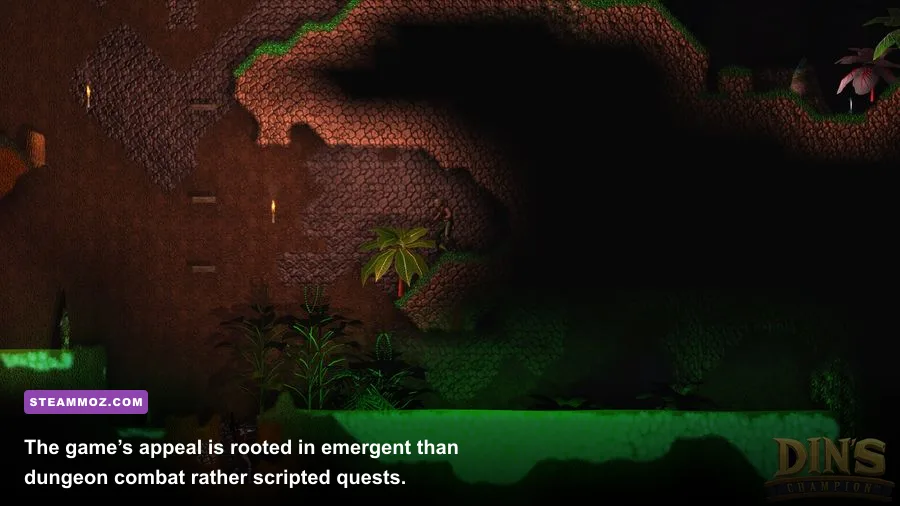
The most important part of this Din’s Champion review is separating confirmed information from wishful thinking. The title is associated with Soldak Entertainment, the studio behind Din’s Curse, Din’s Legacy, Depths of Peril, Zombasite, and Drox Operative. Those games share a recognizable design philosophy: procedurally generated worlds, systemic NPC behavior, flexible character development, and disasters that keep happening while you’re busy looting.
That lineage makes Din’s Champion interesting, but it doesn’t magically turn a project page into a finished product. As of 2026, the publicly accessible material does not provide a stable release build, a final class roster, a complete item database, confirmed minimum specifications, or a developer-locked launch date. The safest source is the official Steam search listing; if a store page, demo, or Early Access build appears, its contents should take priority over old forum posts and third-party summaries.
That distinction matters because ARPG fans often fill gaps with assumptions. A screenshot can suggest an interface. A developer comment can suggest a mechanic. Neither confirms final balance. There are no responsibly citable Din’s Champion weapon damages, cooldown values, armor coefficients, boss phases, or frame-rate benchmarks yet. Inventing those numbers would make this look like a review while giving readers fiction.
| Review area | Publicly confirmed in 2026 | What remains unknown |
|---|---|---|
| Developer | Soldak Entertainment is associated with the project | Final production schedule |
| Genre direction | Action RPG with the Din’s-series lineage | Final combat and progression rules |
| Platforms | PC interest is strongly implied by the studio’s catalog | Launch platforms and controller support |
| Release status | No stable, widely verifiable finished build | Launch date, price, Early Access scope |
| Performance | No reproducible benchmark set | FPS, resolution targets, GPU requirements |
🎮 Din's Champion
Looking to experience this game? Grab your digital key directly on our store for $15.99.
View on Steammoz Store →Why fans of Din’s Curse should care
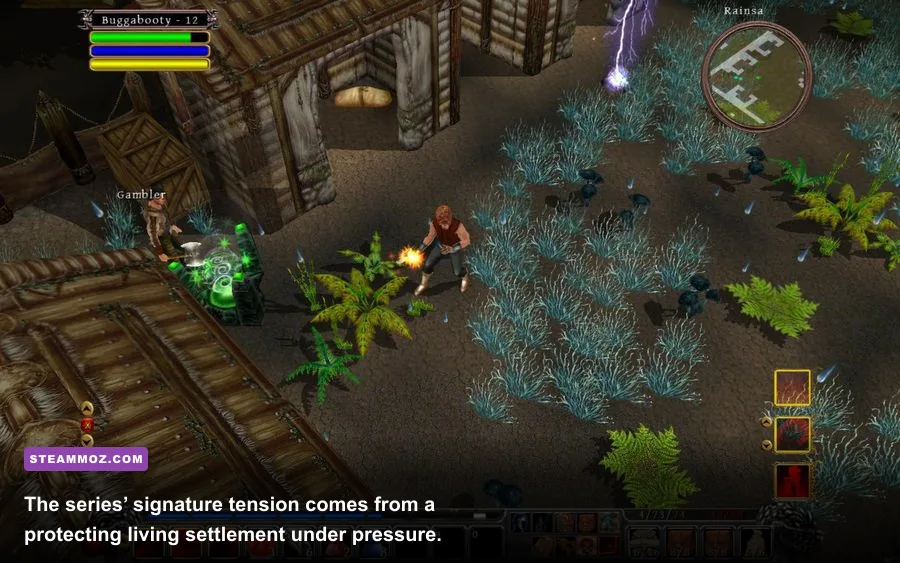
The pitch is compelling because Din’s Curse did things most loot RPGs still avoid. Its world wasn’t a hallway built to deliver you from one boss arena to the next. Town residents had jobs, relationships, needs, and the ability to make your evening dramatically worse. Monsters could attack settlements, quests could fail, and ignoring a problem wasn’t a harmless choice. You might return from a dungeon to find the blacksmith dead, the healer missing, and your carefully planned upgrade path ruined.
That pressure created stories no conventional quest script could manufacture. It also created friction. The old games can feel visually dated, occasionally opaque, and brutally indifferent to players who expect a clean power curve. Din’s Champion has a chance to preserve the emergent tension while smoothing the rough edges: clearer telegraphs, better inventory sorting, readable resistances, modern controller support, and a tutorial that explains why the town is collapsing before it’s already too late.
Fans looking for that exact experience can still explore Dungeons 3 strategy advice, but it’s worth noting that game is a dungeon-management title, not a substitute for Soldak’s reactive RPG simulation. The difference is crucial. Din’s Champion will live or die on whether its systems collide in surprising ways, not on whether it contains another thousand procedurally generated swords.
The legacy problem
Soldak’s games have always rewarded patience, but they also expose their spreadsheets. A build can feel brilliant once you understand attributes, resistances, damage types, status effects, and skill dependencies. Before launch, however, nobody can tell whether Din’s Champion will retain that satisfying complexity or simply inherit the old games’ inconvenience.
What a real review must test before launch
A credible Din’s Champion review needs more than ten minutes of combat footage. First comes the combat loop. Does every weapon type have a reason to exist? Can a slow two-handed weapon interrupt elites, or is attack speed always superior? Are status effects useful against bosses, and do enemies clearly communicate stun, poison, fire, and area attacks? Without a public build, those questions have no defensible answers.
Then there’s progression. Soldak’s earlier games often encourage unusual builds rather than forcing players into a narrow class fantasy. That flexibility only works when the game explains scaling. A final review should record the starting attributes, skill costs, level-up gains, item rarity rules, and whether bonuses stack additively or multiplicatively. It should also test respec costs, because experimentation is fun only when one failed experiment doesn’t permanently wreck a character.
The third test is simulation stability. A living town sounds fantastic until NPC pathfinding breaks, quest targets vanish, or a raid spawns inside a wall. Reviewers need to run multiple worlds, not one lucky seed, and document whether a settlement can recover after key NPC deaths. Procedural generation is not automatically replayability; it becomes replayability when the rules produce variety without producing unwinnable states.
| Test category | Pass condition | Red flag | Why it matters |
|---|---|---|---|
| Combat readability | Enemy attacks have clear audio and visual telegraphs | Deaths arrive without readable warning | Systemic chaos still needs fair counterplay |
| Build variety | Several damage and defense routes remain viable | One dominant stat invalidates alternatives | Flexible RPGs depend on meaningful choices |
| World simulation | NPC schedules and quests recover from disasters | Broken objectives block progression | Emergent failure should be dramatic, not technical |
| Procedural maps | Seeds create distinct tactical situations | Repeated layouts and dead-end objectives | Replayability must survive beyond the first run |
| Interface | Damage, resistances, loot, and quests are readable | Important information is hidden in tooltips | Complexity is worthless when the UI conceals it |
Graphics, performance, and PC requirements
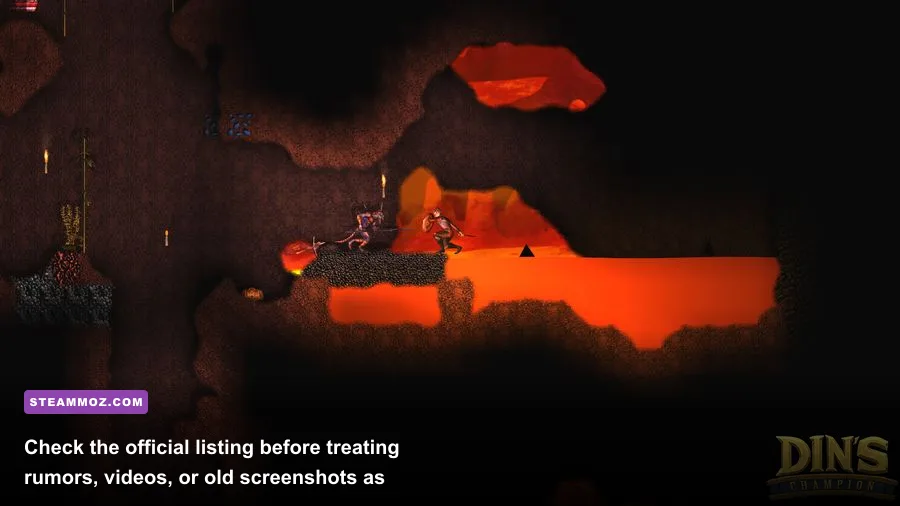
There’s no honest FPS verdict yet. Din’s Champion has no reliable public benchmark suite, and the final renderer, resolution targets, shader options, and simulation load have not been documented in a way reviewers can reproduce. That last point matters more than pretty screenshots. In a Soldak-style RPG, performance can dip during a town raid when dozens of NPCs, monsters, projectiles, pathfinding checks, and status effects resolve simultaneously.
When a playable build arrives, test it at 1080p and 1440p with three repeatable scenarios: an empty dungeon, a crowded combat room, and a full settlement defense. Log one-percent lows rather than reporting only average FPS. Also test whether shadows, particles, lighting, and simulation density are separate controls. If the game offers a simulation-quality slider, lowering it should reduce CPU pressure without making combat unreadable.
| Setting or test | Recommended launch profile | Expected impact to verify | Review note |
|---|---|---|---|
| Resolution | Native 1080p | Baseline measurement | Use the monitor’s native output first |
| Shadows | Medium | Usually GPU-heavy | Check readability around dungeon corners |
| Particles | High, then Medium for raids | Can spike during skill-heavy fights | Watch one-percent lows |
| Lighting | High if stable | Moderate GPU load | Important for telegraph clarity |
| Simulation density | Default until benchmarked | Potential CPU bottleneck | Never trade NPC behavior for a prettier screenshot |
For comparison, our Dragonkin settings guide shows why graphics advice should be based on measured frametimes rather than vague claims about “optimization.” Din’s Champion deserves the same treatment when it becomes testable.
Should you play Din’s Champion in 2026?
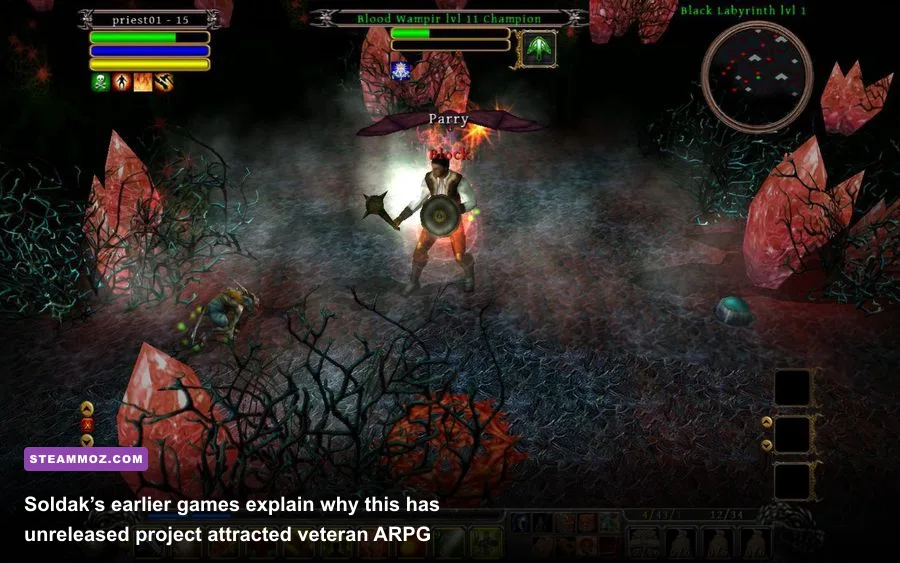
Right now, the answer is wait. That isn’t a dismissal of the concept. It’s the only responsible recommendation while the game lacks a stable version that readers can buy, install, and evaluate. Wishlist it through the official Steam storefront, follow updates from Soldak Entertainment’s official site, and treat any future Early Access launch as a systems test rather than a finished review product.
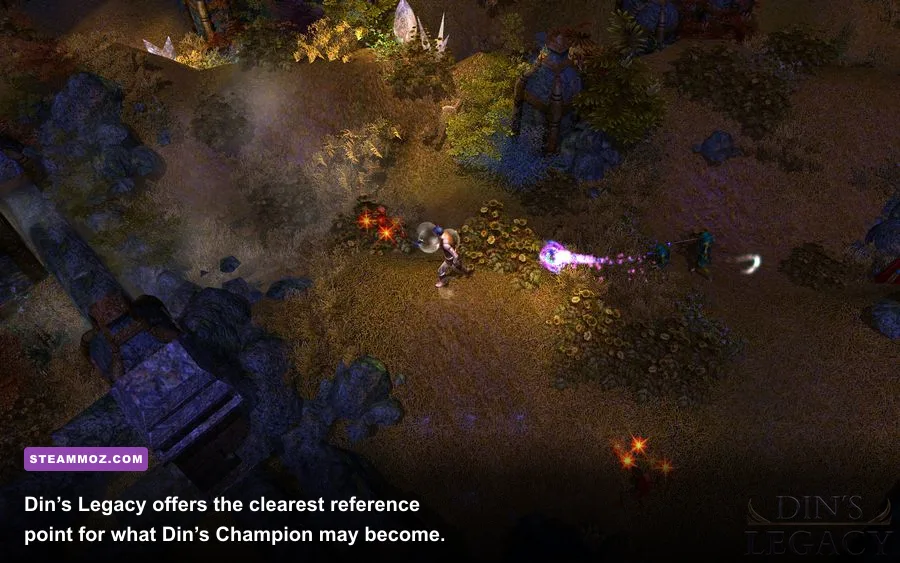
If you want the studio’s design today, Din’s Curse remains the closest match for town-defense chaos, while Din’s Legacy is the better pick for players who want a more traditional action-RPG structure and build experimentation. Neither is a modern visual showcase, but both demonstrate the kind of systemic ambition Din’s Champion must match.
The project becomes worth playing immediately if it delivers three things: a stable simulation, transparent build math, and meaningful consequences that don’t collapse into random punishment. It also needs modern conveniences without sanding away the danger. Let players sort loot, understand resistances, recover from accidental quest failures where appropriate, and see why an NPC matters before a demon eats them.
Final verdict
Din’s Champion is a promising watchlist RPG, not a 2026 recommendation. Its heritage gives it a stronger identity than most unannounced or lightly documented action RPGs, and the possibility of a richer, more accessible successor to Din’s Curse is genuinely exciting. But excitement isn’t evidence. Until Soldak publishes a playable build with confirmed mechanics, system requirements, and a real release plan, any review claiming exact weapon tiers, boss counters, or FPS results is getting ahead of the facts.
That leaves the verdict at Not yet—wait for a playable release. Check the official channels, ignore invented stat sheets, and revisit the game once there’s something concrete to put through the dungeon grinder. In the meantime, readers searching for a classic fantasy fix can browse our beginner build guide for Dungeons 2 or our coverage of other long-lived RPGs. Din’s Champion has potential. It just hasn’t earned your time yet.