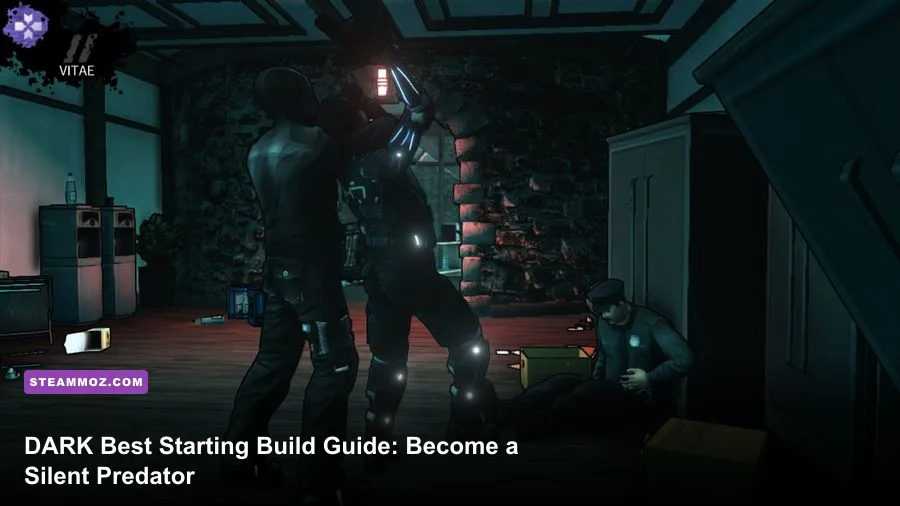
The best starting build in DARK is a control-focused stealth setup: unlock Vampire Vision first, rush Shadow Leap, then add Cloak, Distract, and a defensive skill such as Blood Shield. This route makes Eric Bane faster, harder to detect, and much less vulnerable when a carefully planned takedown goes wrong. Don't build around shooting. DARK's strongest weapon is still the ability to choose where a fight happens.
That matters because DARK isn't a conventional action RPG with a large inventory, traditional strength stats, or a weapon rarity treadmill. Eric gains experience and skill points, then spends them on vampire abilities. The campaign's challenge comes from patrol routes, visibility cones, blood management, and whether you leave a clean escape route after every kill. A good beginner build therefore needs to do three jobs: reveal information, reposition safely, and recover when stealth collapses.
The best beginner skill order for DARK
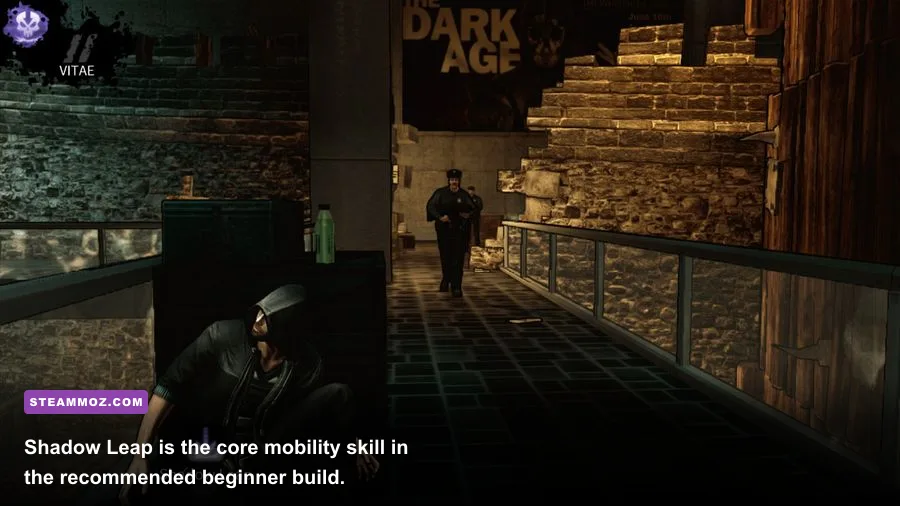
Start by treating the skill tree as a sequence rather than a shopping list. Your first purchase should improve information or movement, not raw damage. Vampire Vision is the foundation because it lets you read an encounter before committing. Once you can see guards and useful objects through the environment, Shadow Leap becomes dramatically more valuable: you aren't teleporting blindly, you're linking safe positions across the room.
After those early tools, take Cloak and Distract. Cloak gives you a reliable answer when a patrol turns at the wrong moment, while Distract lets you split groups without spending precious ammunition. Add Blood Shield after your core movement and stealth skills are online. It isn't permission to play DARK like a brawler; it's insurance for the occasional alert, turret burst, or badly timed civilian interruption.
| Priority | Skill | Why it matters | Best early use |
|---|---|---|---|
| 1 | Vampire Vision | Improves encounter information and target reading | Mark patrols before crossing a room |
| 2 | Shadow Leap | Creates fast, quiet repositioning routes | Reach isolated guards or escape after a kill |
| 3 | Cloak | Breaks visual contact when timing goes bad | Cross a detection cone or reset a chase |
| 4 | Distract | Separates clustered enemies without gunfire | Pull one guard away from a doorway |
| 5 | Blood Shield | Absorbs punishment during an exposed moment | Survive an alert while reaching cover |
| 6 | Shadow Kill | Improves decisive assassination potential | Remove priority targets once routes are clear |
Shadow Kill is powerful, but taking it too early can create a trap. A beginner who can kill one target but can't reach the next position safely will still spend most encounters running. Movement and information multiply the value of every later offensive skill. That is the central logic behind this build.

🎮 DARK
Looking to experience this game? Grab your digital key directly on our store for $2.99.
View on Steammoz Store →How to spend skill points without wasting them
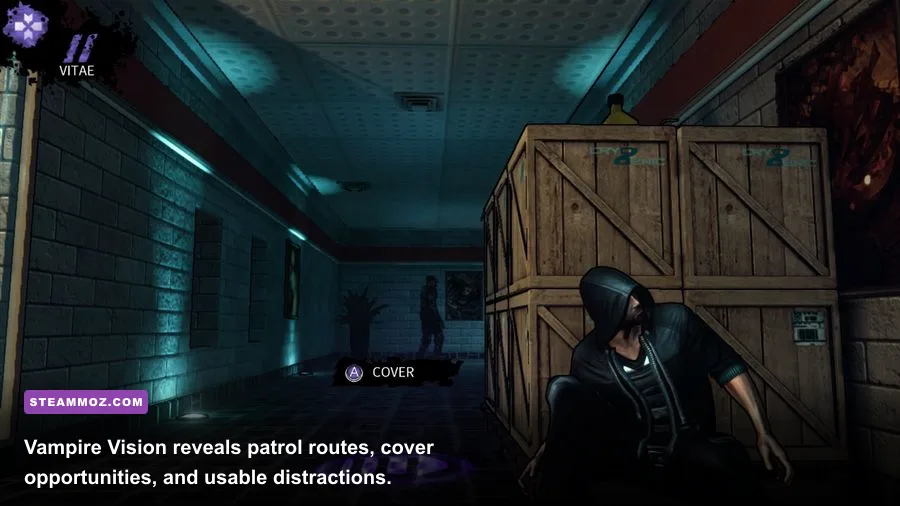
DARK has no conventional stat page where you dump points into Strength, Dexterity, or Intelligence. Your “stat priorities” are ability functions: detection, mobility, stealth duration, crowd control, and survivability. Think of each upgrade as changing the number of mistakes you can afford.
During the opening missions, save enough points to buy the next movement or stealth upgrade rather than immediately purchasing every attractive damage option. If you are repeatedly detected, your next point should usually improve concealment or positioning. If you reach enemies but can't safely cross the room, movement is the answer. If you can infiltrate perfectly but die during every alarm, Blood Shield has higher practical value than another assassination enhancement.
| Build concern | Recommended investment | What it fixes | What to avoid |
|---|---|---|---|
| Can't read the room | Vampire Vision | Unknown patrols and unsafe routes | Buying damage first |
| Can't reach isolated targets | Shadow Leap | Long crossings and poor escape paths | Walking through open sightlines |
| Frequent accidental alerts | Cloak | Late reactions and exposed movement | Trying to outrun every patrol |
| Groups block objectives | Distract | Overlapping guard positions | Opening with a firearm |
| Stealth collapses too quickly | Blood Shield | Damage during recovery | Standing in the open to trade shots |
| Priority targets survive too long | Shadow Kill | Elites and dangerous sentries | Using it before planning the exit |
Keep a simple rule in mind: every assassination must include an exit. Before you attack, identify the nearest shadowed corner, alternate route, or position where Shadow Leap can land. If you can't name that location, you aren't ready to spend blood or trigger the takedown.
For players who want a broader look at stealth design and game-specific systems, Steamoz's Children of Silentown systems guide makes a useful comparison: not every game rewards a weapon-first approach.
Combat rotation for the Shadow Predator build
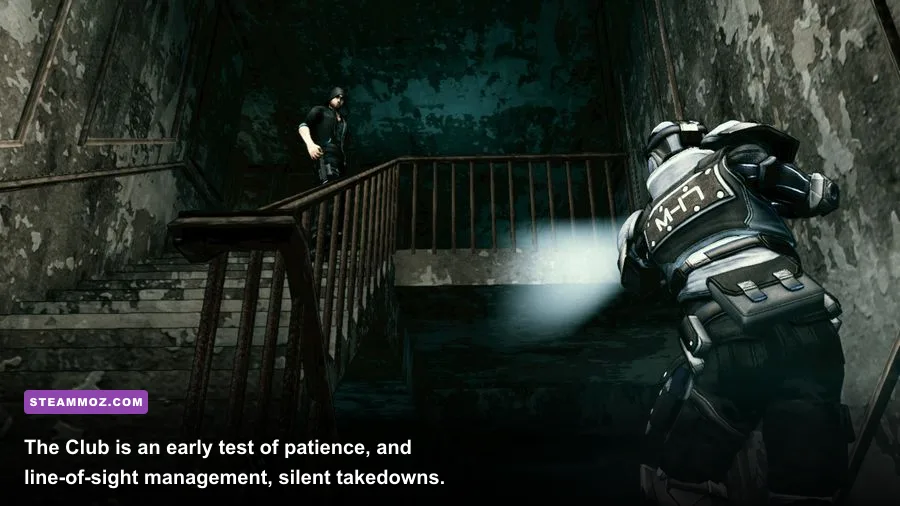
The recommended combat loop is deliberately short: scan, isolate, reposition, kill, disappear. Use Vampire Vision before entering a room. Find the enemy who can see your intended target, then use Distract or a long route to separate them. Shadow Leap closes the distance. Perform the quiet takedown, then immediately move away from the body and the last known position.
That final step is where many new players lose control. A corpse is not a victory screen. Nearby guards can discover it, and the position where you made the kill may still be covered by another patrol. Don't camp beside the body waiting for the next target. DARK's stealth spaces are built around movement between safe pockets.
When to use each ability
Vampire Vision: activate it before every unfamiliar room, not just major encounters. It helps you spot the difference between a route that looks open and one that is covered by a rotating guard.
Shadow Leap: use it to cross danger, not merely to move faster. The best leap ends behind cover or beside an isolated enemy. A flashy leap into the middle of a room is just a louder way to get caught.
Cloak: trigger it as soon as the detection warning becomes dangerous, not after guards have fully identified Eric. It is strongest as a prevention tool. If the room is already in total alarm, it may only buy enough time to reach cover.
Distract: throw the sound or lure where you want a guard to stand, not where you want the guard to look. The point is to create a predictable body position for a takedown or a clean crossing.
Blood Shield: reserve it for unavoidable exposure. It can turn a failed approach into a survivable reset, but relying on it every room drains the build's margin for error and encourages noisy habits.
| Situation | Action order | Reason | Common mistake |
|---|---|---|---|
| Single isolated guard | Vision → Shadow Leap → takedown → relocate | Fastest low-risk removal | Waiting beside the body |
| Two guards overlap | Vision → Distract → separate → takedown | Prevents cross-detection | Attacking the first target immediately |
| Open corridor | Vision → Cloak → cross → cover | Minimizes time in sightlines | Running without checking patrol timing |
| Alarm after a mistake | Blood Shield → Shadow Leap → break line of sight | Preserves a recovery route | Trading shots in the open |
| Elite or priority target | Distract → isolate → Shadow Kill → escape | Removes the encounter's biggest threat | Using the kill with no exit planned |
Firearms and enemy weapons are emergency tools, not the build's identity. Shooting can solve one problem while creating three more: noise, attention, and a worse position for the next patrol. If you have to fire, do it to create breathing room and immediately return to cover.
Mission tactics: The Club and The Geoforge
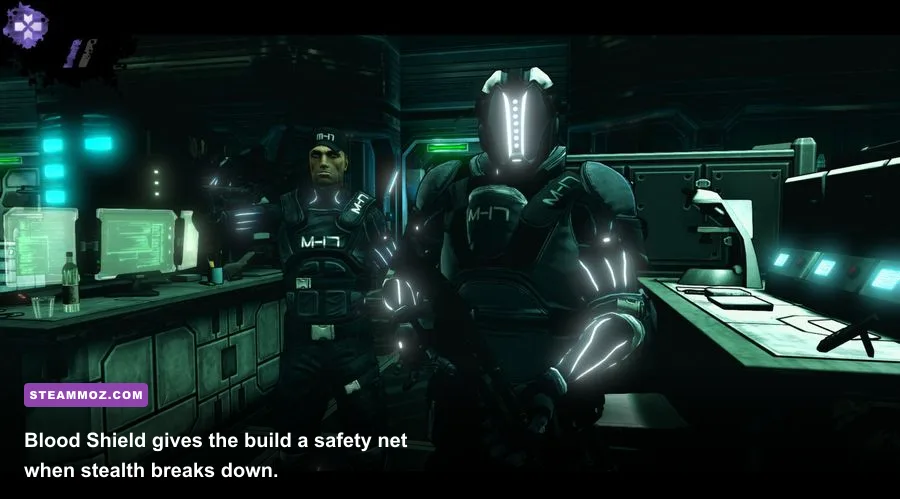
The Club is where the beginner build starts to prove itself. Its interior spaces encourage you to move through linked pockets of cover rather than sprint down the obvious route. Use Vampire Vision at doorways, observe a complete patrol cycle, and mark the guard whose removal opens the largest section of the map. The first target isn't always the closest target; it's the one controlling your next three moves.
Don't burn Cloak simply because a guard is facing your direction. Wait for the patrol to create a gap whenever possible. Cloak is much more valuable when it lets you pass a fixed sightline that cannot be bypassed. Likewise, use Distract near corners and side rooms, where the enemy's new position leaves you with an immediate escape.
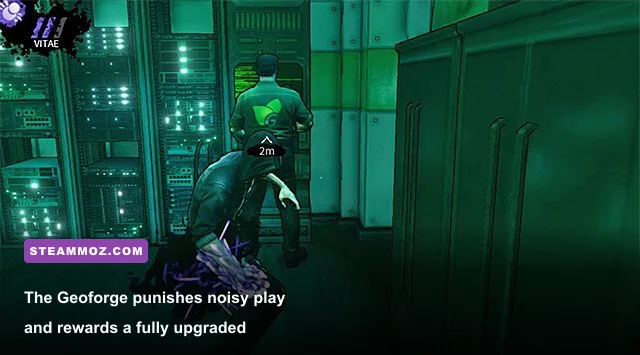
Later, The Geoforge demands cleaner execution. Industrial sightlines are less forgiving, and an alarm can turn a carefully controlled room into a chain reaction. Save Blood Shield for the section where you know a mistake would force you into open fire. Before any major objective interaction, clear or bypass the nearest patrol and check where you will retreat if the game triggers a scripted response.
Reading enemy behavior
Enemy telegraphs are more useful than raw reaction speed. A guard who has only started investigating gives you time to relocate. A fully alerted group has already converted your last known position into a danger zone. Don't return to that spot just because it looks safe now. Move laterally, change floors or rooms when possible, and let the search pattern expire away from your objective.
During boss-style confrontations and heavily guarded areas, the same rule applies: remove support, avoid the center, and use cover to force enemies into predictable approaches. DARK rewards a slow first attempt because learning a room's geometry permanently improves every later run.
If performance issues make detection warnings or movement feel inconsistent, compare your setup with Steamoz's frame-focused PC settings guide and its low-FPS troubleshooting advice. Stable frame pacing matters in a stealth game, even when the graphics are older.
Recommended settings and the build's final form
There is no character-stat respec strategy worth obsessing over in DARK. Your real end goal is a complete control loop: Vampire Vision identifies the threat, Shadow Leap solves positioning, Cloak handles unavoidable sightlines, Distract breaks formations, and Blood Shield protects the reset. Shadow Kill then converts the opening into a decisive removal.
| Stage | Core abilities | Combat identity | Upgrade checkpoint |
|---|---|---|---|
| Opening missions | Vampire Vision, Shadow Leap | Scout and relocate | Don't buy damage before mobility |
| Early campaign | Add Cloak | Cross fixed sightlines safely | Use concealment before full detection |
| Mid campaign | Add Distract | Split patrols and control rooms | Create isolated targets instead of forcing fights |
| Late campaign | Add Blood Shield, Shadow Kill | Recover from errors and eliminate priority threats | Always keep an escape route after the kill |
For the best experience, keep the display responsive and avoid settings that introduce obvious input delay. If you are on modern hardware, a stable frame rate is more important than chasing maximum visual effects in this 2013 release. Disable unnecessary overlays if they interfere with fullscreen behavior, and use the official DARK Steam page for current compatibility notes and community fixes.
It is also worth checking Kalypso Media's official site for publisher information and the game's Steam Community discussions when troubleshooting older PC versions. Community fixes can vary by operating system, so back up configuration files before experimenting.
The biggest beginner mistake in DARK is assuming every encounter must end with a perfect assassination. It doesn't. A good run can include a blocked route, a brief alert, or a retreat behind cover. What matters is whether you regain control before the room dictates your next move. Build for that control, and Eric Bane stops feeling fragile. He becomes what the game wants him to be: a patient predator who turns darkness, distance, and enemy routine into weapons.
For more build-ranking ideas across action games, Steamoz's Bounty of Blood weapon ranking and Dead in Antares gear guide offer useful contrasts with DARK's ability-first progression.