
The best starting build in Cognition Game of the Year Edition is a methodical investigation build: inspect every hotspot, use Erica Reed's Cognition powers only after gathering ordinary evidence, and test item combinations instead of guessing. That may sound strange if you're arriving from an RPG, but Cognition: An Erica Reed Thriller has no stat points, skill tree, weapon loadout, or class selection. Your “build” is really a repeatable puzzle-solving routine, and it makes the difference between a smooth first playthrough and a frustrating pixel hunt.
This guide is aimed at beginners playing the complete four-episode package. It covers the best order for exploring scenes, how to approach psychic clues, when to use the hint system, how to avoid dead ends, and what to expect from The Hangman, The Wise Monkey, The Oracle, and The Cain Killer. If you want the official store listing before starting, check the Cognition Steam page, then settle in for a detective adventure where patience beats reflexes every time.
The “Best Build” Is a Clue-First Investigation Route

Erica Reed is an FBI agent with psychic abilities, but Cognition doesn't let you spend points to improve them. Her powers are fixed parts of the story. The practical build you should follow is built around four habits: sweep the whole scene, exhaust dialogue, separate facts from assumptions, and only then spend time experimenting with supernatural evidence.
That order matters because the game frequently introduces an object before revealing why it matters. A photograph may look like decoration until Erica notices a detail in its past. A locked container may be impossible to understand until a conversation gives you the missing context. Clicking randomly can occasionally work, but it teaches you nothing about the game's logic and makes later puzzles much harder.
| Build Element | Priority | What You Do | Why It Works |
|---|---|---|---|
| Scene sweep | S-Tier | Inspect people, doors, furniture, photos, and loose objects before leaving | Important clues are often separated from the obvious crime-scene item |
| Dialogue investigation | S-Tier | Choose every available topic and revisit characters after new discoveries | New evidence can unlock a fresh conversation branch |
| Evidence linking | A-Tier | Compare clues by meaning, timeline, and contradiction | It prevents random item-combination attempts |
| Cognition powers | A-Tier | Use psychic insight on objects that carry emotional or historical weight | The powers expand context rather than replacing normal investigation |
| Inventory experimentation | B-Tier | Try combinations only when the objects share a clear purpose | Blind combinations waste time and obscure the puzzle's intended logic |
Your opening ten minutes
At the start of a new scene, click every visible hotspot before committing to a conversation or puzzle. Look for changes in Erica's animation, a new line of internal commentary, or an inventory update. Then talk to every available character and repeat the sweep. Cognition often changes a location after a short exchange, so a room that seemed empty can become useful on the second pass.
Don't rush to use a psychic ability because the interface makes it available. First ask what ordinary fact you still don't know. Who owned the object? When was it moved? Why is it out of place? Those questions point toward the correct interaction far more reliably than clicking every supernatural icon on every prop.

🎮 Cognition Game of the Year Edition
Looking to experience this game? Grab your digital key directly on our store for $5.99.
View on Steammoz Store →How to Use Erica Reed's Cognition Powers Without Getting Lost

Erica's psychic abilities are the game's signature mechanic. They let her perceive information that normal detective work can't reveal, but they aren't a universal answer button. Treat them as investigative lenses. An object associated with trauma, a suspicious event, or a hidden memory is a better target than a random cup, chair, or wall.
The safest sequence is observe, question, activate, interpret. Observe the object normally. Question what it tells you about the case. Activate Cognition when the item clearly has a past worth uncovering. Then interpret the vision alongside your existing clues. A vision isn't automatically a complete solution; it may provide a person, location, action, or emotional detail that must be matched with another clue.
Some sequences play like reconstructions of the past, while others are closer to intuitive or psychological impressions. The presentation can be deliberately disorienting. Pay attention to repeated faces, sounds, room layouts, and objects appearing in a different context. Those repetitions are usually more important than the dramatic imagery around them.
| Situation | First Move | Psychic Power Approach | Beginner Mistake |
|---|---|---|---|
| A body or crime scene | Inspect the scene and nearby evidence | Use Cognition on emotionally significant objects after the sweep | Activating the power before examining basic facts |
| A personal keepsake | Ask who owned it and why it matters | Expect a memory fragment or historical context | Assuming the first vision identifies the killer |
| A locked item | Search for its key, mechanism, or owner | Use psychic insight only if the object's history is relevant | Trying powers as a substitute for a physical solution |
| A contradiction | Record what each character claimed | Use a vision to test the timeline, not to invent one | Accepting a dramatic statement without corroboration |
Write down names and relationships when the story introduces them. Cognition's mystery is designed around connections that become clearer over time, especially as Erica investigates the killer known as Cain. A short note such as “object belonged to X; seen at location Y; statement from Z conflicts” can save you from replaying an entire scene.
When to stop using powers
If a psychic sequence gives you no obvious next step, stop clicking and return to the physical world. Search the inventory, revisit the last character you questioned, and inspect the location where the vision took place. The answer is often a new interaction unlocked by information from the vision, not another vision hidden behind a second random hotspot.
Inventory, Dialogue, and Puzzle Priorities for Beginners
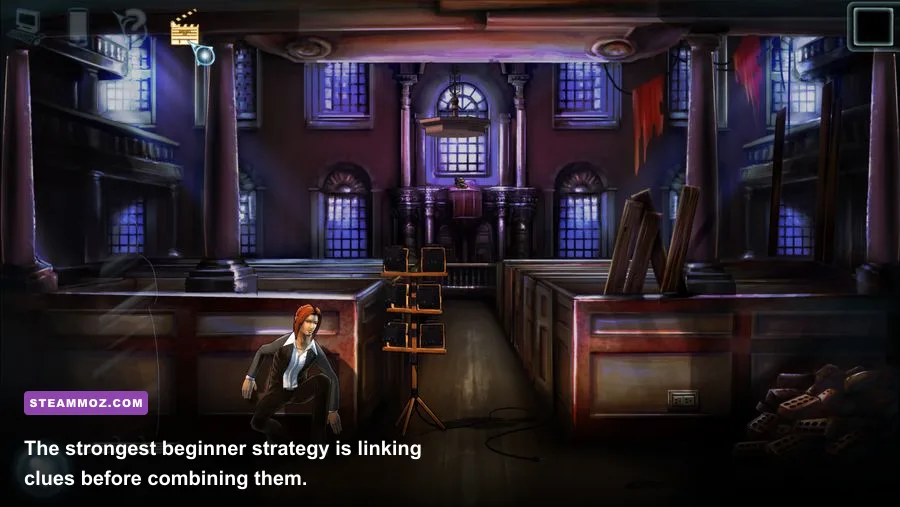
Cognition is a classic adventure game, so the inventory is where many first-time players lose momentum. The trick isn't to combine everything with everything. Build a mental chain: problem, relevant clue, practical tool, result. If you can't explain why two objects belong together, they probably don't belong together yet.
Start with the problem in plain language. “The evidence is inaccessible” is useful. “I need to combine the badge with the mysterious object” is usually too narrow. Once you define the problem, inspect the room again for a tool or person that addresses it. Erica's dialogue often provides the missing verb: identify, open, reach, distract, compare, or reconstruct.
Conversation is just as important as item use. Exhaust every available topic, but don't assume a character's first answer is final. After Erica discovers a new clue, return to earlier contacts. A changed response can expose a lie or point toward a location that wasn't previously available.
| Progression Stage | What to Check | Best Question | Do Not Do This |
|---|---|---|---|
| Entering a scene | All hotspots, exits, characters, and containers | What can I inspect before I commit to anything? | Leaving after clicking only the highlighted evidence |
| After finding an item | Inventory description and possible owner | What problem could this solve? | Combining it with every inventory item immediately |
| After a conversation | New topics and changed room interactions | What fact did this person add or avoid? | Treating dialogue as background flavor |
| After a vision | Related rooms, people, and historical objects | What new context did the vision provide? | Assuming the vision itself is the final answer |
| Before asking for help | Inventory, exits, dialogue, and unexplored hotspots | Which part of the chain is still missing? | Using hints after every failed click |
The anti-pixel-hunt routine
Use a clockwise sweep around every room. Check the foreground first, then the edges, then the exits. Zoom in on suspicious objects and watch for descriptions that differ from generic scenery. If the game offers a hotspot or hint function in your version, use it after a genuine sweep rather than at the beginning. That keeps the solution satisfying while protecting you from a single missed interaction.
Save before major puzzle sequences and before entering a new episode. The Complete Edition packages the whole story, but separate saves make it easier to revisit a clue without replaying hours. Keep at least one rotating manual save instead of relying entirely on quicksaves. Adventure-game logic can feel obvious in hindsight, and a backup lets you recover from an interaction you triggered too early.
The Four-Episode Progression and Where Beginners Stall
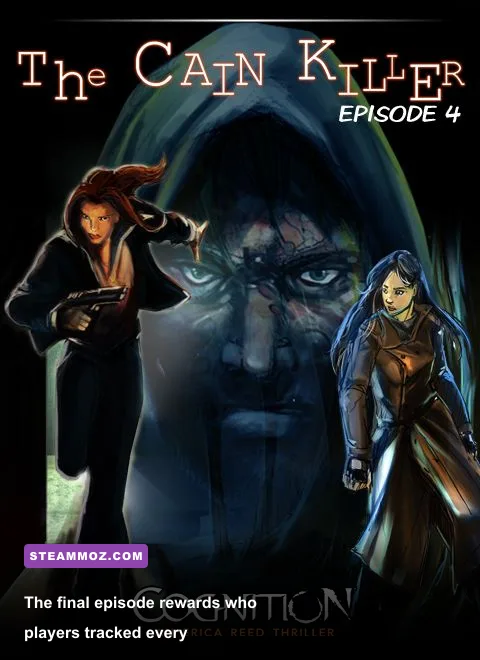
The Game of the Year Edition includes four episodes: The Hangman, The Wise Monkey, The Oracle, and The Cain Killer. Play them in that order. The narrative builds Erica's personal history and her pursuit of Cain across the season, while the puzzles increasingly expect you to remember relationships and earlier discoveries.
The Hangman establishes the investigation loop and Erica's powers. Don't judge the entire game by the first puzzle's rhythm; it is teaching you to alternate conventional detective work with Cognition sequences. The Wise Monkey expands the cast and makes revisiting clues more important. By The Oracle, you should be treating visions as evidence that needs interpretation, not cinematic rewards. The Cain Killer pays off the season's central thread and benefits enormously from taking notes.
| Episode | Beginner Focus | Best Habit | Common Sticking Point |
|---|---|---|---|
| The Hangman | Learn the scene-and-vision loop | Inspect the normal evidence before psychic evidence | Expecting Cognition to solve every puzzle automatically |
| The Wise Monkey | Track people and shifting information | Revisit characters after major discoveries | Forgetting that a new clue can change old dialogue |
| The Oracle | Interpret visions as partial evidence | Compare imagery with the physical timeline | Taking symbolic scenes literally |
| The Cain Killer | Connect the season's central mystery | Use notes to test contradictions and motives | Relying on memory for names and locations |
The most useful “progression curve” is not a character-stat curve. It's your own ability to recognize adventure-game grammar. Early puzzles teach inspection. Middle puzzles test inventory logic and dialogue memory. Later puzzles combine emotional context, chronology, and physical clues. If you feel the game suddenly became harder, check whether you're treating a symbolic vision as literal evidence or forgetting to revisit an earlier location.
What to record between episodes
Before moving on, write down the major victim, suspect, location, and unresolved question. Add any object that appeared in a Cognition sequence and note what it revealed. You don't need a full walkthrough; five or six lines per episode are enough to preserve the relationships that the next chapter expects you to remember.
Settings, Controls, and Quality-of-Life Advice
Cognition is a comparatively lightweight adventure game, so performance tuning isn't a build choice either. Its stylized 3D environments and cinematic scenes should run comfortably on modern PCs, but older systems can still benefit from sensible resolution and display settings. Start with the game's default profile, then lower resolution before touching visual quality if you need steadier performance.
Use headphones if you can. Voice acting, music cues, and environmental sound often signal the emotional importance of a scene even when the visual clue is subtle. Keep subtitles enabled during your first playthrough so you can catch names and small details. If text is difficult to read, adjust the display resolution or Windows scaling rather than skipping dialogue; the story's relationships are part of the puzzle design.
| Setting or Habit | Recommended Starting Value | Performance Impact | Why It Helps |
|---|---|---|---|
| Resolution | Native monitor resolution | Medium | Best readability for inventory and subtitles |
| Resolution on older hardware | One step below native | Low to medium | Usually improves frame pacing before major quality cuts |
| Subtitles | On | None | Keeps names and clues easy to track |
| Audio | Headphones or stereo speakers | None | Preserves dialogue and atmospheric cues |
| Display mode | Fullscreen first; borderless if available | Low | Reduces desktop conflicts on older systems |
If the game misbehaves, verify files through Steam, disable unnecessary overlays, and try compatibility options only after the basic fixes. The official Phoenix Online Studios game page is the right place to check developer information, while the Steam community hub can help identify version-specific issues. For broader PC troubleshooting, our guides to Beacon Pines PC fixes and low-FPS settings cover the same practical checks.
Final Beginner Build: The Exact Playstyle to Follow
Think of your finished Cognition build as Investigator 5, Psychic 3, Experimenter 2. Put most of your attention into ordinary inspection and dialogue, use psychic abilities to deepen a confirmed lead, and reserve free-form experimentation for moments when the game has clearly established a relationship between two clues.
In practice, that means sweeping each scene, talking to everyone, reading every inventory description, revisiting locations after major discoveries, and saving before complicated sequences. When stuck, don't search for a hidden stat upgrade or a stronger ability. Ask what the game has already shown you but you haven't connected yet. That question solves more puzzles than random clicking.
Cognition: An Erica Reed Thriller remains unusual because its supernatural hook supports detective work instead of replacing it. Erica can see pieces of the past, but you still have to decide what those pieces mean. Follow the clue-first route above and the four-episode campaign becomes far less opaque, with fewer inventory dead ends and a much better sense of why each reveal matters. If this style of focused mystery works for you, Steamoz's recommendations for story-driven games like F.E.A.R. 2 and other investigation-heavy adventures are worth browsing after the case is closed.