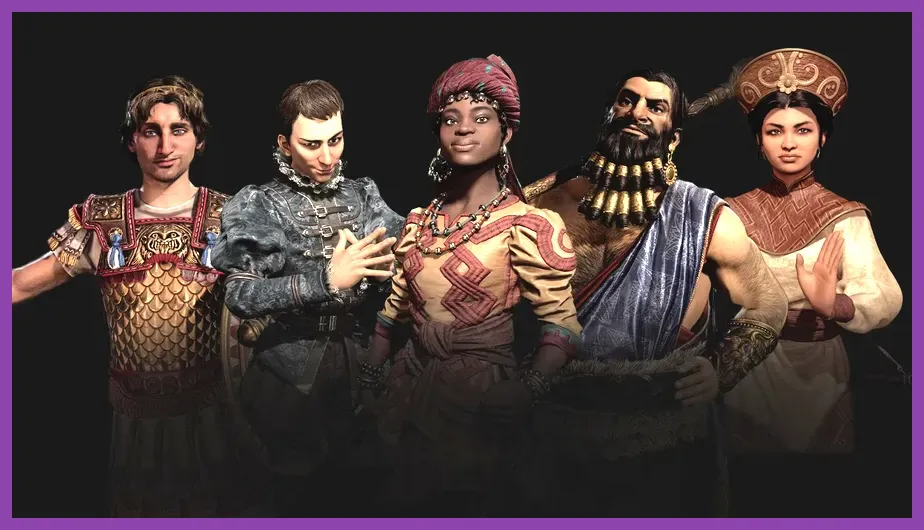
Benjamin Franklin, Harriet Tubman, Augustus, Confucius, and Isabella are the strongest all-purpose leaders in the Civilization 7 tier list for 2026. They remain useful across multiple civilizations, map types, and victory conditions. Napoleon, Genghis Khan, Hatshepsut, Ibn Battuta, Ada Lovelace, and Charlemagne form the next elite group, while narrower leaders such as Tecumseh, José Rizal, and Laozi need a more specific setup to reach their potential. This ranking evaluates every Civilization 7 leader by consistency, early-game impact, age transitions, diplomatic flexibility, and how easily each ability converts into a Science, Culture, Economic, or Military victory.
This list ranks leaders rather than civilizations. Civilization 7 separates the leader from the civilization selected in each age, so the best pick depends on whether your leader ability supports the bonuses, traditions, units, and buildings available in the Antiquity, Exploration, and Modern Ages. A strong leader can compensate for an awkward civilization pairing, but the highest-ranked choices become exceptional when their bonuses overlap with the civilization's main victory route.
For general fundamentals, pair this ranking with Steamoz's beginner strategy guide only for its broader planning principles; Civilization 7 requires different pacing, especially because crises and age transitions punish one-dimensional openings.
S-Tier: The Best Civilization 7 Leaders
1. Benjamin Franklin
Benjamin Franklin is the safest S-Tier choice for players who want a powerful Science or Economic game without committing to an early war. His emphasis on production, specialists, and technological development makes every well-developed settlement more valuable. He is particularly strong when you can protect a compact core of cities and convert surplus production into specialists, projects, and infrastructure. Franklin also benefits from flexible civilization changes because his value comes from development rather than one narrow unit timing.
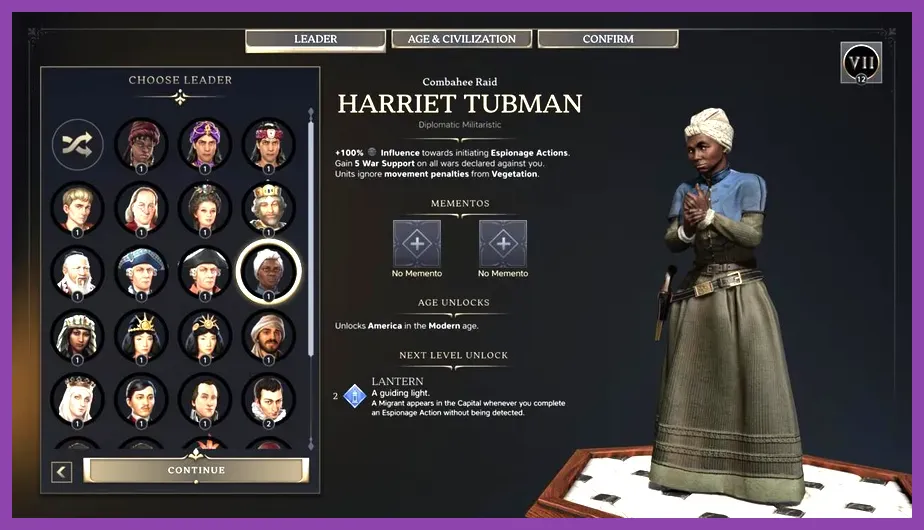
2. Harriet Tubman
Harriet Tubman is one of the best leaders for defensive expansion and border control. Her military and movement advantages make it easier to respond to raids, protect trade routes, and fight on difficult terrain. She does not need to conquer the entire map to be effective. A player who uses Tubman to secure chokepoints and maintain a modernized army can safely pursue Culture, Science, or Diplomacy while rivals waste resources attacking fortified territory.
3. Augustus
Augustus is the strongest consistent choice for wide empires. Extra production and city-building value let him establish settlements faster, repair infrastructure after crises, and convert a large territory into a productive late-game network. He is less dependent on perfect terrain than many specialists. The practical opening is to settle aggressively, connect resources, and use production advantages to keep every new city from becoming a drain on the treasury. Augustus ranks above most expansion leaders because his benefits remain relevant after the initial land grab.
4. Confucius
Confucius is outstanding for players who understand specialists, urban growth, and long-term Science scaling. His bonuses reward deliberate city planning instead of reckless expansion. Place high-value districts and buildings in cities with strong food and production, then concentrate specialists where their yields can be multiplied by later infrastructure. Confucius can also pivot into Culture because developed cities produce the population and buildings needed for strong cultural projects. He is slightly less forgiving than Franklin, but his peak is higher in a well-managed empire.
5. Isabella
Isabella is the premier resource and exploration leader. Her ability to exploit valuable resources makes her excellent on maps with multiple continents, navigable coastlines, natural wonders, or contested luxury deposits. She can fund expansion through trade and resource control while using exploration to locate settlement sites before rivals. Isabella is especially dangerous in the Exploration Age, where a resource-rich empire can turn economic momentum into fleets, colonies, and a late-game victory. Her rank falls only when the map provides very few valuable resources.
A-Tier: Powerful Leaders With Clear Strengths
6. Hatshepsut
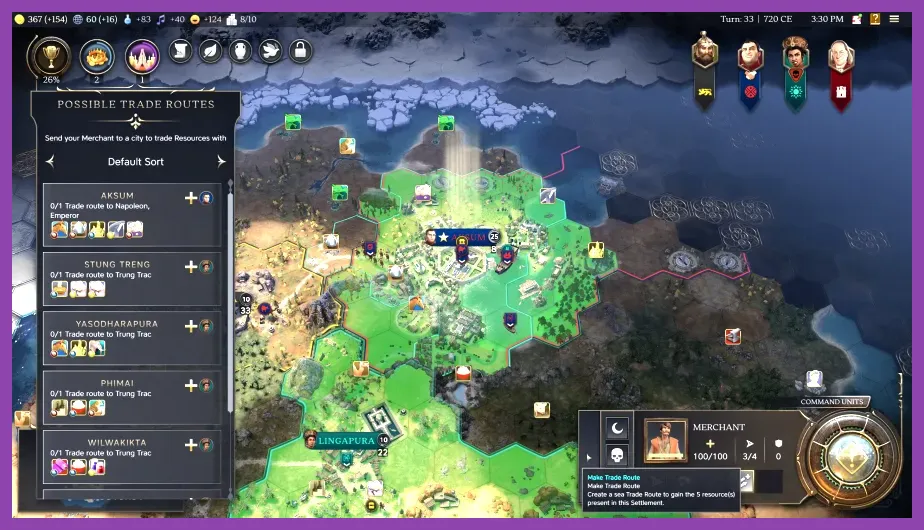
Hatshepsut is a top Culture and Economic leader whose strength comes from improving trade around luxury and resource-rich territory. She rewards players who establish routes early, maintain diplomatic relationships, and build cities near attractive commercial targets. Her main weakness is that she needs access to the right map features. When resources are scarce or rival wars close the trade network, she loses some of the advantage that places her below Isabella.
7. Ibn Battuta
Ibn Battuta is one of the most reliable exploration leaders. Extra information about distant lands, better movement, and improved rewards from discovering the map create an advantage before most rivals know where their best opportunities are. Use him to reveal city-state positions, natural wonders, resources, and settlement corridors during the first age. He is ideal for Economic and Diplomatic victories, but his direct production is weaker than Augustus's, so exploration must be converted into actual settlements and alliances.
8. Napoleon
Napoleon remains one of the best Military leaders for players who want early pressure without sacrificing every diplomatic option. His combat-focused identity makes a timing attack more efficient, especially when paired with a civilization that provides strong early infantry or cavalry. Attack a nearby rival after completing essential economic infrastructure rather than rushing into a war with an underdeveloped capital. Napoleon's limitation is opportunity cost: if the first target is well defended or protected by mountains, his main advantage can sit unused.
9. Genghis Khan
Genghis Khan is the clearest domination specialist. He thrives when horses, open terrain, and weak neighbors are available. His army should stay mobile, capture cities in a connected direction, and avoid spreading across multiple fronts. Genghis is not as flexible as Napoleon because peaceful games leave much of his identity inactive. Still, on a large Pangaea map, he can snowball from one successful conquest into an overwhelming military economy.
10. Ada Lovelace
Ada Lovelace is an excellent Science leader with strong late-game scaling. Her value increases as you unlock advanced technologies, specialists, and production-heavy research infrastructure. She is best when the capital and two or three secondary cities can safely focus on laboratories, projects, and high-yield specialists. Ada is weaker than Franklin in the opening because she does not always solve early expansion or defense problems, but she can surpass him in a protected, highly developed empire.
11. Charlemagne
Charlemagne is a durable hybrid leader for players who want military security alongside infrastructure growth. He can defend a developing empire while preparing a later offensive or diplomatic victory. His best games use a compact core, reliable food production, and a professional army rather than constant conquest. He ranks below the pure S-Tier leaders because his bonuses are broad rather than explosive, but that same breadth makes him comfortable for new players.
12. Amina
Amina excels when resource access, trade, and military readiness can support one another. She is strongest in frontier regions where a new settlement can claim a valuable deposit and immediately contribute to the economy. Use scouts and traders to identify the most profitable expansion route, then protect it with enough military strength to discourage opportunistic attacks. Amina is a strong Economic choice, but her effectiveness depends more heavily on map generation than Augustus.
13. Pachacuti
Pachacuti is a specialist in difficult terrain and compact development. Mountains, hills, and defensible valleys can become high-yield city locations instead of obstacles. He is excellent on maps where flat land is limited and rivals struggle to attack through narrow approaches. His ceiling is high for Science and Culture, although open maps with abundant flat terrain reduce the value of his terrain-focused identity.
14. Xerxes
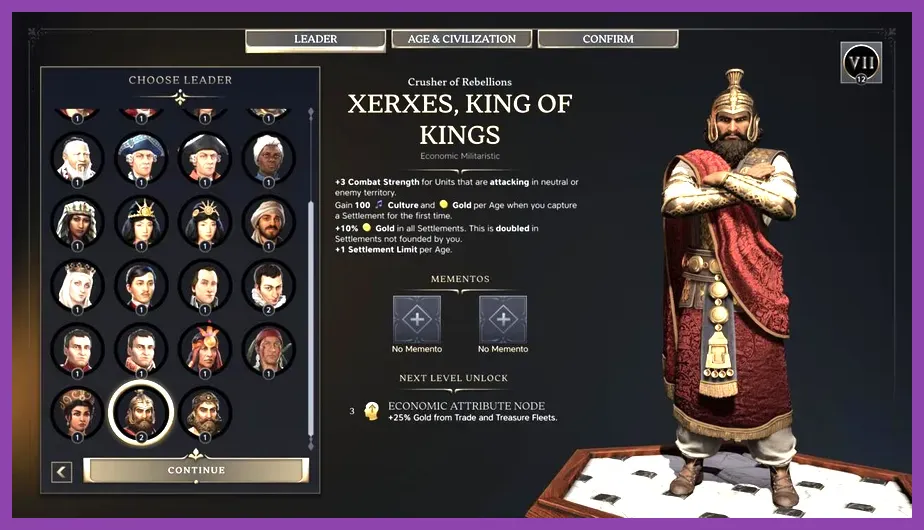
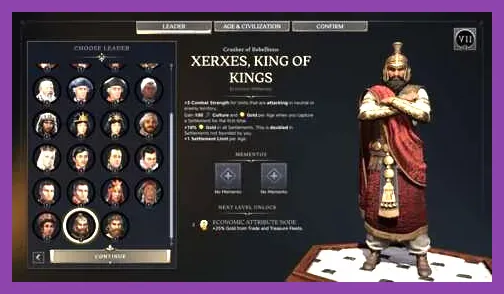
Xerxes offers a strong Military and Economic hybrid. Conquests can generate rewards that fund the next phase of expansion, allowing a successful war to become an economic snowball. The correct approach is selective aggression: take valuable targets, secure their infrastructure, and stop before war weariness or logistics damage your core. Xerxes falls short of the top military leaders because he needs successful campaigns to unlock his full value.
15. Gorgo
Gorgo is a reliable culture-through-conflict leader. She works well for players who defend aggressively, defeat enemy units, and convert military success into Culture. Her ideal game does not require total conquest. Instead, maintain a strong army, punish invasions, and use victories to accelerate policies and cultural development. She is less effective when neighbors remain peaceful or when the map makes battles rare.
16. Pericles
Pericles is a steady Culture and Diplomacy leader who benefits from city-state relationships and a developed urban network. He is best when the player can maintain influence without constantly fighting. Build early culture infrastructure, protect diplomatic routes, and avoid unnecessary grievances that make alliances harder to sustain. Pericles is dependable but slower than Hatshepsut or Isabella when the map provides rich economic opportunities.
B-Tier: Good Leaders That Need the Right Setup
17. Trung Trac
Trung Trac is a capable military leader whose strongest games use defensive terrain, disciplined unit positioning, and short wars. She can punish rivals who attack through forests, hills, or narrow borders. The problem is that her advantage is more reactive than proactive. If neighbors are distant or the map is extremely open, other military leaders usually create pressure more efficiently.
18. Tecumseh
Tecumseh is built around alliances, diplomacy, and relationships with independent powers. He can be valuable on crowded maps where city-states and minor factions are numerous. Invest in influence, defend allied territory, and use diplomatic agreements to create a safe economic core. Tecumseh becomes much weaker on isolated maps or in matches where independent settlements are quickly absorbed by larger empires.
19. José Rizal
José Rizal is a strong Culture specialist with bonuses that reward great works, celebrations, and peaceful development. He is capable of a fast cultural finish when the player protects key cities and prioritizes civic progress. However, he has fewer tools for recovering from an early military setback. Build defensive units before overcommitting to cultural projects, because a single lost city can erase the advantage gained from several turns of preparation.
20. Laozi
Laozi is a patient Science and Culture leader who prefers tall cities and careful research. His strengths become visible after the empire has enough population and infrastructure to benefit from specialist-focused development. He is a good choice for players who dislike early wars, but he can struggle to claim land against aggressive neighbors. Use terrain, diplomacy, and defensive pacts to buy the time his strategy requires.
21. Machiavelli
Machiavelli rewards manipulation, diplomacy, and opportunistic conflict. He performs well when rivals are already fighting and you can intervene at the moment a city or resource becomes vulnerable. His ceiling is impressive in competitive matches, but his value depends on reading the political situation correctly. Players who ignore diplomacy or declare wars without preparation will get less from him than from a straightforward military leader.
22. Friedrich
Friedrich is a useful Culture and Science hybrid with strong potential in a developed empire. He benefits from planning specialized cities and using production to accelerate important buildings and projects. His early turns are less explosive than Augustus's, and he does not provide the same direct defensive security as Tubman. Choose Friedrich when the map allows a stable core and you want to switch between Culture and Science after the first age.
23. Ashoka
Ashoka is a flexible leader for players who prioritize happiness, population, and stable city growth. He can create a prosperous empire that supports several victory paths, but his advantages are gradual. The strongest opening secures food, housing, and amenities before attempting ambitious expansion. Ashoka is easy to play in peaceful matches but can feel underpowered when early military pressure demands immediate production.
24. Lafayette
Lafayette is a diplomatic support leader who becomes more valuable when alliances, influence, and shared wars dominate the match. He can help a cooperative empire stay secure while building toward Culture or Diplomacy. His lower ranking reflects a lack of direct economic acceleration. If neighboring leaders refuse agreements, Lafayette has fewer ways to force the game in his favor.
C-Tier: Niche Picks and Difficult Openings
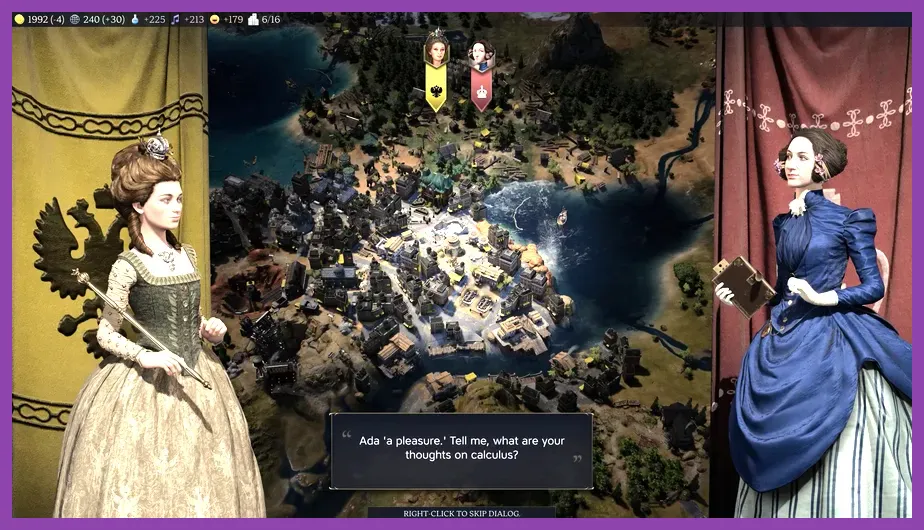
25. Himiko
Himiko can be effective for a specialist-focused Culture or Diplomacy strategy, particularly when the map offers several nearby independent powers. Her game plan is fragile because it depends on influence, relationships, and enough safety to develop. A strong player can turn her into a powerful diplomatic leader, but most players will achieve more consistent results with Pericles or Tecumseh.
26. Isabella's narrow map dependency
Isabella is normally an A-Tier leader, but her performance deserves a separate warning because resource-poor starts can make her feel like a C-Tier pick. Do not treat this as a contradiction in the ranking. Scout the region before committing to a resource-heavy plan. If no valuable resources or coastal opportunities exist, shift into basic expansion and diplomacy instead of forcing an economic strategy that the map cannot support.
27. Confucius's execution barrier
Confucius also has a high skill requirement despite his S-Tier placement. His bonuses do not rescue inefficient city layouts. Players must understand when to assign specialists, which cities should build infrastructure, and when a short-term production sacrifice creates long-term Science. If you prefer simple openings, Augustus or Charlemagne will deliver more immediate value.
The lower part of this list should not be read as a claim that these leaders are unusable. Civilization 7's age system, map scripts, and civilization pairings can move a leader by an entire tier. A C-Tier leader with the perfect terrain and civilization bonuses may outperform an S-Tier leader trapped between hostile neighbors.
Best Leader Picks by Victory Condition
Science Victory
Choose Benjamin Franklin first, Confucius second, and Ada Lovelace third. Franklin is best for balanced development and production, Confucius rewards specialist management, and Ada has the strongest late-game research identity. Laozi and Friedrich are suitable alternatives when the map is peaceful and supports tall cities. Protect your research core with defensive units, because losing a high-population capital is more damaging than delaying one technology.
Culture Victory
Hatshepsut, José Rizal, Pericles, and Friedrich are the leading choices. Hatshepsut is strongest when luxury resources and trade routes are abundant. José Rizal is better for a peaceful great-work strategy, while Pericles prefers city-state influence and diplomatic stability. Gorgo can reach Culture through military victories when rivals provide frequent battles.
Economic Victory
Isabella, Ibn Battuta, Amina, and Augustus are the best economic leaders. Isabella wants resources and exploration, Ibn Battuta wants map knowledge and trade access, Amina wants profitable frontier settlements, and Augustus wants a large productive empire. Establish trade routes before overbuilding military units, then use the resulting income to maintain roads, infrastructure, and diplomatic relationships.
Military Victory
Genghis Khan is the strongest pure domination pick, followed by Napoleon, Xerxes, Harriet Tubman, and Trung Trac. Genghis wants open terrain and early targets. Napoleon is more flexible, Xerxes turns conquest into economic momentum, Tubman protects an expanding border, and Trung Trac performs best in defensive terrain. Before declaring war, check reinforcements, roads, resource income, and the opponent's nearest production centers.
Diplomatic Victory
Confucius, Ibn Battuta, Tecumseh, Pericles, Lafayette, and Himiko are the most suitable choices. Ibn Battuta is the safest because exploration reveals the diplomatic landscape early. Tecumseh and Himiko become stronger when independent powers are numerous, while Pericles and Lafayette prefer stable alliances. Avoid grievances that can isolate you during the final age.
How to Use This Tier List in 2026
Start by choosing the victory condition you can realistically support with the map. Do not select Genghis Khan on a water-heavy archipelago unless you already know how to create a naval economy. Likewise, do not select Isabella and ignore nearby resources. Leader selection should follow the map, not replace scouting.
Next, match the leader to the civilization available in the current age. Augustus with a high-production civilization is an obvious expansion engine, but Augustus with a trade-focused civilization can also succeed if settlement space is limited. Franklin paired with a civilization offering specialist buildings can become a research powerhouse. Hatshepsut paired with a resource-rich civilization can dominate the economy without fighting.
During the Antiquity Age, prioritize a secure capital, scouting, food, and enough military strength to survive the first crisis. During the Exploration Age, convert your leader's advantage into new trade routes, colonies, alliances, or conquest. During the Modern Age, stop expanding simply because you can and concentrate production on the victory projects that your chosen leader supports.
Finally, reassess the ranking after every major patch. Firaxis can adjust leader bonuses, crisis rules, civilization abilities, and victory requirements, so a leader's tier may change even when the historical roster stays the same. Check the official Civilization VII Steam page, the official Civilization VII website, and the Civilization VII community wiki for balance notes and roster updates. For more strategy coverage, Steamoz's team composition guide is useful for thinking about role balance, while the Portal 2 tier list shows how rankings can separate raw strength from practical consistency.
The overall 2026 recommendation is simple: pick Franklin or Augustus for the most forgiving games, Isabella or Ibn Battuta for economic control, Genghis Khan or Napoleon for conquest, and Confucius or Ada Lovelace for Science. Use the B-Tier and C-Tier leaders when their specific map conditions appear, not because they are automatically weak. Civilization 7 rewards adaptation, and the best leader is ultimately the one whose ability your starting terrain lets you exploit immediately.