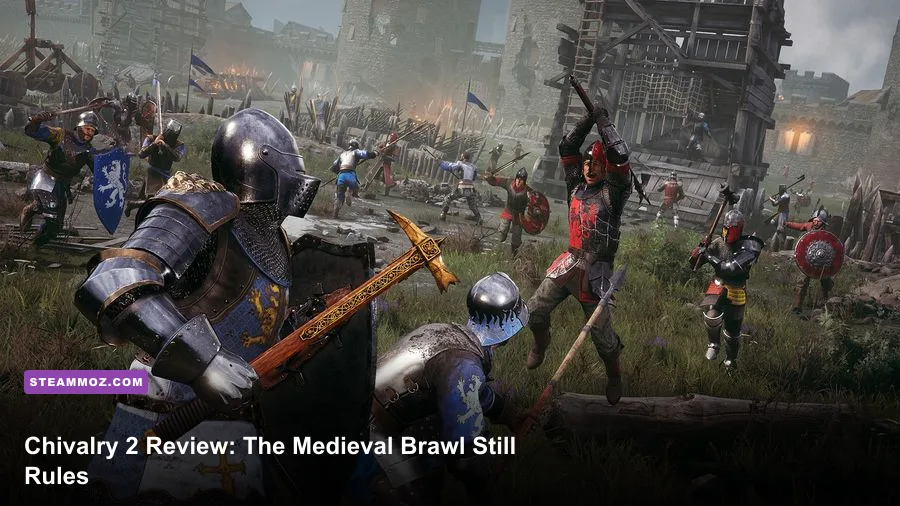
Yes, Chivalry 2 is still worth playing on Steam in 2026—especially if you want a multiplayer action game built around readable melee skill rather than loot, battle passes, or a bloated progression treadmill. Torn Banner’s medieval brawler remains at its best when 64 players collide around a gate, trebuchet, or burning village, and its first-person combat still produces moments no other game quite matches. The catch is that the community is more experienced, the launch-era novelty has faded, and solo players may need to tolerate uneven matchmaking or rely on server browsers at quieter hours.
This is not a perfect competitive fighter. Hit detection can occasionally look suspicious, team balance can fall apart, and a veteran with hundreds of hours can make a new player feel like a training dummy. Yet Chivalry 2 has an unusually generous learning curve. You can contribute with a well-placed bandage, a smart flank, or a perfectly timed catapult shot long before you master countering every overhead swing. In 2026, that combination of accessibility, spectacle, and mechanical depth still makes the Steam edition a strong recommendation.
Before buying, check the official Steam page for the current price and edition contents. If you are comparing it with other older multiplayer games, our Desperados III review is a useful reminder that longevity does not always require constant live-service updates.

Why Chivalry 2 Still Feels Different
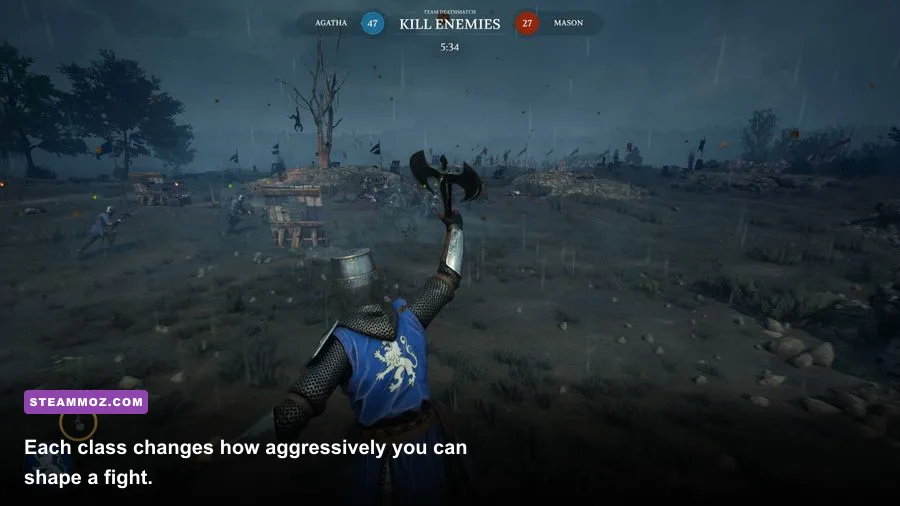
Chivalry 2’s defining trick is that it makes melee combat expressive without turning every encounter into a spreadsheet. Your primary actions are simple—slash, stab, overhead, block, dodge, kick, jab, and throw—but the interaction between them creates an enormous amount of room for decision-making. A slash can be dragged across multiple targets. An overhead can be accelerated or delayed. A stab can punish an opponent who keeps their guard raised. The result is a combat system that rewards timing and spatial awareness more than memorizing an elaborate ability bar.
The stamina model gives those decisions consequences. Blocking drains stamina, and a guard break leaves you vulnerable, so holding block forever is not a viable defense. A successful counter restores momentum and protects you from the next part of an attack sequence. Ripostes are particularly important: block the incoming strike, then answer with the matching attack direction to create a brief window where your response automatically covers incoming blows. Against one opponent, this feels precise. Against three, it becomes a desperate exercise in positioning and target selection.
That last point separates Chivalry 2 from traditional dueling games. You are not expected to win every outnumbered fight. The smart play is often to back toward teammates, use a jab to interrupt a wind-up, kick a shield user after they commit to a block, or throw a weapon to create enough space to escape. The game’s best players look dominant because they understand distance and initiative, not because they blindly spam counters.
| Combat Tool | Best Use | Common Mistake | Practical Counter |
|---|---|---|---|
| Slash | Clearing groups and catching sidesteps | Wide-swinging near allies | Drag the arc away from teammates |
| Overhead | Breaking predictable blocks and hitting low targets | Using it at maximum distance | Close space first or accelerate the swing |
| Stab | Fast single-target pressure | Repeating it into a counter | Mix in a feint or jab |
| Kick | Opening a blocking opponent | Throwing it against an attacking enemy | Use it after reading a stationary guard |
| Jab | Interrupting long wind-ups | Expecting it to win every exchange | Follow with a quick slash or disengage |
The combat is also wonderfully physical. A severed arm, a dropped sword, or a flaming chicken is not just visual noise; it reinforces the game’s cartoon brutality. That tone matters. Chivalry 2 can be played seriously, but it never becomes humorless. An opponent may spend thirty seconds taunting on a wall before a teammate launches a rock at them. Those unscripted moments are why matches remain memorable long after the novelty of the maps wears off.

🎮 BRAWL
Looking to experience this game? Grab your digital key directly on our store for $14.99.
View on Steammoz Store →Classes, Weapons, and the Best Way to Start
There are four main classes—Knight, Footman, Vanguard, and Archer—with subclasses that push each toward a distinct battlefield role. You do not pick a permanent build, and there is no talent tree demanding a single correct answer. Instead, class and weapon selection determine your reach, stamina feel, damage profile, and utility. That makes the progression forgiving: experimenting rarely ruins a character.
For a new Steam player, the Vanguard Raider is an excellent starting point. The Raider carries two primary weapons, letting you bring a long-reaching weapon such as the Dane Axe alongside a more flexible option. The Dane Axe hits brutally hard and teaches you to respect range, while its slower rhythm discourages panic-spamming. The Vanguard’s Oil Pot can deny a doorway or objective approach, and the class’s high health pool gives you room to make mistakes.
The Knight Guardian is the safer choice for players who prefer holding territory. The shield changes how you approach ranged pressure and makes narrow objective areas easier to anchor. The trade-off is mobility: you will not reposition as freely as a Vanguard, and a shield is not a magical answer to kicks, flanks, or coordinated attacks. Use it to occupy space, not to stand motionless in front of five enemies.
Footman subclasses are dependable in objective modes. The Poleman’s long reach is excellent for stabbing around allies, while the Engineer can place barricades that shape entrances and delay a push. Engineers are often undervalued because their direct damage is less glamorous, but a well-positioned barricade near an objective can buy the team several critical seconds. Those seconds matter more than a flashy kill streak.
Archer is the most controversial class and the easiest to play badly. Its ammunition is limited, its health is low, and shooting teammates is both embarrassing and tactically costly. A good Archer targets exposed enemies, enemy Archers, and players interacting with objectives. A bad Archer sits behind the team farming torso hits while the frontline collapses. If you choose the class, move with the objective and switch to a secondary weapon when the fight reaches you.
| Class or Subclass | Recommended Weapon | Strength | Best For |
|---|---|---|---|
| Vanguard Raider | Dane Axe and secondary primary | High damage and two-weapon flexibility | Aggressive beginners and flankers |
| Knight Guardian | Longsword with shield | Durability and objective control | Holding chokepoints |
| Footman Poleman | Halberd or Polehammer | Reach around friendly players | Second-line pressure |
| Footman Engineer | Shovel or sledgehammer | Barricades and defensive utility | Objective-minded support |
| Archer | War Bow or Crossbow | Ranged pressure and target selection | Players with strong positioning |
Weapon unlocks are tied primarily to class and weapon usage rather than an aggressive monetization loop. The progression is worth engaging with because different weapons genuinely change your spacing. The Longsword is a clean all-rounder, the Messer gives you a broader-feeling slash profile, the War Club rewards close pressure, and the Maul delivers satisfying heavy hits at the cost of speed. Do not chase a tier list too early. The best weapon is the one whose timing you can read under pressure.
For deeper progression advice, the general principles in our Dins Curse survival tips apply surprisingly well here: protect the objective, learn when to retreat, and treat support actions as real contributions rather than consolation prizes.
Modes and Maps That Decide the Verdict
Chivalry 2 is at its strongest in 64-player Team Objective, where battles unfold through several connected stages. You may begin by escorting a siege engine, fight over a town square, burn supplies, and finish by defending or killing a named ruler. The objectives keep the match moving and prevent the best fighters from simply farming kills in the center of the map.
The Raid on Aberfell is a great example. The Mason forces push into a village, steal pigs, destroy structures, and finally confront the Agathians amid a sprawling assault. Rudhelm Siege offers a more traditional castle assault, with attackers moving siege equipment toward the walls before storming the inner stronghold. Escape from Falmire is especially memorable because its late-stage rescue and escape objectives can reverse a match that seemed decided.
Other maps create different tactical problems. Darkforest’s winding lanes reward ambushes and punish players who wander away from the convoy. Fighting Pit compresses the action into a brutal arena where spatial awareness matters more than long rotations. The Trayan Stronghold shifts from open streets into heavily defended interiors, making Engineer barricades and shield users increasingly valuable.
Team Deathmatch and Free-for-All are useful for practicing mechanics, but they expose the game’s weaknesses more clearly. Without a strong objective pulling players across the map, matches can become messy clusters of veterans hunting isolated targets. Duels are a better training ground if you want to improve fundamentals, though the skill ceiling becomes much steeper there. Beginners should spend time in the tutorial and Training Grounds, then move into objective modes rather than hiding in low-pressure playlists forever.
| Mode | What It Tests | New Player Value | Verdict |
|---|---|---|---|
| 64-Player Team Objective | Positioning, teamwork, and adaptation | High; many ways to contribute | Best overall experience |
| 40-Player Team Objective | Cleaner frontline decisions | High; less overwhelming | Excellent alternative |
| Team Deathmatch | Individual combat and target selection | Medium | Good warm-up, weaker showcase |
| Free-for-All | Awareness and opportunistic attacks | Low to medium | Fun but punishing |
| Duels | Feints, counters, and matchup knowledge | Low at first, high later | Best serious practice mode |
The map design is not perfectly balanced. Attackers can sometimes snowball after an early breakthrough, while defenders may spend an entire stage respawning into an impossible choke. That imbalance is partly intentional: the mode wants a dramatic narrative rather than a sterile tournament bracket. Still, the most satisfying matches are the ones where both teams understand the objective. Killing enemies near the wrong location is often less valuable than escorting the ram, burning the gate, or standing on the final capture zone.
Steam Performance and the Settings Worth Changing
On PC, Chivalry 2 can look excellent while remaining surprisingly scalable. Large battles are demanding because the game is rendering dozens of armored characters, effects, ragdolls, fire, foliage, and wide outdoor environments at once. A modern mid-range system should target 60 frames per second at 1080p or 1440p with sensible settings, but a locked frame rate is more valuable than maxing every option. Melee timing feels far better when frame pacing is stable.
Start by choosing a frame-rate target that your system can hold during a siege, not during an empty corner of the map. If you have a 120Hz or 144Hz display, a stable 90 or 120 FPS is useful, but do not sacrifice clarity to chase a number that collapses whenever the gates fall. Lowering shadows, effects, and foliage usually produces a more meaningful improvement than reducing texture quality. Textures can often stay high if your graphics memory is adequate.
| Setting | Recommended Value | Typical FPS Impact | Visual Trade-Off |
|---|---|---|---|
| Resolution | Native monitor resolution | High if reduced | Lower resolution softens weapon silhouettes |
| Textures | High | Low to medium | Uses more VRAM; preserves armor detail |
| Shadows | Medium | Medium to high | Less contact depth in courtyards |
| Effects | Medium | Medium | Fewer fire, dust, and impact details |
| Foliage | Medium | Medium | Cleaner sightlines and fewer plants |
| View Distance | High | Medium | Better awareness across objectives |
| Motion Blur | Off | Negligible | Sharper camera movement |
Input settings deserve equal attention. Turn off motion blur, test sensitivity in a low-stakes match, and avoid changing mouse sensitivity every ten minutes. The game’s directional attack system rewards consistent muscle memory. If you use a controller, adjust the look sensitivity gradually and make sure you can turn quickly enough to respond to flankers without overcorrecting during a counter.
For current hardware details, consult the official Chivalry 2 support site and Torn Banner’s official game site. Community reports can help with unusual crashes, but remember that driver behavior and Windows updates can change performance more than a single in-game slider.
One practical warning: crowded fights can produce visual clutter that is not strictly a performance problem. Bright team colors, fire, blood effects, and overlapping bodies make it harder to read attack direction. If you are struggling to see animations, lowering effects may help your actual decision-making even when your FPS counter barely moves.
What Has Aged Well and What Hasn’t
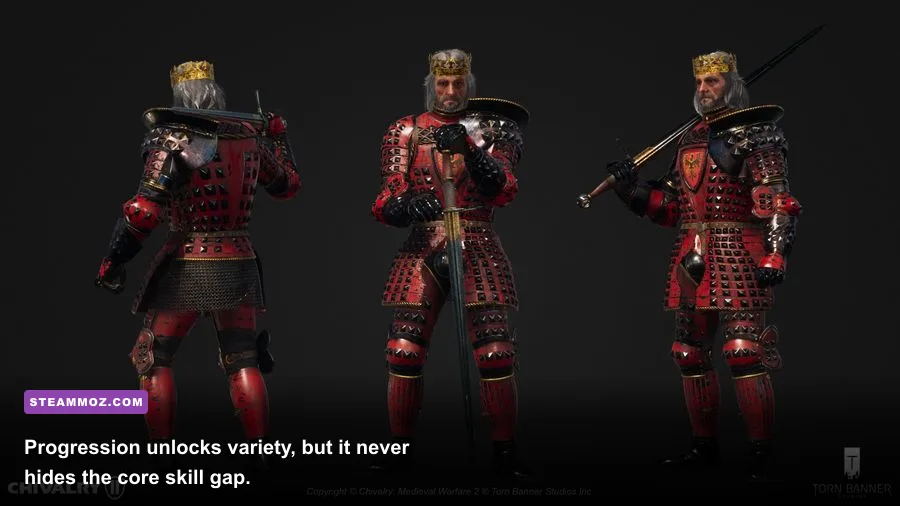
The good news is that Chivalry 2 does not depend on a story campaign or an endlessly escalating gear system. Its core loop—join a match, learn a weapon, improve your timing, and make increasingly bold decisions—still works. Cosmetics, emotes, armor sets, and weapon skins add personality, but the important combat capabilities are not locked behind a premium power track. That makes returning after a break refreshingly painless.
The bad news is that a four-year-old multiplayer game naturally has a more uneven population. Popular objective playlists are generally the safest bet, while niche modes may depend on region and time of day. Cross-platform matchmaking helps fill servers, but it also means the skill range can be enormous. You may share a team with a first-day player and an opponent who can manipulate attack timing so smoothly that their sword appears to teleport.
That expertise gap is the biggest obstacle for new players in 2026. The tutorial explains inputs, but it cannot teach the thousands of tiny choices that separate survival from instant death. Start with a forgiving class, stay near teammates, and focus on one concept per session. First learn not to hold block forever. Then learn to counter slashes. After that, add feints, kicks, jabs, and target switching. Trying to master every mechanic at once only creates frantic button mashing.
There are also social drawbacks. Public matches can include players ignoring objectives, team damage accidents, and the occasional deliberately obnoxious teammate. The game’s silly voice lines and emotes make harmless chaos part of the charm, but they can become tiring when a match is already lopsided. Muting individual players and using the objective markers keeps the experience focused.
Compared with loot-heavy action games, Chivalry 2 is refreshingly direct. Compared with a disciplined competitive fighter, it is noisy and occasionally unfair. That is the trade. You are buying a medieval battlefield simulator with the soul of a slapstick action movie, not a perfectly symmetrical esport.
If you enjoy games that demand long-term build planning, you may prefer reading our Dragonkin: The Banished settings guide or Dungeon Siege retrospective. Chivalry 2 offers almost the opposite philosophy: the meaningful progression happens in your hands, not on a character sheet.
Final Verdict: Buy It on Steam in 2026?
Chivalry 2 remains worth playing in 2026, and the Steam edition is still the easiest recommendation for PC players who want chaotic medieval multiplayer. Buy it if you enjoy readable but deep melee combat, objective-driven battles, emergent comedy, and the satisfaction of turning a losing fight with one good decision. It is especially strong with friends, but solo players can still find plenty of value in Team Objective matchmaking.
Hold off if you need a robust single-player campaign, perfectly balanced competitive rounds, or a consistently busy server in every mode and region. The game’s rough edges are real: matchmaking quality varies, veteran players can be intimidating, and the occasional hit-registry oddity will make you question what just happened. None of those flaws erase the central appeal, though.
The best way to approach Chivalry 2 is to treat every match as a story rather than a scorecard. You will lose a duel, accidentally throw a hatchet into a teammate, get flattened by a catapult, and then somehow escort a burning ram through a collapsing fortress. That combination of skill, spectacle, and absurdity is still rare. In a market full of games asking you to grind for another reward, Chivalry 2 simply asks you to pick up a sword and charge.
Steam verdict: Recommended. It is not the freshest multiplayer game in 2026, but it remains one of the most entertaining ways to spend an evening online. Buy it at full price if you already know the formula is for you; otherwise, a Steam sale makes this an easy, low-risk pickup.