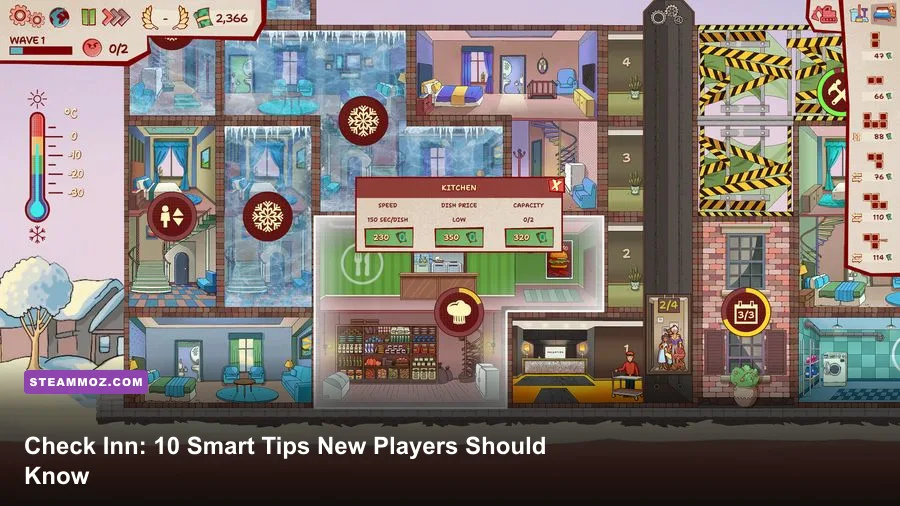
New players should treat Check Inn as a cash-flow puzzle before treating it like a decorating game. Keep the first property compact, prioritize cleanliness and guest access, raise prices only after satisfaction stabilizes, and maintain a cash reserve large enough to survive one slow booking cycle. That approach prevents the three classic early mistakes: expanding too soon, buying attractive furniture with no return, and running out of money while the inn is still generating complaints.
Check Inn looks relaxed, but its systems quietly compound. A room that takes too long to reach, a facility that sits unused, or a staff task left unattended can reduce satisfaction across several bookings. The best opening is deliberately boring: build a dependable loop, learn what guests value, then spend your profits on upgrades that improve several systems at once.
Before starting, check the game's current official Steam listing for updates and version notes. Balance changes can affect prices, task timing, and unlock requirements, so don't blindly copy an old build from a launch-week video.
1. Build for circulation, not screenshots
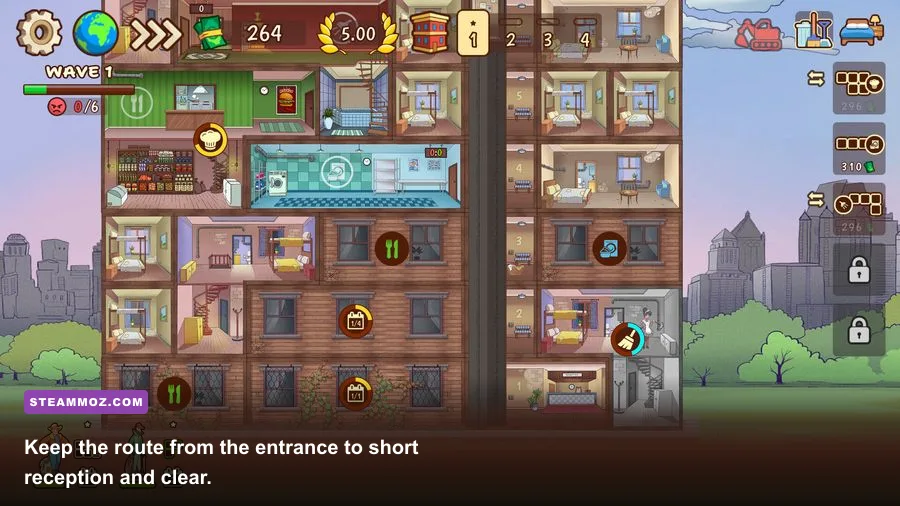
Your first floor should function like a short circuit. Guests should enter, reach reception, find their room, access the bathroom or shared facilities, and leave without crossing through staff-only work areas. Every unnecessary turn adds walking time, and walking time matters because guests judge the whole stay—not just the room they paid for.
Put reception close to the entrance, then place the most frequently used guest facilities along the same main route. Keep storage, cleaning supplies, and staff workstations behind or beside reception rather than at the far end of the building. This gives workers a shorter route while preserving a clean guest-facing path.
A useful early layout is one central corridor, two compact rooms, and one shared service area. Don't create a maze of tiny corridors just to fit another decorative object. If a new room forces guests to walk around furniture or makes staff repeatedly cross the lobby, the extra booking may not cover the efficiency loss.
| Layout Element | Early Target | Why It Matters | Common Mistake |
|---|---|---|---|
| Reception | Beside entrance | Shortens check-in and check-out paths | Hiding it behind decoration |
| Guest corridor | One main route | Reduces walking and congestion | Building several dead ends |
| Storage | Near staff areas | Speeds up cleaning and restocking | Placing it in the guest wing |
| Rooms | Two reliable rooms first | Creates stable income | Opening too many unfinished rooms |

🎮 Check Inn
Looking to experience this game? Grab your digital key directly on our store for $7.49.
View on Steammoz Store →2. Protect your first cash reserve
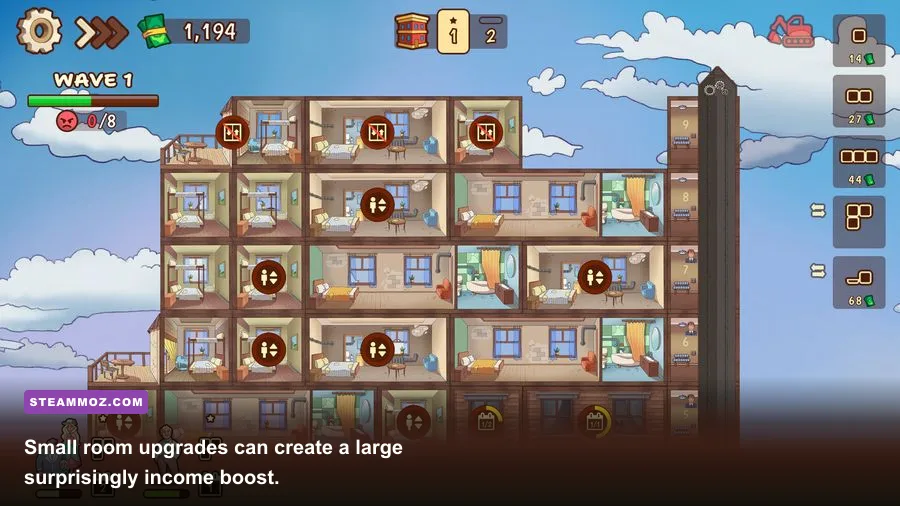
Don't spend every coin the moment you receive it. Keep at least 25 percent of your current cash untouched during the opening phase. That reserve covers cleaning, repairs, required facilities, and the awkward gap between an expansion purchase and the first profitable booking.
The important number isn't the price of an item; it's the time it takes to repay itself. A room upgrade costing 400 currency that adds 20 currency per booking needs 20 successful bookings before it breaks even. If the upgrade also improves satisfaction and prevents cancellations, its real value is higher—but you still need enough liquidity to reach that point.
Use a simple three-bucket system. Spend roughly half of available cash on infrastructure that unlocks or improves bookings, keep a quarter for operations, and leave a quarter untouched. Once the inn has several completed booking cycles without a deficit, you can move more aggressively into expansion.
Decorations are the biggest early trap. A beautiful object that raises appeal by a small amount may look productive, but it won't rescue a dirty room or a slow service route. Buy visual upgrades after the inn's basic loop is reliable, not before.
| Cash Situation | Safe Spending Limit | Best Purchase | What to Avoid |
|---|---|---|---|
| Opening phase | 50 percent | Required rooms and core facilities | Luxury decoration |
| Stable income | 65 percent | High-use service upgrades | Unfinished expansion wings |
| Strong reserve | 75 percent | Room capacity and profitable amenities | Buying several low-use items |
3. Cleanliness beats luxury early on
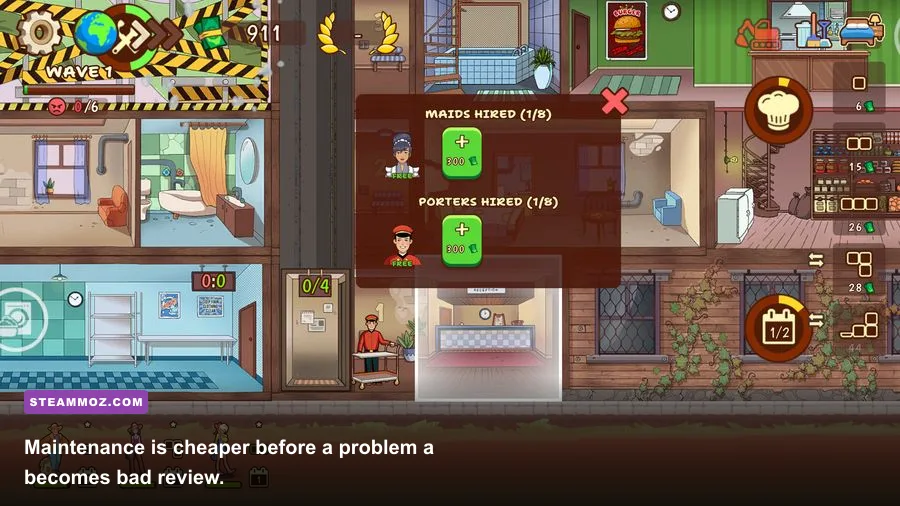
New players often chase comfort or visual appeal because those upgrades are easy to notice. Cleanliness is less glamorous, but it usually has the better early return. A clean, modest room can produce repeatable income; a luxurious room with neglected maintenance can create a chain reaction of unhappy guests and wasted operating time.
Watch the condition of each room between bookings. Clean rooms before the next guest arrives rather than waiting for the task queue to become crowded. If Check Inn gives you control over priorities, place room turnover above optional decoration or low-impact errands. The goal is to make every available room bookable at the start of the next cycle.
Keep cleaning supplies and maintenance access near the rooms they serve. A worker who spends half a shift walking back to storage is effectively a worker with reduced productivity. This is especially painful once you add more rooms, because a small route inefficiency gets multiplied by every booking.
There is also a timing trick: complete maintenance during quiet periods instead of interrupting a busy check-in window. A repair that blocks a room before arrival is manageable. A repair that begins after a guest has already reached the property is much more damaging to satisfaction.
4. Learn what each guest actually pays for
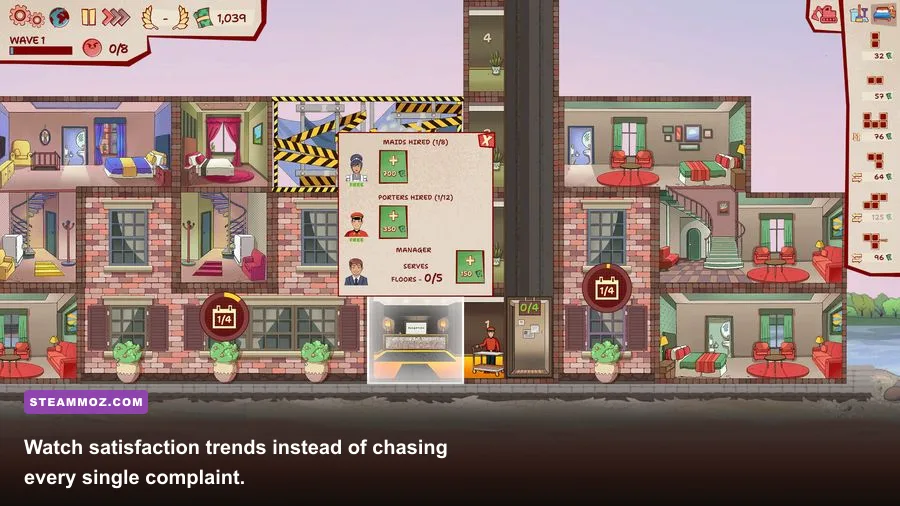
Not every guest values the same improvement. Some care about room quality, some react strongly to cleanliness, and others are more sensitive to amenities or service speed. Read the booking details and review feedback as data. Don't upgrade blindly based on the most expensive item in the shop.
Track three numbers after each cycle: the room's income, the cost of servicing it, and the satisfaction result. If an amenity increases the room's price but creates extra upkeep, calculate the difference rather than assuming it is profitable. A room earning 80 currency with 20 currency in operating cost is better than one earning 100 with 35 currency in cost if both attract similar demand.
Price changes should be gradual. Increase the rate after a run of successful stays, then watch booking volume and satisfaction for the next cycle. A large price jump can erase demand even when the room itself is excellent. If bookings slow, return to the previous price before spending money on another upgrade.
| Signal | Likely Problem | First Response | Don't Do This |
|---|---|---|---|
| Low satisfaction, normal bookings | Cleanliness or service issue | Improve turnover and routes | Raise prices |
| Good satisfaction, weak bookings | Price or demand mismatch | Test a small price reduction | Build more rooms |
| High income, rising upkeep | Overbuilt amenities | Compare net profit per cycle | Buy another luxury item |
| Complaints after expansion | Staffing or pathing bottleneck | Shorten routes and prioritize tasks | Expand again immediately |
5. Expand only after a profitable rhythm
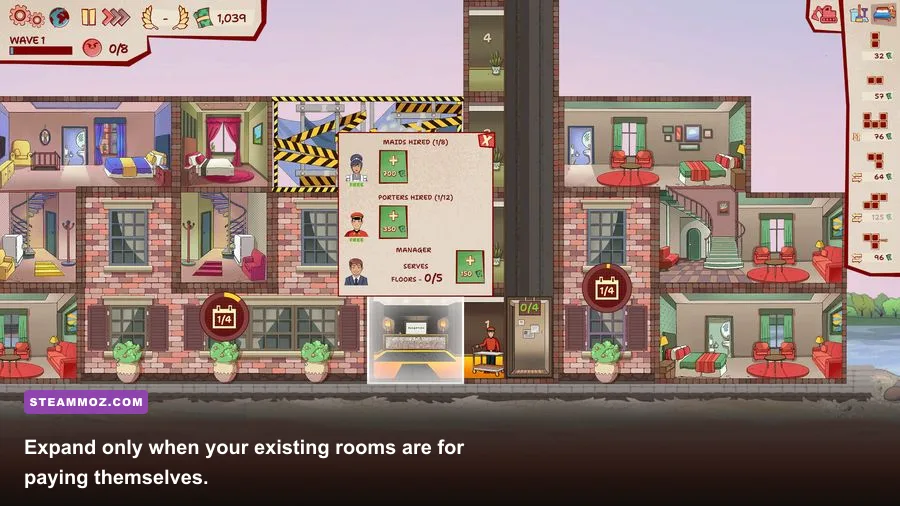
Expansion feels like progress, but a larger inn magnifies every weakness in the original layout. Wait until your existing rooms complete several positive booking cycles and your reserve can cover at least one slow period. If you cannot comfortably pay for a repair, cleaning requirement, and one new facility, you aren't ready for another wing.
Expand in modules. Add one or two rooms, furnish them completely, test the flow, and only then extend the building. This is much safer than purchasing a large empty area and hoping future bookings will pay for it. An unfinished wing can consume money while contributing nothing to revenue.
Use your first expansion to solve a bottleneck rather than chase maximum capacity. If rooms are full but guests are unhappy, improve service. If satisfaction is excellent and bookings are being refused because no rooms are available, add capacity. The correct upgrade depends on what is limiting the inn right now.
Save before major construction when possible. A bad placement can force an expensive redesign, and the most damaging layouts are often the ones that look efficient on paper but create congestion once guests and workers move simultaneously.
6. Staff priorities matter more than staff numbers
Hiring another worker is not always the answer. If staff members spend their time walking between distant rooms, additional employees may simply create traffic. First improve task priority and storage placement, then hire when the task queue remains full despite a sensible layout.
Give essential work a clear order: room turnover, urgent maintenance, guest-facing service, restocking, and optional chores. The exact labels can differ between versions, but the principle remains the same. A clean room that can be sold is worth more than a decorative task that makes the lobby prettier.
Observe workers during a busy cycle. If one worker handles all rooms while another idles, the issue may be assignment range or task priority rather than staffing. If everyone is busy but rooms still miss their turnover window, shorten routes and increase storage access before adding payroll.
Payroll is a recurring cost, so judge a hire by the extra net income it enables. If an additional worker costs 60 currency per cycle but prevents only 30 currency of lost bookings, the hire is making the inn poorer even if the operation feels smoother.
7. Use time controls with purpose
Speed controls are powerful, but running at maximum speed all the time makes it easy to miss a room condition, a delayed task, or an approaching booking. Use normal speed while planning and during guest arrival windows. Accelerate only after checking that rooms are ready and staff are not stuck.
Pause before construction. Inspect guest paths, rotate furniture, and confirm that doors and service areas remain accessible. Pausing for ten seconds is cheaper than discovering that a misplaced object has blocked the route for an entire day.
During quiet periods, queue predictable work such as cleaning and restocking. Before the next arrival window, cancel low-value tasks if they threaten room readiness. This small habit keeps the inn responsive instead of letting the task list control you.
8. Treat reviews as diagnostic tools
Reviews are not just decoration or flavor text. They tell you which system failed from the guest's perspective. A complaint about waiting may indicate a poor route, an overloaded workstation, or an arrival schedule your current staff cannot handle. A complaint about comfort points toward the room itself, while repeated cleanliness criticism means your turnover cycle is too slow.
Look for repeated complaints rather than reacting to one bad stay. One unhappy guest can be noise. Three guests identifying the same issue is a trend worth fixing. Make one change at a time when possible, because changing price, furniture, staffing, and layout together makes it impossible to know what worked.
Keep a small note outside the game with room price, net income, and the most common complaint. Management games become much easier when you compare cycles instead of relying on memory.
9. Spend unlocks on compounding improvements
When several upgrades become available, choose the one that improves multiple future cycles. Better cleaning capacity, shorter service routes, and room improvements that increase both satisfaction and price usually outperform a single-use decorative bonus.
Think in terms of compounding. A 10 percent improvement applied to one room is useful; a route or facility improvement that affects four rooms is usually stronger. Likewise, an upgrade that prevents downtime can outperform a higher room price because it protects income you would otherwise lose.
For broader management-sim strategy, Steamoz's Dungeons 3 beginner tips and Dungeons 2 resource route guide use the same valuable principle: fix the bottleneck that affects the largest part of your economy.
10. Build a repeatable daily checklist
Before ending each cycle, inspect the entrance, reception, every active room, the task queue, and your cash reserve. Confirm that rooms are clean, essential facilities are working, staff can reach their assignments, and the next booking will not push you into a deficit.
After the cycle, compare revenue with operating expenses. If profit is positive but tiny, don't immediately expand. Let the reserve grow. Once the inn can absorb a bad booking cycle without cancelling planned upgrades, reinvest in the most frequently used room or facility.
Finally, keep the official Steam news feed and Steam community discussions bookmarked for patches and player-discovered quirks. Check Inn's balance can shift after updates, especially around guest demand and facility value.
The strongest opening plan for Check Inn
Start with a compact two-room layout, a reception desk beside the entrance, nearby storage, and only the facilities needed to make those rooms operational. Keep 25 percent of your cash in reserve, prioritize cleaning and maintenance, and record net profit after each booking cycle. Raise prices only when satisfaction is stable, then expand one module at a time.
That plan may look conservative, but it gives you room to react. Check Inn rewards players who notice small inefficiencies before they become expensive problems. A short worker route, a clean room, and a sensible reserve will beat a flashy hotel with empty facilities almost every time. Once the core loop is profitable, the creative side opens up—and your decorations will finally be paying for themselves.